

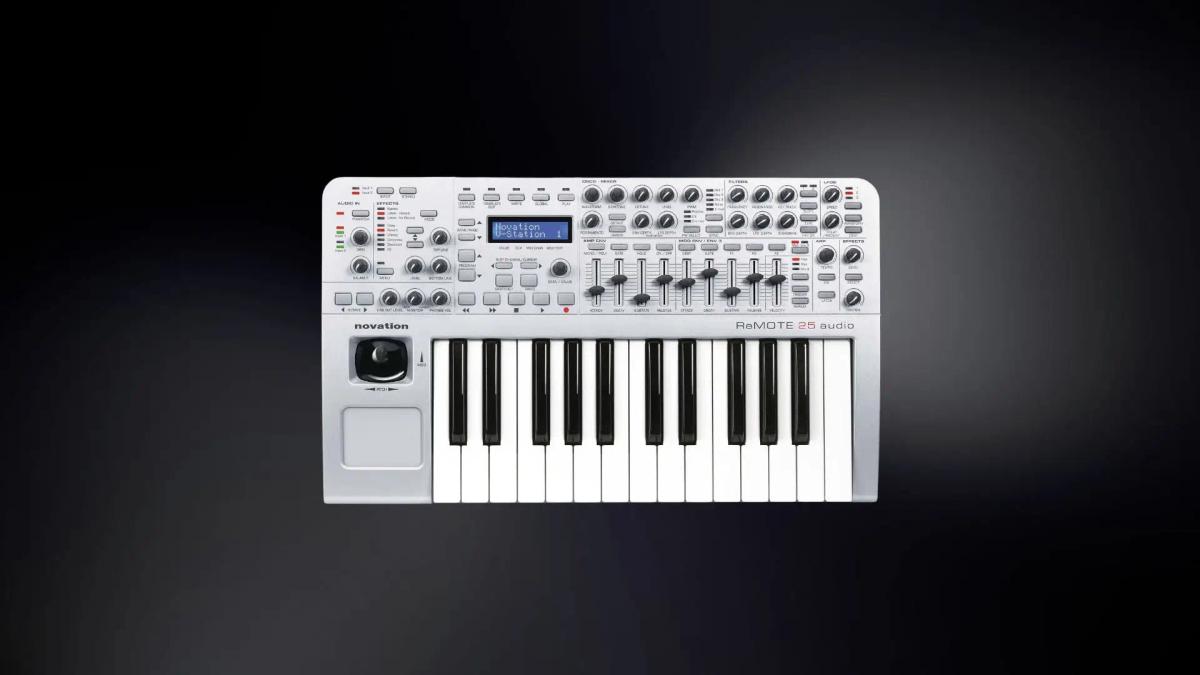
The Novation X-Station 25 is a 25-key virtual analog synthesizer, MIDI controller, USB audio interface, effects processor, and compact production keyboard introduced in 2004. It belongs to a very specific moment in electronic music history: the point at which laptop production, soft synths, compact controllers, and hardware sound engines were beginning to merge into one portable working environment. Its importance is not only that it contains an eight-voice KS-derived synth engine, but that it treats synthesis, control, recording, monitoring, and portability as parts of the same musical workflow.
Table of Contents
Novation X-Station 25 sound and character
The Novation X-Station 25 has the bright, immediate, slightly glassy character associated with early-2000s Novation virtual analog instruments. It is not an analog polysynth pretending to be a vintage machine, and it should not be judged as one. Its strength lies in clean digital oscillators, quick modulation access, glossy effects, and a performance-oriented front panel that lets the player turn relatively simple subtractive patches into animated, usable sounds.
Its three-oscillator engine makes it capable of thick detuned leads, trance-era stacks, metallic sync sounds, compact digital basses, synthetic electric-piano colors, noise textures, and motion-heavy arpeggiated patches. The waveform list combines classic analog-style shapes with noise options and sampled digital waveforms, which gives the Novation X-Station 25 more tonal variety than a strictly saw-square-triangle virtual analog would have. The result is a sound that can move from familiar VA brass, strings, and leads into more obviously digital keyboard colors.
The filter is central to the Novation X-Station 25’s personality. It offers low-pass, high-pass, and band-pass modes, 12 dB and 24 dB slopes, resonance, key tracking, and overdrive. That gives it a practical range: smooth enough for pads and wide chords, pointed enough for acid-like sequences, and bright enough for cutting electronic leads. The onboard overdrive and effects help compensate for the inherently tidy nature of the DSP engine, giving patches more edge, size, and finished-record polish.
The Novation X-Station 25 is especially good at sounds that reward motion: rhythmic arpeggios, tempo-synced filter movement, PWM-style pads, rubbery mono leads, gated electronic textures, and performance patches shaped with aftertouch, joystick, and X/Y pad. Its tone is not deeply unstable or vintage in the way a VCO polysynth is, but Novation included drift and unison-related behavior that can add a controlled sense of analog-style movement. Its best sounds are therefore not “old analog recreated perfectly,” but compact, hands-on, laptop-era virtual analog with enough grit and immediacy to remain musically useful.
Features and architecture
- Manufacturer: Novation.
- Year: 2004.
- Production years: the release year is well documented as 2004; a confidently verified production end year was not found in the primary sources used here.
- Synthesis type: virtual analog subtractive synthesis with FM capability inside the KS-derived synth engine.
- Category: 25-key digital keyboard synthesizer, MIDI/USB controller, USB audio interface, and effects processor.
- Polyphony: 8 voices.
- Original price and current market price: archived retail evidence shows a regular price of $599 and a sale price of $499 for the Novation X-Station 25; current used pricing is inconsistent, with Reverb showing no active listings or used estimate at the time checked and eBay UK showing examples roughly in the low-to-mid £200 range.
- Oscillators: three oscillators per voice, a separate noise oscillator, 17 listed waveform values, oscillator sync, detune, unison detune, VCO drift, portamento, and FM between oscillators 2 and 3 via a dedicated FM envelope.
- Filter: multimode resonant filter with low-pass, high-pass, and band-pass modes, 12 dB and 24 dB slopes, key tracking, resonance capable of self-oscillation, and overdrive.
- LFOs: two LFOs with 32 listed waveform values, including standard shapes, sample-and-hold types, envelope-like shapes, and pattern-style waves.
- Envelopes: amp envelope, modulation envelope, and a third AD envelope used for additional modulation and FM behavior.
- Modulation system: velocity, channel aftertouch, joystick, X/Y touchpad, LFO modulation, envelope modulation, MIDI control assignment, and template-based controller mapping.
- Sequencer / arpeggiator: onboard arpeggiator with latch, multiple modes, octave range, rhythmic patterns, gate time, keysync, and routing to internal, external, or combined destinations; no onboard step sequencer.
- Effects: dual multi-effects architecture, including reverb, chorus/phaser, delay, compressor, distortion, and EQ.
- Memory: 200 KS synth memories, 200 user synth locations, 40 user template memories, and factory templates for software and MIDI control.
- Keyboard: 25 full-size semi-weighted velocity-sensitive keys with channel aftertouch and selectable velocity curves.
- Inputs / outputs: two XLR/quarter-inch combo inputs, two quarter-inch audio outputs, coaxial S/PDIF output, stereo headphone output, sustain pedal input, and expression pedal input.
- MIDI / USB: MIDI In, two MIDI Outs, USB MIDI, USB audio, and simultaneous MIDI/USB operation.
- Display: two-line, 16-character blue backlit LCD.
- Dimensions / weight: 468 × 278 × 68 mm; 2.5 kg.
- Power: external power supply, USB power, or six C-cell batteries; the manual notes that some laptops may not provide enough USB current under heavier power conditions.
Strengths
- It is a genuinely integrated production instrument rather than a synth with a token USB port. The combination of synth engine, controller surface, audio interface, preamps, effects, and monitoring made it unusually practical for a small studio or mobile setup in the mid-2000s.
- The 25-key format is compact, but the control surface is unusually generous: knobs, encoders, sliders, buttons, transport controls, joystick, and X/Y pad give the Novation X-Station 25 a much broader performance identity than many small controllers.
- The KS-derived synth engine is immediate and musically direct. It does not bury the user in menus before basic sound design can begin, which matters for leads, basses, pads, and arpeggiated parts that benefit from fast tactile adjustment.
- The keyboard specification is stronger than many compact instruments of its class. Full-size semi-weighted keys with channel aftertouch make it more expressive than a typical small USB controller.
- The audio side is not decorative. Dual combo inputs, phantom power, monitoring, effects, 24-bit 44.1/48 kHz operation, and S/PDIF output made it a real recording hub for musicians working without a larger interface.
- Its X/Y pad and joystick support a style of performance that fits electronic music particularly well: filter sweeps, modulation morphs, pitch movement, and evolving textures can be played rather than merely programmed.
- The arpeggiator is more useful than a basic up/down utility because its pattern, latch, range, timing, and routing options allow it to drive both internal sounds and external MIDI gear.
Limitations
- Eight voices are workable for leads, basses, compact pads, and arpeggios, but limiting for dense sustained chords, layered pads, or unison-heavy playing.
- The Novation X-Station 25 engine is monotimbral, so it cannot behave like a multitimbral workstation or run several independent synth parts at once.
- There is no onboard sampler and no proper onboard sequencer, which prevents it from becoming a true self-contained workstation despite its broad studio role.
- The audio interface belongs to the USB 1.1 and early driver era. It remains historically important, but modern operating-system compatibility and latency expectations should be checked carefully before purchase.
- The sound can be recognizably early-2000s virtual analog: clean, bright, and sometimes slightly polished rather than physically deep or analog-unstable.
- The 25-key range is portable but musically restrictive for two-handed playing, wide pads, or more traditional keyboard performance.
- Because it combines several devices in one chassis, a fault in controls, display, power, interface behavior, or keybed can affect more than one part of the workflow.
- Market listings are irregular, so buyers may have to choose based on condition and functionality rather than a stable, transparent price guide.
Historical context
The Novation X-Station 25 appeared in 2004, a transitional year for Novation and for electronic music hardware more broadly. Novation had already built a strong identity around virtual analog synthesis through instruments such as the Supernova, Nova, K-Station, and KS series, while also developing MIDI controller keyboards for computer-based musicians. The X-Station brought those strands together: the hands-on controller layout of the ReMOTE line, the audio-interface idea of the ReMOTE Audio, and a KS-derived synth engine in one portable keyboard.
That timing matters. By the early 2000s, the laptop was becoming a realistic production center, but many musicians still wanted hardware immediacy: real keys, real knobs, direct monitoring, physical MIDI ports, and a synth that could make sound without loading a plug-in. The Novation X-Station 25 answered that tension. It did not reject the computer; it assumed the computer was present. But it tried to make the computer feel less abstract by placing performance, synthesis, audio input, MIDI control, and monitoring under the player’s hands.