

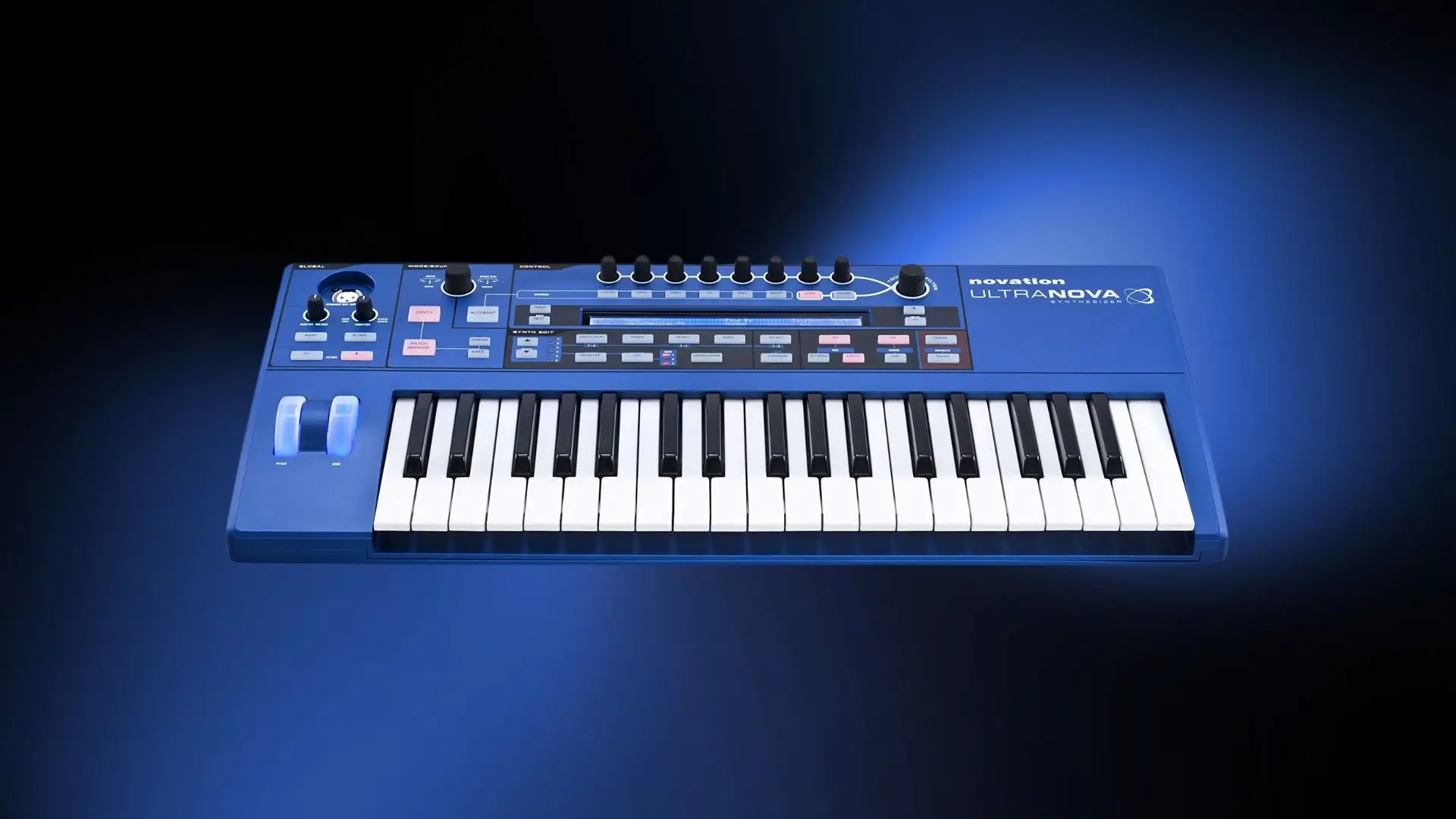
The Novation UltraNova is a compact digital keyboard synthesizer introduced in 2010 as part of Novation’s Nova lineage. It is a single-part virtual-analog and wavetable instrument with a vocoder, a deep modulation system, a 37-note velocity-sensitive keyboard with aftertouch, touch-sensitive performance controls, and a built-in USB audio interface. Its importance lies less in one spectacular innovation than in the way it condensed several early-2000s Novation ideas into a portable, computer-aware synthesizer for the post-hardware-workstation era.
Table of Contents
Novation UltraNova sound and character
The Novation UltraNova sounds like a deliberately modern digital synthesizer rather than an instrument trying to pass as a vintage analog machine. Its tone can be bright, polished, glassy, synthetic, and wide, with a strong aptitude for pads, electronic basses, cutting leads, rhythmic arpeggios, vocoder textures, and animated digital timbres. It can make conventional virtual-analog sounds, but its more distinctive territory appears when its wavetable oscillators, modulation matrix, filters, effects, and touch controls are used together.
Its architecture explains much of that character. Three oscillators per voice, 36 wavetables, two ring modulators, noise, two filters, six envelopes, three LFOs, and a 20-slot modulation matrix give the instrument far more internal movement than its compact format suggests. The result is not the heavy, unstable behavior of a voltage-controlled polysynth. It is a controlled digital environment where motion, polish, and programmed transformation matter more than drift or raw circuitry.
The effects section also shapes the Novation UltraNova’s identity. Its presets can sound large and finished because the synth offers five effects slots per patch, with processing such as EQ, compression, delay, chorus, distortion, reverb, panning, and Gator. That makes the instrument immediately useful for electronic production, but it also means some factory sounds can feel more like demonstrations of the effects engine than bare oscillator-and-filter tone. In practical use, the Novation UltraNova often sits best when programmed with restraint: reduce excessive delay or chorus, let the wavetables move, and use the filters and modulation system to give the sound internal life.
Features and architecture
- Manufacturer: Novation.
- Year introduced: 2010.
- Production years: Introduced in 2010; now discontinued. A reliable official end-of-production year was not found, so it should not be stated as a precise range.
- Synthesis type: Digital virtual-analog subtractive synthesis with wavetable capability, vocoder processing, ring modulation, and DSP effects.
- Category: Compact monotimbral keyboard synthesizer with vocoder, performance controls, USB integration, and built-in audio-interface functions.
- Polyphony: Up to 20 internal voices according to Novation’s user documentation. Practical available polyphony depends on patch settings, especially unison.
- Original price and current market price: Launch-era UK information placed the RRP around the high-£500 range, with an estimated street price around £500; a 2011 review listed £599 / $849.99. Current used-market signals generally place it in the affordable used digital-synth bracket rather than the collectible-vintage tier.
- Oscillators: Three digital oscillators per voice, plus noise and two ring-modulator sources. The oscillator section includes classic analog-style waveforms and 36 wavetables.
- Filter: Two filters, with 14 filter types covering low-pass, high-pass, and band-pass variations.
- LFOs: Three main LFOs.
- Envelopes: Six envelope generators.
- Modulation system: 20-slot modulation matrix, with each slot routing one or two sources to a destination. The matrix can also interact with the touch-sensitive encoders for performance modulation.
- Sequencer / arpeggiator: No conventional step sequencer. It includes an arpeggiator with multiple modes and 33 rhythmic patterns, plus a Chorder function that can trigger programmed chords from single keys.
- Effects: Five FX slots per patch. Effects include panning, EQ, compression, delay, chorus, distortion, reverb, and Gator-style rhythmic gating.
- Memory: Factory patches are arranged in banks A to D, with patch browsing by category and genre. The documentation shows the patch system as bank-based rather than sample-based.
- Keyboard: 37-note, three-octave keyboard with velocity and aftertouch.
- Inputs / outputs: Stereo main outputs, auxiliary outputs, headphone output, S/PDIF digital output, two jack audio inputs, dynamic microphone XLR input for the supplied gooseneck microphone, sustain pedal input, and expression pedal input.
- MIDI / USB: MIDI In, Out, and Thru on DIN connectors; USB connection for computer integration, MIDI, editor/librarian communication, Automap use, and audio-interface functions.
- Display: Two-row by 72-character LCD dot-matrix display, paired with eight touch-sensitive rotary encoders.
- Dimensions / weight: The official user guide checked for this article does not provide a single definitive dimensions-and-weight specification. Third-party listings vary, so those figures are not stated here as a verified official specification.
- Power: 12 V DC, 1250 mA external power supply, or USB bus power when the host can provide sufficient current.
Strengths
- It is deeper than its size suggests. The combination of three oscillators, wavetables, two filters, six envelopes, three LFOs, and 20 modulation slots gives the Novation UltraNova enough depth for evolving pads, rhythmic motion, layered digital movement, and complex performance patches.
- The touch-sensitive controls are genuinely useful in performance. Rather than treating its compact panel as a limitation only, Novation gave the eight encoders touch behavior that can trigger or shape assigned modulations. This makes the instrument more playable than a menu-driven synth of similar depth might otherwise be.
- The keyboard format is more serious than many small synths. A 37-note keyboard with velocity and aftertouch gives the Novation UltraNova a stronger performance identity than mini-key vocoder synths or desktop modules, especially for leads, pads, and expressive filter movement.
- The vocoder is integrated into the instrument’s identity. The supplied gooseneck microphone and 12-band vocoder make vocal processing part of the synth’s design rather than an afterthought. It fits the Novation UltraNova’s broader role as a compact electronic performance instrument.
- The effects engine makes it production-friendly. Five effects slots per patch allow polished sounds without external processing, which is useful for live work, sketching, and DAW-based production.
- Its DAW-era design was forward-looking for its price class. The editor, librarian, Automap integration, USB connection, and audio-interface role positioned the Novation UltraNova between hardware synth and studio controller at a time when many musicians were shifting toward hybrid computer-based setups.
Limitations
- It is monotimbral. The Novation UltraNova cannot layer multiple independent patches or operate as a multitimbral workstation. This matters for players who want splits, stacked pads, or several separate parts from one synth.
- It does not behave like an analog polysynth. Its sound is digital, clean, and controlled. That is a strength for modern electronic textures, but it will not replace the organic instability of a VCO-based instrument.
- The interface still involves menu work. The touch encoders and section buttons help, but the synthesis engine is deep enough that detailed programming depends on pages, abbreviations, and the display.
- The software ecosystem has aged. Novation still hosts downloads, but current compatibility notes show that some older functions, especially Automap and USB audio behavior on newer macOS systems, are no longer as straightforward as they were at launch.
- Factory presets can overstate the effects engine. Some sounds are heavily processed, so the instrument may seem more polished than raw. For mix work, reducing effects is often necessary.
- Unison consumes voices. The maximum voice count is not what the player always experiences in dense unison patches, where the number of playable notes can drop quickly.
- It has no conventional onboard step sequencer. The arpeggiator, Chorder, and Gator are useful, but users expecting workstation-like sequencing or Elektron-style pattern construction will need external sequencing.
Historical context
The Novation UltraNova appeared in 2010, at a point when Novation had become strongly associated with controllers, DAW integration, and performance devices. MusicRadar described it at launch as Novation’s return to hardware synth territory after several years of controller-focused activity, and Novation later identified it as the fourth member of the Nova family. That placement matters: the Novation UltraNova was not a nostalgic reissue, but a compact reinterpretation of the Nova and SuperNova idea for a decade increasingly shaped by laptops, plug-in instruments, USB workflows, and portable electronic rigs.
Its relationship to the SuperNova II is central. Novation described the Novation UltraNova as taking the SuperNova II engine as a starting point, then adding contemporary elements such as wavetable synthesis, software editing, stronger filter options, and touch-sense performance controls. This was historically significant because the late-1990s and early-2000s virtual-analog era had produced instruments that were powerful but often physically larger, rack-based, or more explicitly studio-oriented. The Novation UltraNova repackaged that lineage into a blue, compact, three-octave keyboard that could sit beside a laptop as easily as on a live stage.
The broader market context also matters. By 2010, the compact vocoder/virtual-analog keyboard category had already been shaped by instruments such as the microKORG. The Novation UltraNova entered that territory with a more full-sized performance feel, deeper modulation, and stronger computer integration. It was not the cheapest or simplest synth in that space, but it was Novation’s answer to a market that wanted immediacy, portability, and software-aware hardware without abandoning real synthesis depth.