

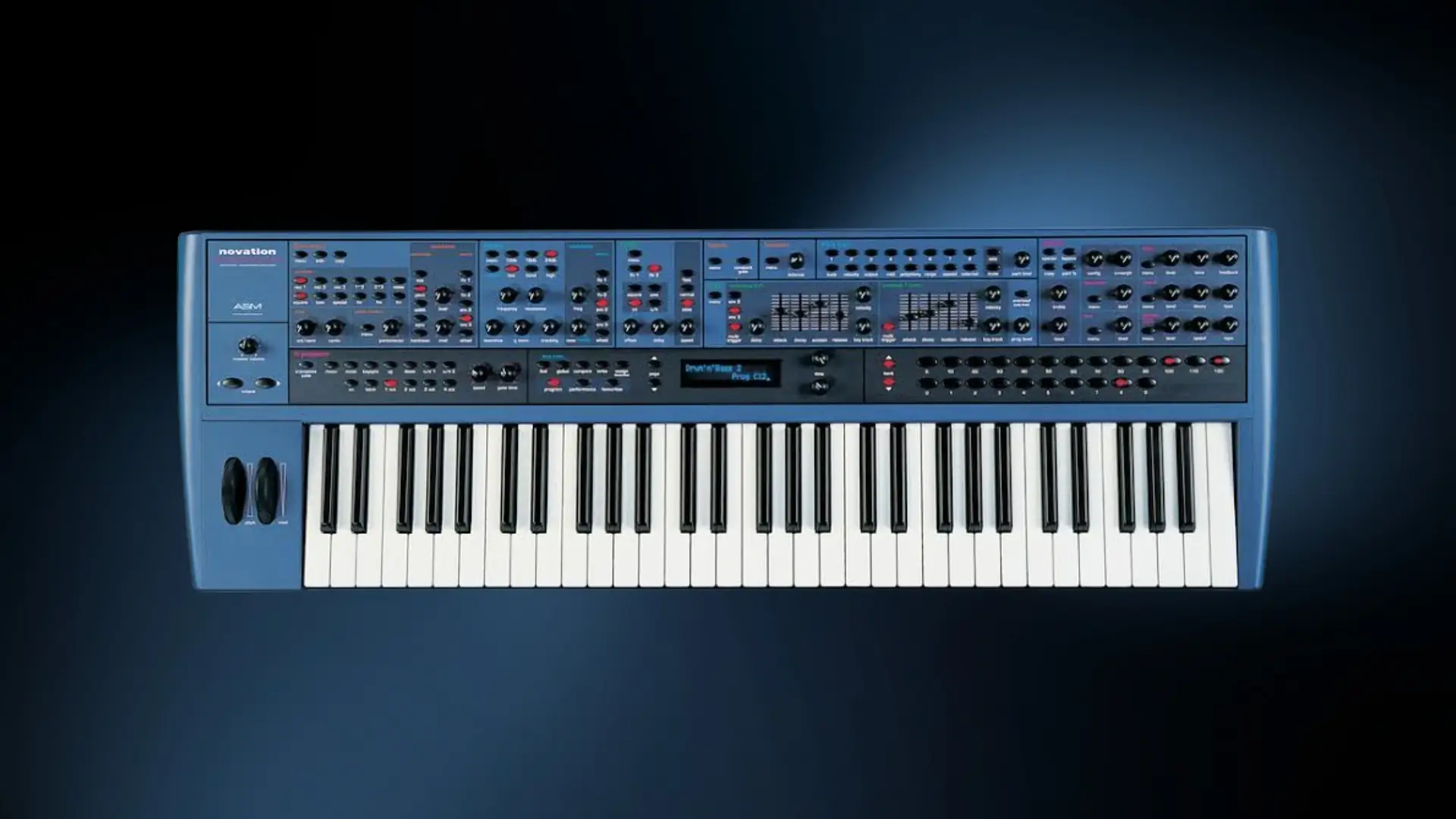
The Novation Supernova II Keyboard is a 61-note digital analogue-modelling synthesizer introduced in 2000 as the keyboard version of Novation’s second-generation Novation Supernova II Keyboard platform. Built around Analogue Sound Modelling, expandable polyphony, eight-part multitimbrality, deep modulation, a 42-band vocoder, extensive onboard effects, and a velocity- and aftertouch-sensitive five-octave keyboard, it represented Novation’s most ambitious early-2000s attempt to turn the virtual-analog synth into a complete performance instrument rather than just a rack module or studio sound source.
Table of Contents
Novation Supernova II Keyboard sound and character
The Novation Supernova II Keyboard does not sound like a single-purpose analog clone. Its identity comes from range rather than purity. Contemporary reviewing described it as capable of sounding rich, warm, punchy, thin, brittle, smooth, and harsh, depending on programming. That spread is important: this is not a synthesizer whose value depends only on one sweet spot. It belongs to the late-1990s and early-2000s virtual-analog generation, but it pushes that vocabulary into a broader, more production-ready territory.
Its three-oscillator-per-voice design, FM routings, ring modulation, oscillator hardness control, unison behavior, and VCO drift function give it more movement and instability than a strictly clean digital subtractive synth would suggest. The instrument can do bright trance stacks and sharp digital-era leads, but it can also produce rounded pads, animated basses, metallic FM colors, synthetic percussion, and evolving multitimbral textures. Its character is polished rather than raw, but not sterile when programmed carefully.
The filter is central to its personality. The 12, 18, and 24 dB modes, low-pass, high-pass and band-pass operation, overdrive, Q behavior, and special dual-filter structures let the synth move from familiar subtractive sweeps into more animated and unusual resonant shapes. The result is not vintage drift in the strict analogue sense. It is closer to an early-2000s idea of power: controlled, bright, layered, effects-rich, and capable of becoming very large inside a mix.
Its effects architecture matters as much as its oscillators. The Novation Supernova II Keyboard’s multitimbral design allows programs to retain their own effects inside performances, which helps explain why the instrument can sound unusually complete before any external processing is added. In practical terms, a layered performance can keep each part’s spatial, delay, modulation, and tonal identity intact. That made it particularly suited to electronic production, live sets, and dense programmed arrangements where the synth itself behaves almost like a compact electronic music workstation.
Features and architecture
- Manufacturer: Novation Electronic Music Systems.
- Year introduced: 2000.
- Production years: not consistently documented in official public sources. Novation places the Novation Supernova II Keyboard in 2000 and currently categorizes the Novation Supernova II Keyboard as a legacy instrument; one market database lists production start as 1999 and production end as 2000, but that range should be treated cautiously.
- Synthesis type: digital analogue modelling, branded by Novation as Analogue Sound Modelling.
- Category: 61-key virtual-analog / analogue-modelling polyphonic keyboard synthesizer.
- Polyphony: 24 voices on the standard model, 36 voices on the Supernova II Pro, and 48 voices on the Supernova II Pro X; the standard and Pro versions could be expanded with appropriate voice expansion boards.
- Original price signal: a contemporary Australian review listed the keyboard at A$5,295 and the rack version at A$4,195; this should be understood as a regional review price, not a universal global MSRP.
- Current market price signal: no stable single market value is visible across public sources. Reverb currently shows the 61-key 24-voice model with no active listings and no displayed estimated value; synth.market lists rough street-price signals around US$900 for the standard keyboard and higher for expanded Pro models.
- Oscillators: three oscillators per voice, with additional sound sources including two ring modulators and noise. The Double Saw waveform can increase oscillator-like density without reducing polyphony. The engine also includes FM routings, oscillator sync behavior, hardness shaping, VCO drift emulation, and unison options.
- Filter: resonant 12, 18, and 24 dB-per-octave filter modes, configurable as low-pass, high-pass, or band-pass, with additional special dual-filter types, modulatable separation, Q behavior, overdrive, and a filter-bypass mode useful for drum-style programming.
- LFOs: two LFOs capable of audio-rate operation, MIDI clock synchronization, slew, delay, and fade-in or fade-out behavior.
- Envelopes: three envelopes per voice, including one ADSR envelope and two delay-ADSR envelopes. The envelopes include loopable attack/decay stages, sustain time and sustain rate functions, and tracking options.
- Modulation system: comprehensive modulation matrix with 130 possible routings, including oscillator and filter modulation paths.
- Sequencer / arpeggiator: no conventional onboard sequencer. It includes a built-in arpeggiator with preset monophonic, preset polyphonic, and user-programmable monophonic and polyphonic patterns, with up to eight arpeggiators available simultaneously in Performance Mode.
- Effects: distortion, comb filter, EQ, reverb, chorus, flanger, phaser, ensemble, rotary speaker, delay, and panning/tremolo effects. The system provides seven effects per program or part, plus a global 42-band vocoder, giving the instrument one of its defining multitimbral strengths.
- Memory: 1024 programs in eight banks, 400 drum programs, eight drum maps of 50 programs each, 512 performances in four banks, and 128 favourites.
- Keyboard: five-octave semi-weighted velocity-sensitive keyboard with channel aftertouch.
- Inputs / outputs: eight assignable audio outputs, two assignable audio inputs, headphone output, pedal/switch connections, and optional S/PDIF/ADAT digital I/O through an expansion card.
- MIDI / USB: MIDI In, Out, and Thru via DIN connectors. USB is not part of the documented I/O.
- Display: fluorescent 128 x 18 matrix display.
- Dimensions / weight: keyboard version measures 1018 mm wide, 330 mm deep, and 112 mm high including knobs; weight is 10 kg.
- Power: internal multi-voltage power supply rated for 90V to 260V, 50 or 60 Hz, with 40W power requirement.
Strengths
- Its multitimbral effects structure is the defining advantage. Many multitimbral synths force compromises when patches are combined, but the Novation Supernova II Keyboard was designed so performances could preserve much of the character of individual programs.
- The sound engine is unusually deep for a virtual-analog keyboard of its period. Three oscillators, FM, ring modulation, special filters, audio-rate modulation, loopable envelopes, and a large modulation matrix give it more programming depth than a basic subtractive VA.
- The keyboard version turns the engine into a real performance instrument. The 61-note semi-weighted keyboard, aftertouch, front-panel controls, master-keyboard functions, splits, layers, zones, and multiple outputs make it more stage-ready than the rack version.
- It is strong at electronic-music production sounds: animated pads, trance-era leads, synthetic drums, arpeggiated patterns, basses, vocoder textures, and layered performance patches.
- The onboard vocoder and audio inputs broaden the instrument beyond ordinary keyboard synthesis, allowing external signals to become part of the synthesis and effects system.
- The interface balances knobs, buttons, sliders, and menus better than many complex digital synths of its era. It is not menu-free, but it gives the important synthesis areas enough physical control to encourage programming rather than preset browsing.
Limitations
- The instrument is physically large. At five octaves and 10 kg, it is not a casual desktop synth or compact controller substitute.
- It has no USB, no modern editor integration as part of the original hardware concept, and relies on MIDI and SysEx-era workflows for deeper backup and data handling.
- The display is small relative to the depth of the instrument. The engine can justify a larger graphical screen, especially for performances, modulation, effects configuration, and multitimbral work.
- Gain staging needs attention. Contemporary review notes indicate that it can be easy to overload internally, so careful program gain and effects management matter.
- The factory sounds were historically associated with dance, trance, and harder electronic styles. That helped the instrument fit its period, but it can also make the synth seem narrower than it actually is if judged only by presets.
- It is not a modern wavetable synth, sample workstation, or software-integrated production hub. Its value lies in deep virtual-analog programming, performance architecture, and effects-rich multitimbrality.
- The production history and used-market data are not as cleanly documented as some better-known vintage synths. Buyers need to verify the exact version, voice count, OS, expansion status, and hardware condition.
Historical context
The Novation Supernova II Keyboard arrived at a moment when virtual analog was no longer a novelty. By 2000, musicians already knew the basic proposition: digital hardware could imitate the immediacy and architecture of analogue subtractive synthesis while offering polyphony, memories, MIDI control, and reliability. The Access Virus and Roland JP-8000 had become part of that conversation, and Novation’s original Novation Supernova II Keyboard rack had already established the company as more than the maker of Bass Station-derived instruments.
The Novation Supernova II Keyboard was Novation’s answer to the next question: what happens when a virtual-analog synth stops being just a sound module and becomes a full multitimbral production system? The original Novation Supernova II Keyboard had earned respect, but criticisms around FM, audio inputs, digital expansion, and waveform variety created space for a broader second-generation design. The Novation Supernova II Keyboard responded by adding more synthesis depth, more control, a keyboard version, vocoder functions, external input processing, and a more performance-oriented architecture.