

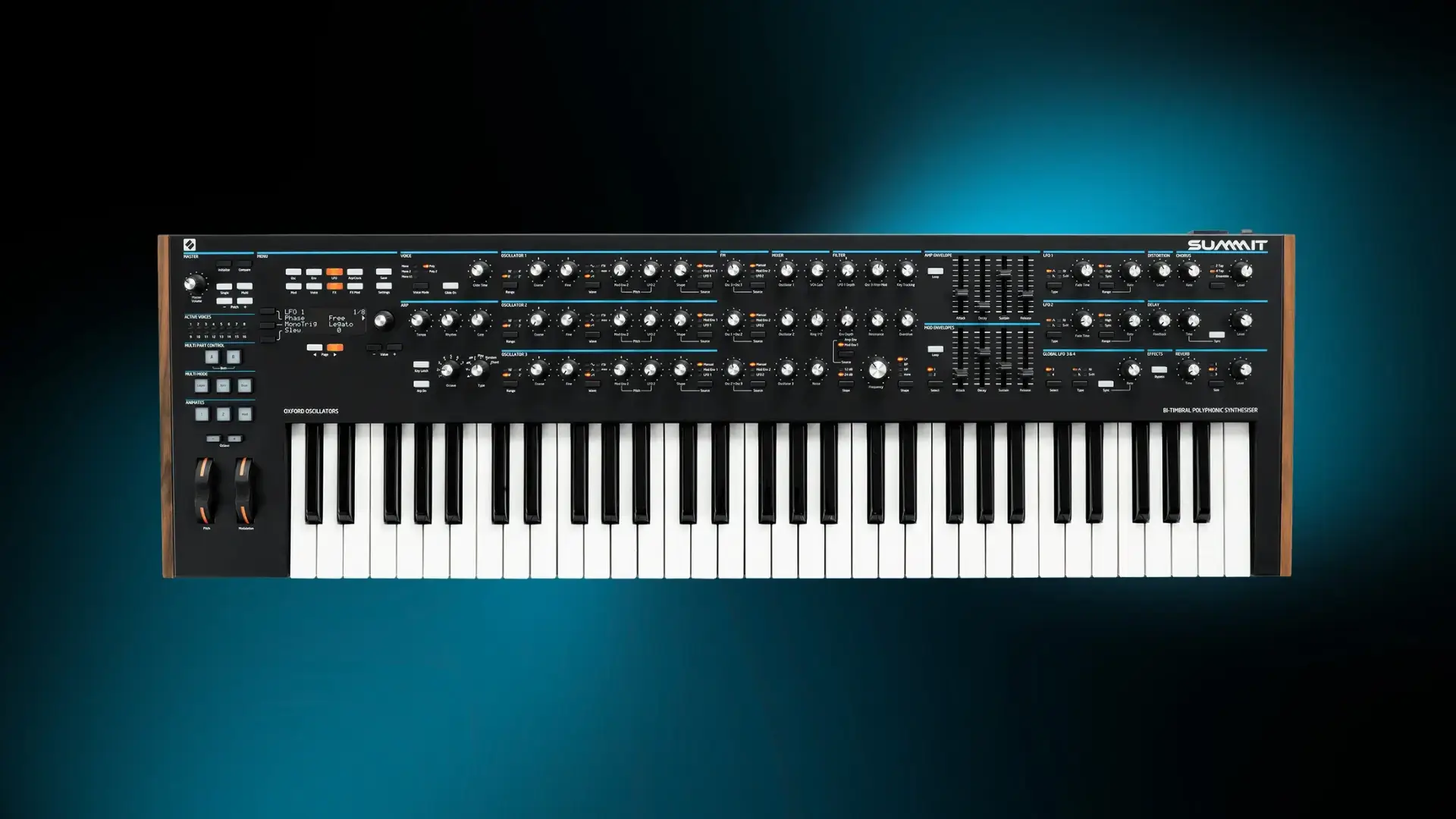
The Novation Summit is a 61-key, 16-voice, two-part multitimbral hybrid polysynth introduced in 2019 as Novation’s flagship keyboard synthesizer. Built around a dual implementation of the Peak synth engine, it combines FPGA-based New Oxford digital oscillators with an analog filter, VCA, and distortion signal path. Its importance lies in that combination: it gave Novation a serious full-size performance instrument at a time when the market was again valuing tactile polysynths, hybrid tone generation, and instruments that could move between studio sound design and live keyboard work.
Table of Contents
Novation Summit sound and character
The Novation Summit sounds broad, polished, and deliberately hybrid. It does not behave like a purely vintage analog instrument, and that is part of its identity. The New Oxford oscillators give it a stable, precise, high-resolution foundation, while the analog filters, VCAs, and distortion stages give the sound body, pressure, and movement after the digital oscillator stage. The result is a synth that can sound clean without becoming thin, aggressive without becoming crude, and atmospheric without relying only on effects.
Its strongest territory is the large-format polyphonic language of pads, brass-like stacks, basses, leads, arpeggios, evolving digital textures, and cinematic layers. The two-part architecture is central to that impression. A single patch can already be dense, but split and layered patches make the Novation Summit feel more orchestral than its basic voice count might suggest. It is especially convincing when the digital side is allowed to remain audible: wavetable movement, FM relationships, ring modulation, and oscillator shaping give it a more modern grammar than a conventional analog polysynth.
At the same time, the Novation Summit can still lean toward classic subtractive territory. Its analog filter section, variable filter configurations, drive stages, and front-panel immediacy make it capable of familiar analog-style basses, strings, brass, sync-like motion, and thick unison sounds. Its character is not fragile or unstable in the old-VCO sense. It is more controlled, more architectural, and more studio-ready. That makes it less romantic than some vintage-inspired polysynths, but more flexible as a central instrument.
Features and architecture
- Manufacturer: Novation.
- Year introduced: 2019.
- Production years: 2019 to present; the instrument remains listed by Novation and major retailers as of 2026, although availability can vary by region.
- Synthesis type: digital/analog hybrid synthesis.
- Category: flagship 61-key polyphonic keyboard synthesizer.
- Polyphony: 16 voices in single mode, or two 8-voice parts in bi-timbral operation.
- Multitimbrality: two-part architecture with layer, split, and dual bi-timbral modes.
- Original price and current market price: launch-period pricing was reported around £1,899 / $2,199; current new-price signals in 2026 range from roughly $2,138 at Thomann’s U.S. listing to $2,899.99 in U.S. retail listings, while used-market estimates commonly sit below new price.
- Oscillators: three New Oxford numerically controlled oscillators per voice, FPGA-based, capable of analog-style waveforms, wavetable synthesis, and FM-style relationships.
- Waveforms: sine, triangle, sawtooth, square/pulse, plus 43 wavetables of five waveforms per row.
- Additional sound sources: noise generator with high-pass filter control and ring modulator.
- Filter: analog multimode OTA filter section per voice, with low-pass, band-pass, high-pass, and dual-filter configurations; 12 dB and 24 dB operation are available depending on configuration.
- Analog signal path: analog filters, analog VCAs, and analog distortion stages.
- LFOs: two LFOs per voice, plus global LFO 3 and LFO 4.
- Envelopes: three envelopes per part, including amp envelope and two modulation envelopes, with delay/hold stages available beyond basic ADSR behavior.
- Modulation system: 16-slot modulation matrix, with two sources per destination per slot.
- Modulation sources: includes velocity, aftertouch, modulation wheel, expression pedals, envelopes, LFOs, Animate buttons, pitch bend, and CV modulation input.
- Sequencer / arpeggiator: arpeggiator with key latch and 33 patterns; it is not designed as a full workstation-style onboard sequencer.
- Effects: per-part effects including analog distortion, chorus, delay, and reverb, with effect modulation options.
- Firmware expansion: Summit firmware v2.0 added expanded stereo controls, additional modulation possibilities, chorus modes, flanger, phlanger, new effects modulation destinations, and Lo-Fi delay.
- Memory: up to 512 patches on the hardware; ships with 256 factory patches.
- Keyboard: 61-key semi-weighted keyboard with velocity and aftertouch, plus pitch and modulation wheels.
- Inputs / outputs: stereo main outputs, stereo auxiliary outputs, stereo audio inputs, headphone output, two pedal inputs, and CV modulation input.
- MIDI / USB: MIDI In, Out, and Thru; USB-MIDI class-compliant connection. USB is for MIDI communication and system functions, not bus power.
- Display: OLED display.
- Dimensions / weight: approximately 998.5 mm wide, 303.5 mm deep, and 92 mm high; weight approximately 11 kg.
- Power: IEC power connector; maximum power consumption listed at 1A.
Strengths
- The Novation Summit gives the Peak architecture a genuinely playable body. The 61-key keyboard, aftertouch, split/layer modes, and larger front panel turn a powerful desktop sound engine into a more immediate performance instrument.
- Its hybrid architecture is unusually balanced. The digital oscillators are not simply a cost-saving substitute for analog VCOs; they are the source of wavetable, FM, and precise oscillator-shaping behavior that an ordinary analog polysynth would not provide.
- The analog filter and distortion path gives the sound enough physical weight to avoid the sterile quality that can affect some digital-heavy instruments.
- The two-part architecture is musically useful rather than decorative. Layered pads, split bass/lead setups, cinematic textures, and live performance combinations are part of the instrument’s practical identity.
- The front panel is dense but purposeful. FM, effects, LFOs, envelopes, filter routing, and performance controls are not buried so deeply that the synth becomes a preset machine.
- The effects are integrated into the sound-design system rather than feeling like a simple final polish stage, especially because the effects themselves have modulation destinations.
- Firmware and content support have helped the instrument age better than many fixed-architecture keyboards. The Wavetable Editor, Components ecosystem, artist sound packs, and firmware updates widened the instrument’s identity after launch.
- It is a strong “one serious synth” candidate for musicians who want a single keyboard that can cover analog-style subtractive work, modern wavetable motion, FM-edged textures, and layered performance patches.
Limitations
- It is not an all-analog polysynth. Players specifically seeking VCO instability, vintage component drift, or a historically analog signal from oscillator to output may find the Novation Summit too controlled.
- The two-part structure is powerful, but it is still limited to two parts. It is not a multitimbral workstation or a replacement for a full arrangement engine.
- In bi-timbral mode, the 16 voices are effectively divided between two parts, which means dense layered patches can consume polyphony quickly.
- The instrument is physically substantial. At around 11 kg and nearly one meter wide, it is portable for a flagship keyboard, but not casual in the way a compact desktop or 37-key synth is.
- USB does not provide audio or bus power. It is useful for MIDI and system communication, but the Novation Summit still behaves like a traditional hardware synthesizer in a studio routing setup.
- The arpeggiator is useful, but the Summit is not built around a deep onboard sequencer. Users who want Elektron-style sequencing or workstation arrangement tools will need external hardware or a DAW.
- Some of the deepest options still require menu navigation. The panel is generous, but the full architecture is too large to be entirely knob-per-function.
- Its price places it in competition with distinctive analog and hybrid polysynths, so the buyer must value flexibility and architecture as much as a singular vintage-style tone.
Historical context
The Novation Summit appeared in 2019, during a period when the hardware polysynth market had become unusually competitive again. Analog revivals, boutique reissues, modern Sequential instruments, high-end digital hybrids, and performance-oriented keyboards were all competing for attention. In that context, the Novation Summit was not a nostalgic reissue. It was Novation’s flagship statement: a modern hybrid keyboard that used digital oscillators not as a compromise, but as a source of sonic range.
Its relationship to Peak is central. Peak had already established the New Oxford oscillator architecture in a compact desktop format. Novation Summit expanded that idea into a larger instrument with 16 voices, two parts, expanded front-panel control, a 61-key keyboard, audio input, auxiliary outputs, and deeper performance behavior. In simple terms, Novation Summit answered the question Peak naturally created: what would this engine become if Novation treated it as the basis for a full professional keyboard rather than a desktop module?
The Novation Summit also fits into Novation’s broader history in a specific way. Novation had long been associated with practical electronic instruments, MIDI controllers, groove-oriented tools, Bass Station lineage, and compact synthesis. Novation Summit pushed the brand into a more explicitly premium keyboard space. It did not abandon Novation’s pragmatic design culture, but it gave that culture a more ambitious form.