

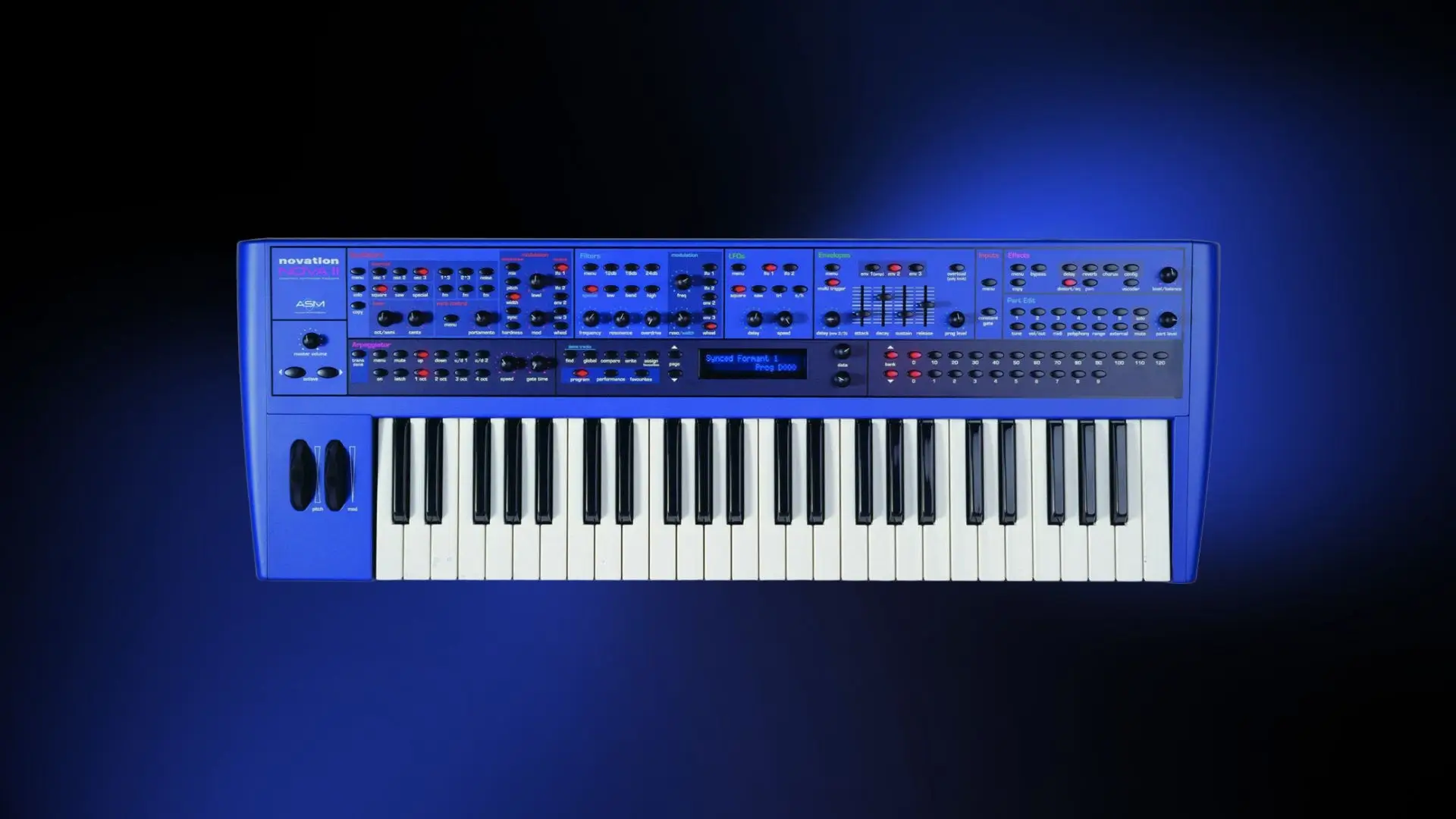
The Novation Nova II Keyboard is an early-2000s digital analogue-modelling synthesizer from Novation’s Nova/Supernova family. Released in 2000, it translated the company’s late-1990s virtual-analog language into a performance-oriented keyboard format, combining ASM synthesis, multi-part operation, extensive per-part effects, arpeggiation, a vocoder, and a densely populated front panel. Its importance is not that it perfectly imitated vintage analog hardware, but that it captured a particular moment when digital synths were trying to be playable, multitimbral, effect-heavy production instruments rather than simple preset machines.
Table of Contents
Novation Nova II Keyboard sound and character
The Novation Nova II Keyboard belongs to the polished, saturated side of early virtual analog. Its sound is digital, but not thin in the way that criticism is sometimes applied to older VA instruments. It was built around Novation’s Analogue Sound Modelling engine, with three oscillators per voice, ring modulation, FM options, noise, resonant multimode filtering, overdrive, and a large internal effects structure. That combination gives it a broad, finished character: basses can be solid and immediate, pads can become wide and animated, arpeggiated patches can sound almost arrangement-ready, and atmospheric textures benefit from the fact that effects are not merely an afterthought.
The Novation Nova II Keyboard is especially convincing when used as a layered electronic instrument rather than as a strict analog impersonator. Its strengths lie in trance-era stacks, animated polysynths, sync sounds, bright digital bells, FM-leaning mallets, evolving pads, vocoder textures, and rhythmically complex arpeggiated parts. The tone can be warm by VA standards, but it remains a product of its period: clean, controlled, sometimes glossy, and capable of becoming very large very quickly.
What gives it character is the interaction between the sound engine and the effects architecture. Many synths of its era could produce saws, pulses, resonant sweeps, and sync leads. The Novation Nova II Keyboard’s identity comes from letting those sounds live inside a multi-effects environment where delays, reverbs, chorus-like treatments, comb filtering, distortion, EQ, panning, and vocoding are structurally integrated into the instrument. It is therefore less like a raw oscillator-and-filter machine and more like a compact electronic production system with keys.
Features and architecture
- Manufacturer: Novation.
- Year: 2000 release framing.
- Production years: not confidently verifiable from reliable public sources checked; the instrument is now treated by Novation as legacy equipment.
- Synthesis type: digital Analogue Sound Modelling, Novation’s virtual-analog synthesis system.
- Category: polyphonic digital/virtual-analog keyboard synthesizer.
- Polyphony: standard Novation Nova II Keyboard, 12 voices expandable; Nova II X, 24 voices expandable; Nova II XL, 36 voices; expansion boards could raise supported configurations further, with the manual describing 48 voices when the 24-voice board is installed in a Nova II X.
- Original price and current market price: original manufacturer MSRP was not confidently verified; current used-market signals are sparse, with modern listings generally appearing as used instruments rather than new stock.
- Oscillators: three oscillators per voice, two ring modulators, and a noise generator; the manual notes that ring modulators can be swapped for FM modulators on oscillator 3.
- Filter: resonant 12, 18, and 24 dB-per-octave low-pass, high-pass, and band-pass modes, plus nine special dual filter types with modulatable frequency separation; filter overdrive is included.
- LFOs: two LFOs capable of audio-rate operation, MIDI clock sync, slew, and delay behavior.
- Envelopes: three envelopes, consisting of one ADSR and two delay-ADSR types, with loopable attack/decay stages and additional sustain-time, sustain-rate, ADR tracking, and level-tracking functions.
- Modulation system: comprehensive modulation matrix with 130 possible routings.
- Sequencer / arpeggiator: built-in arpeggiator with preset polyphonic and monophonic patterns, user-programmable polyphonic and monophonic patterns, and multiple simultaneous arpeggiators in Performance mode.
- Effects: distortion, comb filter, EQ, reverb, chorus/flanger/phaser/ensemble/rotary speaker, delay, and panning per program; the manual also describes a global 42-band vocoder.
- Memory: 512 programs in four banks, 200 drum programs, four drum maps, 256 performances, and 128 favourites.
- Keyboard: 49- or 61-note semi-weighted keyboard with aftertouch, depending on version/source listing.
- Inputs / outputs: six assignable analog outputs, two assignable inputs, headphone output, and optional SPDIF/ADAT digital I/O via expansion.
- MIDI / USB: MIDI In, Out, and Thru; no USB connection is documented in the manual specification.
- Display: small blue display.
- Dimensions / weight: 853 mm length, 298 mm depth, 95 mm maximum height including knobs; 8 kg.
- Power: built-in multi-voltage power supply, 100 V to 240 V.
Strengths
- The Nova II Keyboard gives players a large amount of synthesis depth without abandoning hands-on performance. Its front panel is dense, but the instrument was clearly designed to be edited, not merely browsed.
- Its per-part effects philosophy is central to its usefulness. The synth can preserve complex sound design and effects behavior across multitimbral performances, which makes layered patches feel more complete than on many instruments where parts must share a limited global effects pool.
- The sound engine is broad enough to cover classic VA duties, FM-flavored tones, ring-modulated textures, drum-oriented patches, vocoder sounds, and rhythmic arpeggiated material.
- The combination of multi-part operation, multiple arpeggiators, assignable outputs, and MIDI transmission from controls makes it useful as both a sound source and a performance hub in a hardware setup.
- Its sonic personality fits electronic genres that value movement, width, and polish: trance, progressive electronic music, synthwave-adjacent textures, ambient, and studio-built layered arrangements.
- The instrument’s architecture reflects a serious late-1990s and early-2000s idea of the synthesizer as a complete production device, not just a tone generator.
Limitations
- The standard 12-voice model can feel constrained when using dense patches, unison-style programming, layered performances, or long releases.
- The interface is hands-on but not minimalist. Its many buttons, modes, and performance structures reward study rather than instant familiarity.
- Its tonal identity is recognizably digital VA. Players looking for unstable analog oscillator behavior, discrete analog filters, or raw vintage drift may find it too clean or too period-specific.
- The small display limits how much information can be read at once, especially compared with modern synths that use larger screens and graphical modulation views.
- Used units require careful inspection. Age-related issues, expansion status, keyboard condition, display condition, encoders/buttons, outputs, and OS version matter more than they would on a current production instrument.
- Original pricing and production-run details are not consistently documented in reliable public sources, which makes historical market analysis less precise than with better-documented flagship instruments.
- There is no modern USB workflow built into the hardware specification, so computer integration depends on MIDI and external interfaces.
Historical context
The Novation Nova II Keyboard sits in the aftermath of Novation’s 1990s rise. Novation had already established itself with Bass Station, DrumStation, Super Bass Station, Supernova, and Novation Nova II Keyboard. The official company history frames Supernova as a major Chris Huggett-era project and describes the 1999 Nova as a desktop synth based around the same Supernova engine. Novation Nova II Keyboard arrived after that lineage had already defined a Novation sound: analog-inspired digital synthesis, strong real-time control, multitimbral operation, and effects as part of the instrument’s musical identity.
The timing matters. Around 2000, virtual-analog synths were not retro curiosities. They were practical tools for dance music, studio production, live electronic performance, and hybrid MIDI setups. Musicians wanted polyphony, memory, MIDI control, arpeggiation, multitimbrality, and onboard effects, because the studio was becoming more computer-connected but not yet fully software-dominated. The Novation Nova II Keyboard answered that world: it was not a minimalist analog revival synth, but a digital performance machine built for a period when hardware still needed to carry large parts of an arrangement by itself.
It also appeared before Novation’s later 2000s identity became strongly associated with MIDI controllers and DAW integration. That makes the Novation Nova II Keyboard historically useful: it belongs to the last phase of Novation’s first major synth-family arc, before products such as the X-Station, Remote SL, Launchpad, UltraNova, MiniNova, Peak, and Summit reframed the company in different ways.
Legacy and significance
The Novation Nova II Keyboard matters because it shows a version of synthesis history that is often flattened. The usual story says that analog disappeared, virtual analog imitated it, software took over, and analog returned. The Novation Nova II Keyboard complicates that story. It was not only trying to imitate the past. It was trying to solve the practical problem of making an electronic music workstation that could layer, modulate, arpeggiate, process, perform, and communicate through MIDI in a single box.