

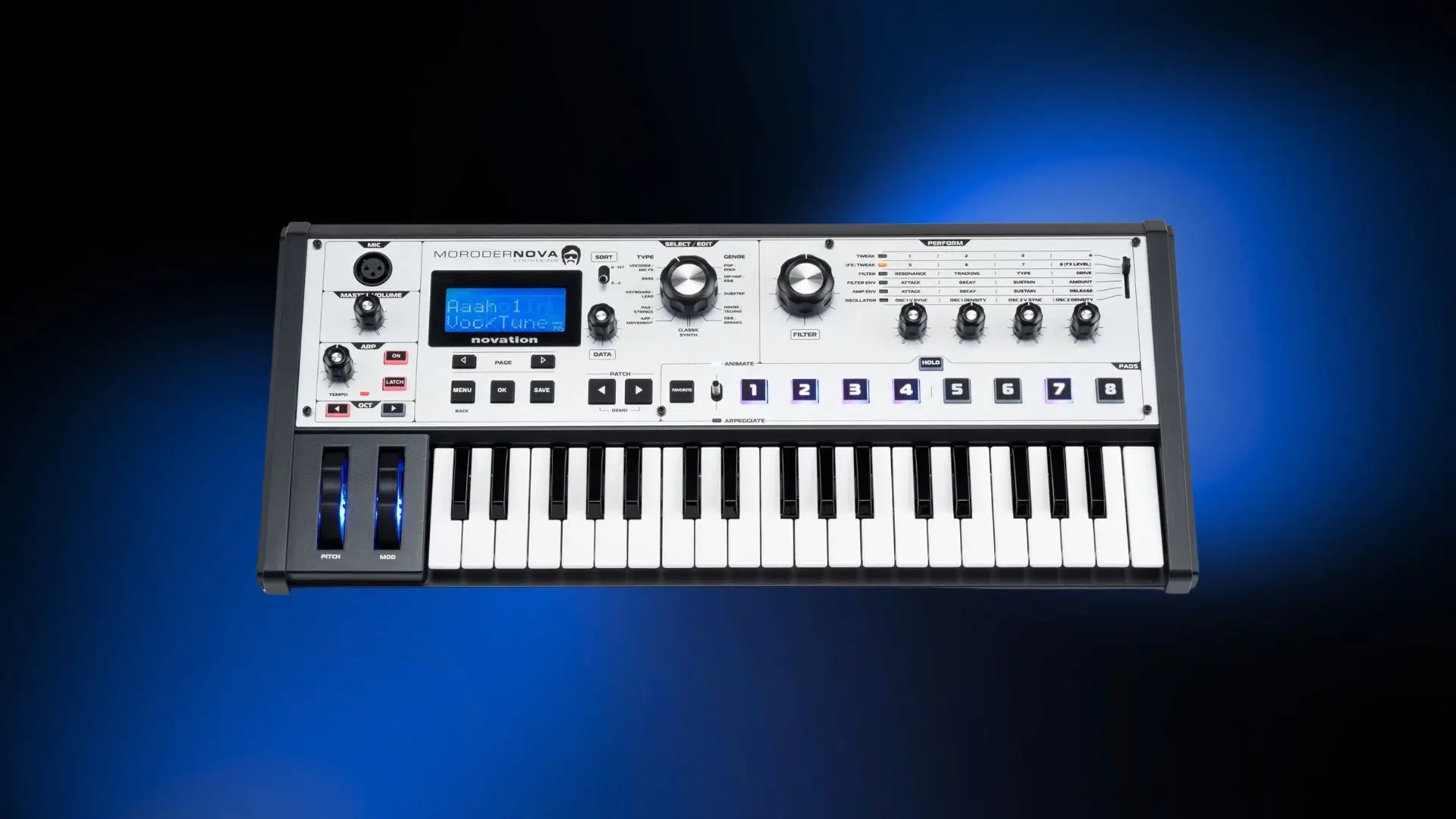
The Novation MoroderNova is a limited-edition 37-key digital synthesizer introduced in 2015 as a Giorgio Moroder signature version of the Novation MiniNova. It was not a new synthesis platform, but a culturally loaded reinterpretation of an existing compact synth: the UltraNova-derived MiniNova engine, placed inside a silver-and-black Moroder-branded shell and loaded with Moroder-approved sounds. Its significance lies less in technological novelty than in the way it turned a small digital performance synth into a tribute object for one of electronic music’s most consequential producers.
Table of Contents
Novation MoroderNova sound and character
The Novation MoroderNova sounds, at its core, like a MiniNova: bright, flexible, digital, compact, and more capable than its small format suggests. Its character comes from a virtual-analog and wavetable architecture that can move between sawtooth-driven basses, animated pads, metallic digital textures, vocoder phrases, rhythmic gated effects, and glossy lead sounds. It does not behave like a vintage analog polysynth, and it should not be judged as one. Its strength is the opposite: it compresses a deep digital engine into a portable performance instrument.
The Moroder connection gives the Novation MoroderNova a conceptual direction. The included sound set points toward disco, synth-pop, soundtrack electronics, vocoded performance, and the kind of sequenced brightness associated with Moroder’s work across the 1970s, 1980s, and his later public revival. That does not mean the MoroderNova recreates the exact circuits used on the original records. It is a digital instrument using patches as historical translation. The result is more “memory of Moroder” than “Moroder studio replica.”
The Novation MoroderNova excels at sharp arpeggiated patterns, synthetic basses, wide digital pads, robotic vocal treatments, and lead sounds that benefit from onboard effects. The five-slot effects structure matters here: delay, chorus, distortion, reverb, compression, EQ, and gator effects help the MiniNova engine sound larger than its physical size. The eight Animate buttons are also central to its personality, because they let a patch change in performance rather than remain static. In practice, the Novation MoroderNova is most persuasive when treated as a compact electronic-pop performance machine, not as a miniature workstation or a vintage analog substitute.
Features and architecture
- Manufacturer: Novation.
- Year introduced: 2015.
- Production years: limited 2015 run of 500 numbered units with certificate of authenticity.
- Synthesis type: digital synthesis with virtual-analog, wavetable, subtractive, vocoder, and effects-based sound design.
- Category: compact keyboard synthesizer and vocoder.
- Polyphony: up to 18 voices.
- Original price: advertised in the United States around a $449.99 minimum advertised price, with a higher suggested retail price reported at launch; UK review pricing was reported at £319.99.
- Current market price: used prices vary because examples appear infrequently; recent used asking signals have been around the mid-US$800 range.
- Oscillators: three main oscillators per voice, plus noise source and two ring modulator sources.
- Waveforms: classic analog-style waveforms, digital waveforms, and 36 wavetables.
- Filter: two filter sections with 14 filter types based around low-pass, band-pass, and high-pass variants.
- LFOs: three assignable LFOs.
- Envelopes: six envelope generators, including dedicated amplitude and filter envelopes plus four assignable envelopes.
- Modulation system: 20-slot modulation matrix, with performance control through the front-panel controls and Animate buttons.
- Sequencer / arpeggiator: arpeggiator with editable rhythmic interaction through the eight backlit buttons; not a full onboard song sequencer.
- Effects: five effects slots, with processors including panning, EQ, compression, delay, chorus, distortion, reverb, and gator-style rhythmic processing.
- Memory: 256 onboard patches with additional user storage; Moroder-themed patches are also available as a downloadable MiniNova patch set.
- Keyboard: 37-note velocity-sensitive mini-key keyboard.
- Inputs / outputs: XLR dynamic microphone input, 1/4-inch audio input, stereo 1/4-inch outputs, 1/4-inch headphone output, and sustain pedal input.
- MIDI / USB: 5-pin MIDI In and Out, plus USB-B for computer connection and USB MIDI.
- Display: 16-character LCD.
- Dimensions / weight: approximately 560 mm wide, 250 mm deep, and 75 mm high; weight around 2.5 kg.
- Power: USB bus power or external DC power supply.
Strengths
- It gives the MiniNova engine a strong cultural identity. The standard MiniNova is a compact digital synth; the Novation MoroderNova turns the same architecture into a curated tribute to disco, synth-pop, soundtrack electronics, and vocoder-era pop futurism.
- The sound engine is deeper than the exterior suggests. Three oscillators, wavetables, two filters, six envelopes, three LFOs, a 20-slot modulation matrix, and five effects slots make it far more than a preset toy.
- It is a strong performance synth for compact setups. The Animate buttons, filter knob, arpeggiator controls, pitch and modulation wheels, and onboard vocoder make it useful for immediate electronic gestures.
- The vocoder and VocalTune functions are not decorative extras. They connect directly to the Moroder aesthetic, where the processed human voice often becomes part machine, part pop hook, part future-symbol.
- Its limited run gives it a collector identity that the standard MiniNova does not have. The numbered edition, certificate, custom livery, and Moroder insignia make the instrument memorable even before it is played.
- It remains practically supported. The MiniNova ecosystem, editor/librarian tools, downloads, drivers, and patch resources make the Novation MoroderNova less isolated than many limited editions.
Limitations
- It is not a new synthesizer architecture. Anyone expecting a unique Moroder-specific engine will be disappointed; the hardware and synthesis platform are essentially MiniNova-based.
- The collectibility may exceed the sonic exclusivity. Because the Moroder patches can be loaded into a standard MiniNova, the rare edition’s special value is mainly physical, cosmetic, historical, and symbolic.
- The mini-key format is convenient but limiting for expressive keyboard playing. It works well for programming, portable performance, basses, leads, and vocoder work, but it is not ideal for players who want a full-size keyboard feel.
- Deep editing can be menu-dependent. The engine is powerful, but the front panel does not expose every parameter with a dedicated control.
- It is monotimbral. For layered arrangements, multitimbral sequencing, or workstation-style use, it is not the right tool.
- Polyphony can become constrained when using unison or long-release patches. The headline figure of 18 voices is generous for the size, but real-world programming choices can reduce practical note availability.
- Used prices can be hard to justify if the buyer only wants the sound engine. A standard MiniNova usually makes more economic sense for players who do not care about the Moroder edition.
Historical context
The Novation MoroderNova appeared in 2015, a moment when Giorgio Moroder was unusually visible to a new electronic-music audience. Daft Punk had brought him back into wide pop-cultural conversation through “Giorgio by Moroder” on Random Access Memories, and Moroder’s album Déjà Vu arrived in the same period with contemporary pop collaborators. The Novation MoroderNova belongs to that revival: it is a hardware object tied to a renewed public fascination with one of electronic music’s foundational figures.
For Novation, the instrument sat at an interesting point in the brand’s timeline. The MiniNova had already translated the UltraNova sound engine into a smaller, more affordable, more performance-oriented keyboard. The Novation MoroderNova did not correct or replace that design. Instead, it reframed it. Novation took an existing compact synth and gave it a historical narrative, a celebrity authorship angle, and a collector format.
That decision says something about the mid-2010s synth market. By then, compact synths were no longer merely budget compromises. They were becoming identity objects: small enough for bedrooms and touring bags, powerful enough for serious production, and visually distinct enough to carry cultural meaning. The Novation MoroderNova answered that moment by connecting portable digital synthesis to a producer whose name had become shorthand for electronic pop futurism.