

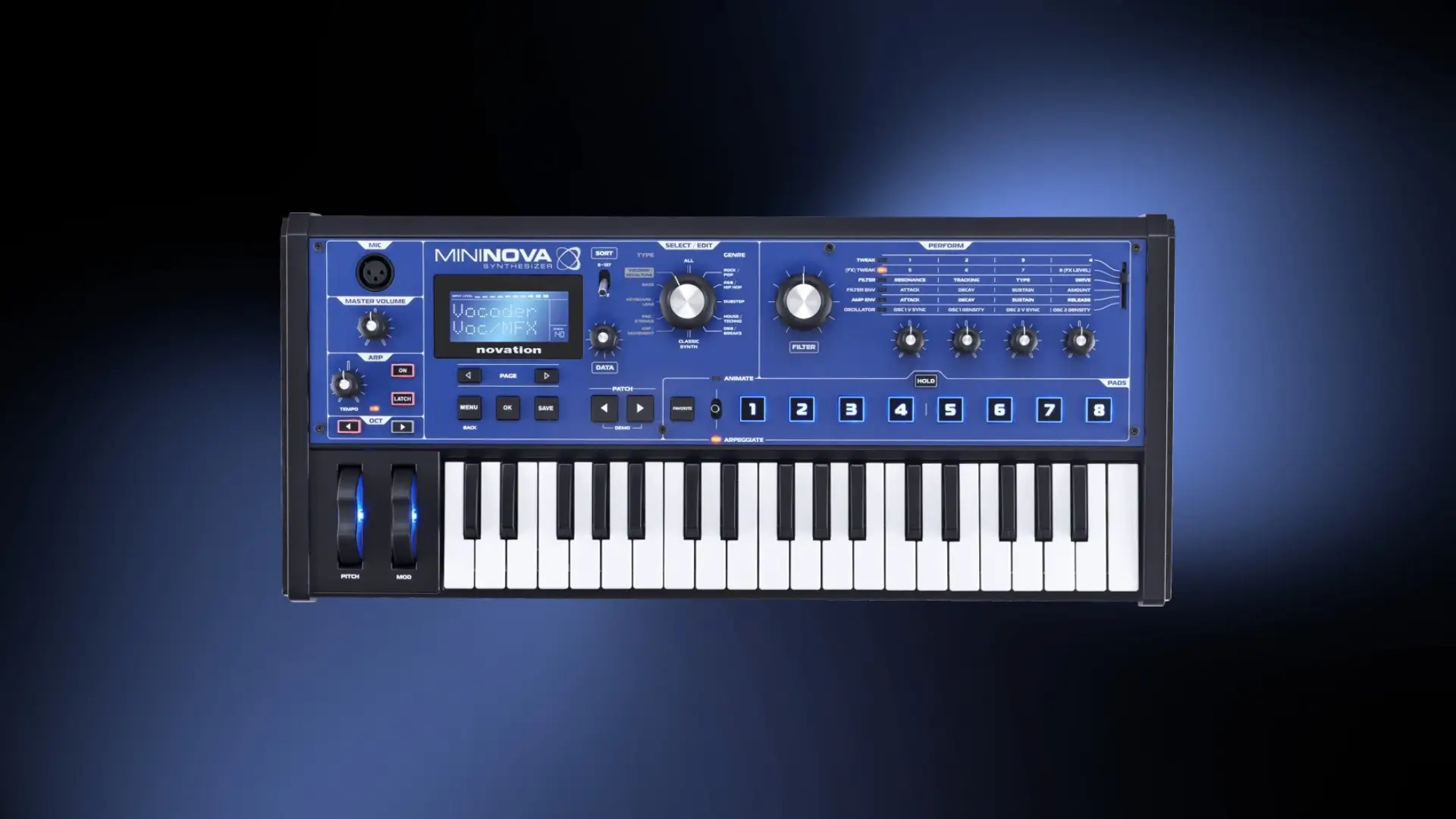
The Novation MiniNova is a compact digital synthesizer and vocoder announced in 2012 and released in October of that year. It takes the sound engine associated with the UltraNova and places it in a 37-mini-key instrument built around performance controls, vocal processing, patch browsing, USB power, and a deliberately portable form. Its importance is not that it invented a new synthesis method, but that it compressed a surprisingly deep virtual-analog and wavetable architecture into a small, affordable keyboard at a moment when compact performance synths were central to electronic music production.
Table of Contents
Novation MiniNova sound and character
The Novation MiniNova sounds like a small instrument only in physical scale. Sonically, it belongs to Novation’s digital Nova lineage: bright, controlled, synthetic, and oriented toward electronic rather than acoustic realism. Its strongest territory is basses, leads, animated pads, arpeggiated patterns, vocoder textures, and aggressive contemporary electronic sounds. Independent reviews from the period repeatedly emphasized its punch, depth, and suitability for harder electronic styles rather than naturalistic emulations.
The character comes from the density of the engine. Each patch can use three oscillators, a noise source, ring modulation, wavetables, two filters, multiple envelopes and LFOs, a modulation matrix, and stacked effects. That gives it a tone that can move from sharp digital brightness to thick detuned patches and evolving wavetable motion. It is not a warm analog polysynth in the vintage sense, and its filters are not the centerpiece in the way they would be on a classic analog instrument. The Novation MiniNova’s identity is more architectural: it earns its sound through layering, modulation, vocal processing, and effects rather than through a single iconic analog circuit.
The vocoder and VocalTune functions are also central to its personality. They place the MiniNova in a lineage of compact synths that were not only studio sound sources but stage-friendly devices for stylized vocals, robotic hooks, and processed performance gestures. That matters culturally because the instrument arrived after the microKorg had already proved that a small keyboard synth with a vocoder could become a visible object in indie, electronic, and home-studio culture. The Novation MiniNova’s answer was not minimalism: it offered far deeper synthesis and more polyphony, but accepted the interface compromises that came with miniaturization. [S2] [S6]
Features and architecture
- Manufacturer: Novation.
- Year introduced: announced in August 2012; released in October 2012.
- Production years: listed on Reverb as 2012–2026, and still represented on Novation’s current product/support ecosystem as of 2026.
- Synthesis type: digital virtual-analog and wavetable subtractive synthesis.
- Category: compact digital keyboard synthesizer with vocoder.
- Polyphony: up to 18 voices, dynamic voicing.
- Original price: announced at £299.99 for October 2012 availability; MusicRadar’s 2013 review listed £300 / $629.
- Current new price signal: Novation’s current page shows $539.99 and a sold-out direct-stock notice; Sweetwater lists the Novation MiniNova at $529.99 and in stock.
- Current used market signal: Reverb identifies it as a 37-key, 18-voice digital keyboard synth and shows active marketplace tracking for the model; visible listings and recent examples commonly sit in the lower-to-mid hundreds of dollars depending on condition.
- Oscillators: three oscillators per patch, plus one noise generator and two ring modulators.
- Waveforms: analog-style waveforms, digital waves, and 36 wavetables.
- Filter: two filter blocks per patch, with 14 filter types across low-pass, band-pass, and high-pass variants.
- LFOs: three LFOs.
- Envelopes: six envelope generators.
- Modulation system: 20 modulation slots per patch, with destinations including oscillator, filter, envelope, effects, and recursive modulation targets.
- Sequencer / arpeggiator: arpeggiator with real-time rhythm editing, 33 patterns, and a chord function that can store chords up to 10 notes.
- Effects: five effect slots per patch, including distortion, compressor, chorus/phase, delay, reverb, gator, and EQ.
- Vocal processing: 12-band vocoder with supplied dynamic gooseneck microphone, plus VocalTune.
- Memory: up to 384 hardware patch locations; ships with 256 factory patches and space for 128 user patches.
- Keyboard: 37-note velocity-sensitive mini-key keyboard; the engine supports aftertouch as a modulation source, but the keyboard itself does not generate aftertouch.
- Performance controls: pitch wheel, modulation wheel, large filter knob, four edit/performance pots, parameter selector, eight backlit Animate/Arpeggiate/Favourite buttons.
- Inputs / outputs: XLR dynamic microphone input, one quarter-inch jack input, stereo quarter-inch outputs, quarter-inch headphone output, sustain pedal input.
- MIDI / USB: MIDI In/Out, USB MIDI, USB B 2.0, and USB power.
- Display: 16-character custom LCD.
- Dimensions / weight: 560 × 75 × 250 mm; approximately 2.52 kg / 5.55 lb.
- Power: USB bus power or included 9V DC supply; maximum power consumption listed as 9V DC 300mA.
Strengths
- Deep engine in a small body: the Novation MiniNova’s biggest strength is the mismatch between its size and its synthesis depth. Three oscillators, wavetables, dual filters, six envelopes, three LFOs, and 20 modulation slots make it more serious than its toy-like footprint may suggest.
- Strong electronic-music vocabulary: it is particularly convincing for basses, cutting leads, animated pads, arpeggios, and hard-edged digital textures. This makes it more useful for synth-pop, EDM, electro, industrial-leaning textures, and modern electronic arrangements than for realistic pianos or orchestral patches.
- Performance animation: the Animate buttons are not cosmetic. They let the player trigger programmed changes in sound, mute or alter arpeggiator steps, and recall favourite patches, giving a small keyboard a surprisingly active live-performance language.
- Vocoder and VocalTune integration: the supplied gooseneck microphone, 12-band vocoder, and pitch-following VocalTune feature make the instrument more than a conventional synth module with keys attached. It is built for stylized voice-as-synth performance.
- Patch accessibility: 256 factory patches, user memory, genre/type browsing, patch librarian support, and editor support make the depth less intimidating for users who do not want to program every sound from scratch.
- Portability: USB bus power and compact dimensions make it practical for small studios, laptop setups, and live rigs where a full-size workstation would be excessive.
- Value retention through usefulness rather than rarity: the ordinary blue Novation MiniNova is not mainly collectible; its appeal is that it remains a usable, supported, compact digital synth with a known engine and a large user ecosystem.
Limitations
- Mono-timbral architecture: it cannot run different patches on separate MIDI channels or provide internal split/layer arrangements, which limits it as a multitrack sound module or self-contained performance keyboard.
- Mini-key compromise: the 37-note mini keyboard helps portability but is not ideal for players who want full-size expressive control. Reviews also noted that the keyboard does not generate aftertouch.
- Menu depth: the engine is powerful, but deeper editing involves page navigation and screen work unless the software editor is used. The interface is usable, not luxurious.
- Not battery-powered: despite the portable format, it relies on USB bus power or the DC supply rather than batteries.
- Effects are useful but not luxurious: the onboard effects are central to many patches, but period reviews did not treat them as high-end studio processors. They are part of the instrument’s sound-design system, not a substitute for dedicated effects.
- Acoustic emulation is not its strength: it is better understood as a synthesizer for synthetic material than as a general-purpose keyboard for pianos, Rhodes, guitars, or realistic ensemble sounds.
- The compact interface shapes the instrument’s reputation: the Novation MiniNova is deeper than many players realize, but its small controls and preset-forward front panel can make it seem more casual than its architecture actually is.
Historical context
The MiniNova appeared in 2012, after the UltraNova had reintroduced the Nova concept in a modern compact digital form. Resident Advisor framed the UltraNova as a bridge between Novation’s past and present, and described the Novation MiniNova as following in its footsteps at a price point aimed at a new generation of users. That positioning matters: the Novation MiniNova was not a flagship statement. It was a compression of an existing engine into a smaller, more affordable, more immediate format.
Its timing also placed it directly in the compact-synth conversation dominated by the microKorg family. MusicRadar explicitly noted the inevitable comparison, while also pointing out that the Novation MiniNova used the UltraNova-derived engine and pushed deeper synthesis into a micro-key form. In other words, it was Novation’s attempt to compete not by copying the simpler compact-vocoder formula, but by loading a small synth with more modulation, effects, polyphony, and patch depth than its size implied.
Inside Novation’s broader history, the Novation MiniNova sits between eras. It is descended from the Nova/Supernova/UltraNova digital lineage, but it predates the later Peak and Summit period, where Novation would return to more premium hybrid synthesis. The MiniNova therefore captures a specific moment: early-2010s compact digital synthesis, designed for producers who wanted immediacy, portability, vocoder performance, and modern electronic presets rather than large-format workstation breadth.