

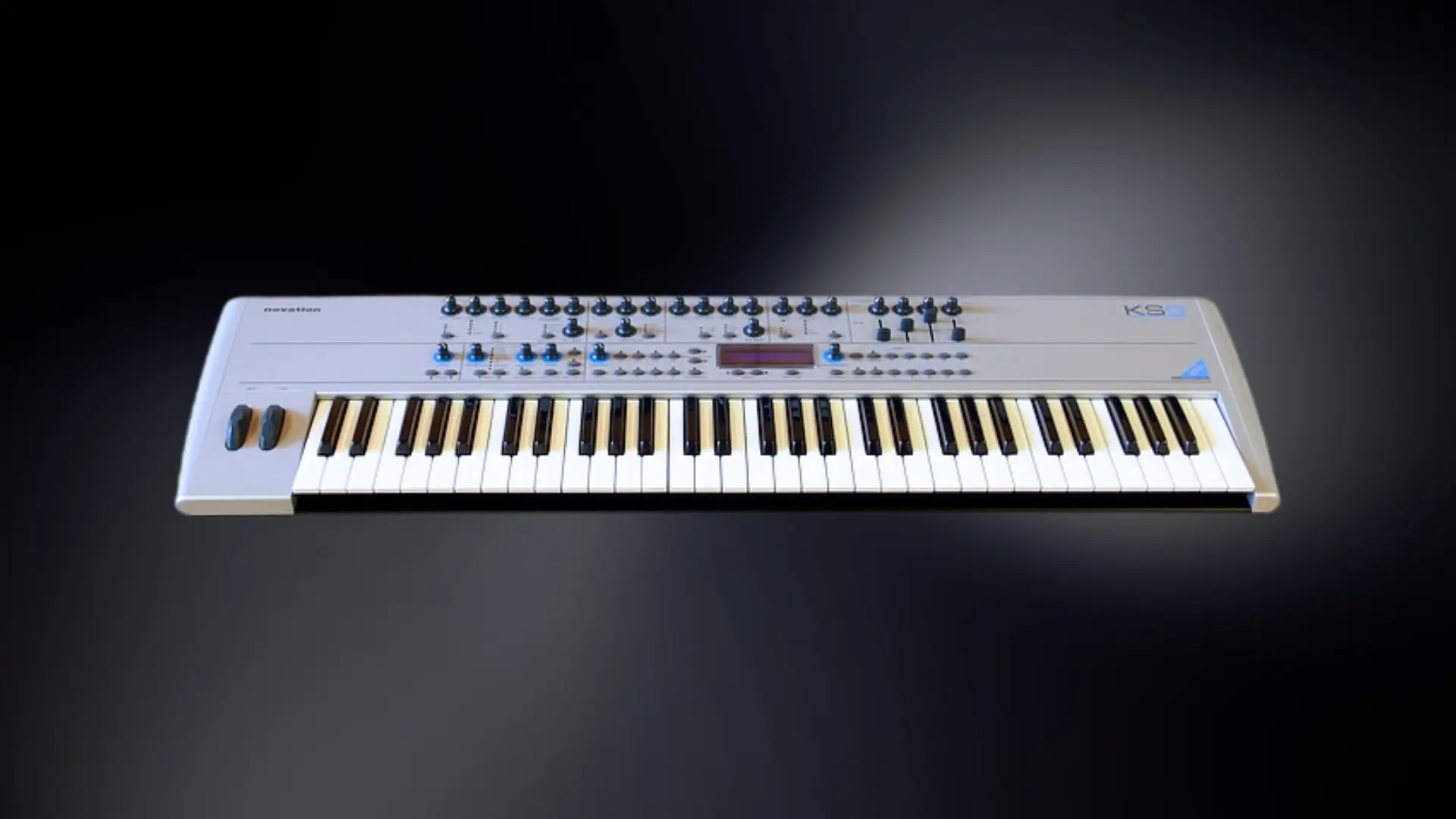
The Novation KS5 is a 61-key, 16-voice digital virtual analog synthesizer introduced around the 2002–2003 KS-series period as the five-octave counterpart to the KS4 and KS Rack. Built as an enhanced, multitimbral development of the K-Station engine, it combined three-oscillator subtractive synthesis, additional digital waveforms, FM, ring modulation, a multimode filter, four independent arpeggiators, a 16-band vocoder, and performance memories in a full-size keyboard with velocity and aftertouch. Its importance lies less in inventing a new synthesis language than in translating Novation’s Nova and Supernova-era performance thinking into a more immediate, lower-cost keyboard instrument.
Table of Contents
Novation KS5 sound and character
The Novation KS5 sounds like an early-2000s virtual analog synth in the best and most revealing sense of that phrase. It is clean, bright, animated, and deliberately performative rather than unstable, woolly, or vintage-authentic. Its tone does not chase the slow drift and irregularity of old analog polysynths. Instead, it favors clarity, speed, and layered movement: glassy pads, rhythmic arpeggios, cutting leads, digital basses, vocoder textures, and synthetic percussion.
Its character comes from the way Novation stretched a subtractive architecture beyond simple saw-square-pulse programming. The three oscillators offer the expected analog-style waveforms, but also double waveforms and complex cycle waveforms, while FM, ring modulation, multiple noise sources, external-input processing, and filter overdrive give the instrument a more hybrid vocabulary. That makes the Novation KS5 especially good at sounds that need motion: sync-like edges, animated pads, tempo-locked delay patterns, arpeggiated sequences, and performance patches where effects behave as part of the patch rather than as an afterthought.
The filter is digital, multimode, and switchable between 12 dB and 24 dB slopes. It can be smooth enough for pads, sharp enough for plucks, and more forceful when resonance and overdrive are pushed. The onboard effects are central to the Novation KS5’s identity. Reverb, chorus/phaser, delay, panning, distortion, EQ/filter processing, and the vocoder make the instrument feel closer to a self-contained performance synthesizer than a plain tone generator. In multitimbral Performance mode, the ability to combine parts, arpeggiators, and effects is arguably more important than any single oscillator waveform.
Features and architecture
- Manufacturer: Novation Electronic Music Systems Ltd.
- Year: shipping was reported in late 2002, while several reference sources list the KS4/KS5 as a 2003-era instrument.
- Production years: the start of availability is documented around 2002–2003; a reliable end-of-production date is not clearly verified in the checked sources.
- Synthesis type: digital virtual analog / subtractive synthesis with complex digital waveforms, FM, ring modulation, noise sources, and external audio processing.
- Category: 61-key polyphonic digital keyboard synthesizer with performance-workstation traits.
- Polyphony: 16 voices.
- Multitimbrality: four-part multitimbral Performance mode.
- Original price: KS5 RRP was reported as £749, approximately $1099.95 at launch.
- Current market price: used-market examples vary by region and condition; recent public listings show prices around the low-to-mid hundreds in pounds or dollars, with older European references placing the Novation KS5 around €300–400 and newer listings often higher.
- Oscillators: three oscillators per voice with square, saw, variable pulse, triangle, sine, double saw, double triangle, double sine, and 16 complex cycle waveforms.
- Noise sources: white, crack, metal 1, and metal 2.
- Additional oscillator functions: PWM, oscillator sync behavior, ring modulation, and FM between oscillators.
- Filter: digital multimode filter with low-pass, high-pass, and band-pass modes; 12 dB / 24 dB slope options; resonance to self-oscillation in 24 dB mode; overdrive and Q normalize parameters.
- LFOs: two LFOs with cyclic and one-shot modes, multiple basic shapes, random/quantized shapes, 12 intricate wavetable shapes, MIDI-clock sync, and speeds up to 1 kHz.
- Envelopes: amplifier and modulation envelopes with ADSR behavior; the modulation envelope also includes delay.
- Modulation system: front-panel modulation sources include LFOs, modulation envelope, velocity, aftertouch, pitch/mod wheels, breath control, keyboard tracking, and external-input triggering.
- Sequencer / arpeggiator: no conventional step sequencer is specified; four independent arpeggiators are available, with speed, range, gate time, MIDI-clock sync, key sync, up/down/random/chord modes, and 16 rhythmic patterns.
- Effects: reverb, chorus/phaser, distortion, panning, delay, 16-band vocoder, and EQ/filter processing.
- Memory: 200 factory programs, 200 user program locations, 50 factory performances, 50 user performance locations, factory/user drum maps, and factory sound restoration via downloadable data.
- Keyboard: 61-note keyboard with velocity sensitivity and aftertouch.
- Inputs / outputs: mono 1/4-inch audio input, four audio outputs via 24-bit D/A architecture, sustain and expression pedal inputs, and headphone output.
- MIDI / USB: MIDI In, Out, and Thru; no USB connection is specified for the Novation KS5.
- Display: two-line style program, performance, and menu display behavior with contrast adjustment.
- Dimensions / weight: 1018 mm wide, 94 mm high, 300 mm deep; 9.5 kg.
- Power: 85–270 VAC, 250 mA.
Strengths
- The KS5 gives the K-Station concept a more serious playing surface: five octaves, velocity, and aftertouch make it more credible as a performance keyboard rather than just a compact programming synth.
- Four-part multitimbrality, four independent arpeggiators, and separate effects behavior in Performance mode give it a compositional usefulness that goes beyond single-patch virtual analog duties.
- The oscillator section is broader than a basic VA engine, because the complex cycle waveforms, double waveforms, FM, ring modulation, and multiple noise sources allow more metallic, digital, percussive, and animated tones.
- Its sound design workflow is immediate enough for learning subtractive synthesis, but deep enough to reward more experienced programming.
- The effects are not merely decorative. They shape the Novation KS5’s musical identity, especially in pads, arpeggios, tempo-synced motion, vocoder textures, and layered performance patches.
- Its current used-market status makes it more approachable than many better-known early-2000s virtual analog keyboards, especially when compared with instruments whose prices have become inflated by nostalgia.
Limitations
- The Novation KS5 is not an analog polysynth, and it should not be judged as one. Players seeking oscillator drift, voltage-controlled filter behavior, or vintage analog irregularity may find it too clean.
- Sixteen voices are useful, but they can disappear quickly when layers, long releases, multitimbral parts, or unison-style programming are involved.
- The instrument belongs to a pre-USB hardware generation, so integration is based on DIN MIDI and SysEx rather than modern plug-in-style computer control.
- The interface is more hands-on than many menu-heavy digital synths, but deeper parameters still require display navigation and page-based editing.
- As an older discontinued instrument, condition matters. Encoders, sliders, buttons, display condition, aftertouch response, keybed feel, outputs, and power reliability should be checked carefully before purchase.
- Its cultural profile is modest. Unlike some classic virtual analog competitors, the Novation KS5 does not carry a large, well-documented mythology of famous records and celebrity users.
Historical context
The Novation KS5 appeared during a transitional moment for Novation. In the 1990s, the company had built its reputation through instruments such as the Bass Station, DrumStation, Nova, and Supernova. The Supernova line established Novation as a serious virtual analog manufacturer, while the A-Station and K-Station brought parts of that language into smaller, more accessible formats.
The KS series expanded that idea. Where the K-Station was compact and focused, the Novation KS5 made the architecture more stage- and studio-friendly through a 61-key keyboard, expanded multitimbrality, extra waveforms, multiple arpeggiators, performance memories, and a broader effects system. It arrived just before Novation’s mid-2000s shift toward integrated computer-music tools, controller keyboards, Automap-era workflow, and later products such as X-Station, SL, Launchpad, UltraNova, Peak, and Summit.
That timing matters. The Novation KS5 belongs to the last phase of Novation’s early virtual analog hardware lineage before the company became more publicly associated with controllers, DAW integration, grid performance, and hybrid computer workflows. It is neither a 1990s flagship nor a later modern hybrid. It is a practical bridge: a full-size, hands-on digital synth from the moment when hardware manufacturers were trying to keep tactile synthesis relevant in studios increasingly shaped by software.