

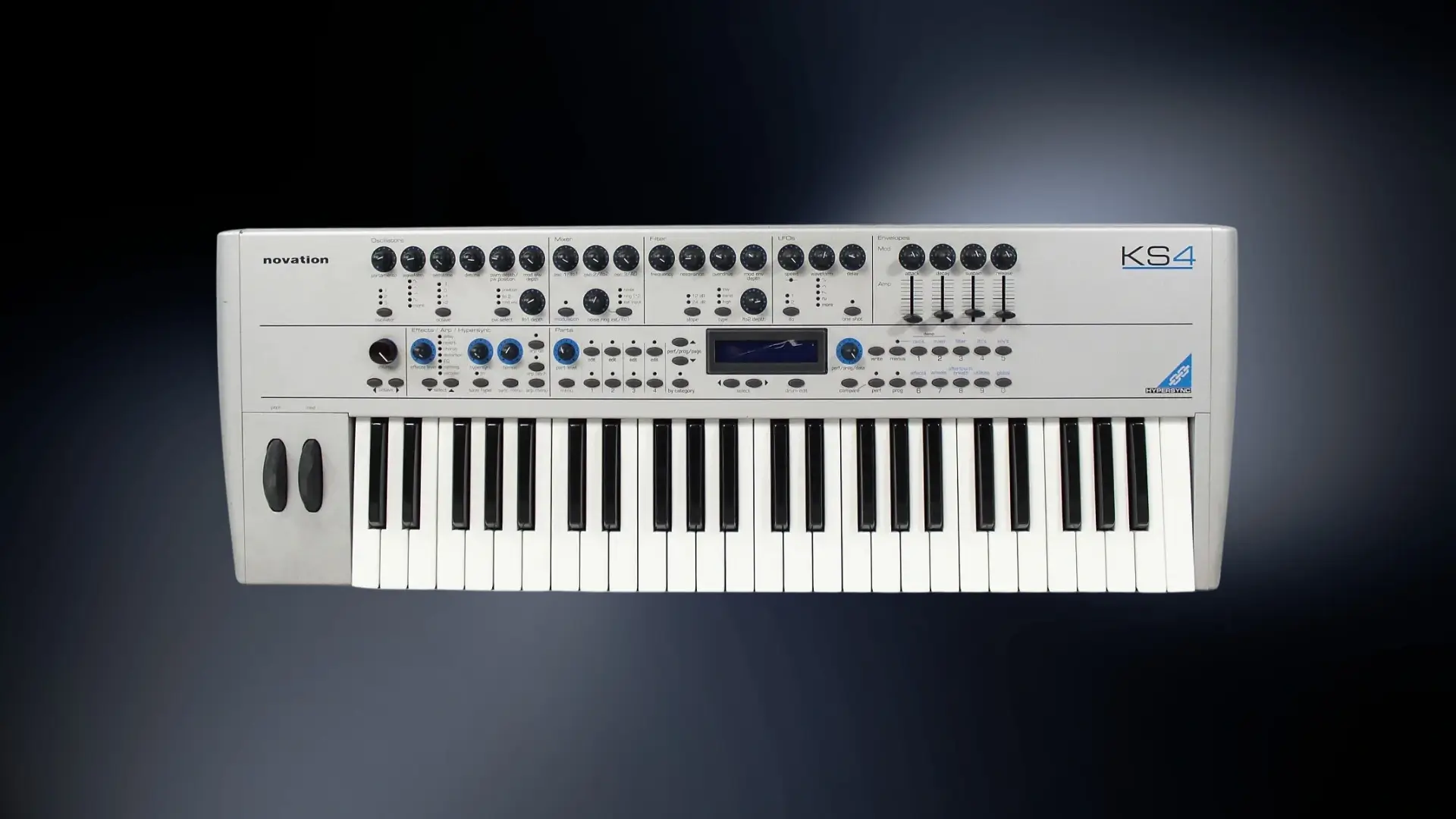
The Novation KS4 is a 49-key, 16-voice digital virtual-analog synthesizer from Novation’s early-2000s KS family. Marketed around the 2002–2003 period, it took the smaller K-Station concept and expanded it into a more serious four-octave performance instrument with four-part multitimbrality, a broader control surface, a 16-band vocoder, multiple effects, four arpeggiators, and Novation’s Hypersync system. Its importance lies less in being a revolutionary flagship and more in how it captured Novation’s polished, liquid, performance-friendly virtual-analog language at a moment when hardware synths were adapting to computer-based production without surrendering hands-on control.
Table of Contents
Novation KS4 sound and character
The Novation KS4 has the clean, glossy, early-2000s Novation character rather than the unstable behavior of a vintage analog polysynth. Its tone is digital, but not thin by default. The strongest patches tend to come from stacking its three oscillators, using the “double” waveforms, adding subtle detune, and letting the resonant multimode filter give the sound movement.
Its pads can be wide, smooth, and gently animated, especially when the LFOs, delay, chorus, phaser, panning, and reverb are synchronized. Its leads are more polished than raw, but unison, detune, sync, FM, ring modulation, and filter drive can push it into sharper territory. The basses are capable, especially for electronic production, though they are more controlled and synthetic than physically heavy in the way a discrete analog monosynth can be.
The filter is central to the Novation KS4’s identity. It offers low-pass, high-pass, and band-pass modes with 12 dB or 24 dB slopes, and it can self-oscillate in 24 dB mode. In practice, this makes the instrument better at liquid sweeps, resonant motion, animated pads, and rhythmic electronic textures than at pretending to be a vintage VCO polysynth. The Novation KS4 is at its best when treated as a digital performance synthesizer with analog-modeling roots, not as a historical analog substitute.
Features and architecture
- Manufacturer: Novation Electronic Music Systems Ltd.
- Year: commonly referenced as 2003, with product documentation carrying a 2002 copyright and major reviews appearing in early 2003.
- Production years: early-2000s production is documented; an exact end year was not confidently verified from primary sources.
- Synthesis type: digital virtual analog / subtractive synthesis with analog-modeled oscillators, complex cycle waveforms, FM, ring modulation, noise, and external audio processing.
- Category: 49-key digital keyboard synthesizer, virtual-analog polysynth, performance synth.
- Polyphony: 16 voices.
- Original price signal: a period UK magazine listing placed the Novation KS4 at £749; this should be treated as a UK retail signal, not a universal global MSRP.
- Current market price signal: used-only; recent public signals include a $500 used listing aggregator result, older Reverb sales around the low hundreds, and as-is units appearing lower depending on condition.
- Oscillators: three oscillators per voice with square, saw, variable pulse, triangle, sine, double saw, double triangle, double sine, and complex cycle waveforms.
- Additional oscillator functions: oscillator sync, FM, ring modulation, multiple noise sources, octave shifting, pulse-width modulation, and external input routing.
- Filter: resonant digital multimode filter with low-pass, high-pass, and band-pass modes; 12 dB / 24 dB slope selection; self-oscillation in 24 dB mode; overdrive and Q normalize parameters.
- LFOs: two LFOs with cyclic and one-shot operation, common waveforms, sample-and-hold-type shapes, additional waveform/pattern options, delay fade-in, and MIDI clock sync.
- Envelopes: amplifier and modulation ADSR envelopes, with additional envelope control for FM behavior.
- Modulation system: mostly fixed and dedicated modulation paths rather than a modern open modulation matrix; includes velocity, keyboard tracking, aftertouch, breath controller, pitch wheel, and mod wheel control over relevant destinations.
- Sequencer / arpeggiator: no conventional step sequencer verified; four independent arpeggiators are available in multitimbral use, with up, down, random, and chord modes. Available sources conflict on the exact rhythmic pattern count, so the safest description is four independent arpeggiators with rhythmic pattern support.
- Effects: reverb, distortion, chorus/phaser, panning, delay, EQ/filter effects, MIDI-clock synchronization, and a 16-band vocoder.
- Memory: 400 program locations, 100 performance locations, and drum-map storage.
- Keyboard: 49-note keyboard with velocity sensitivity and aftertouch.
- Inputs / outputs: stereo master outputs, auxiliary outputs, headphone output, mono audio input, sustain pedal input, and expression pedal input.
- MIDI / USB: MIDI In, Out, and Thru; no USB was verified.
- Display: 2 x 20 character backlit LCD.
- Dimensions / weight: 852 mm wide, 94 mm high, 300 mm deep; 7.5 kg.
- Power: AC mains, 85–270 V AC, 250 mA.
Strengths
- The Novation KS4 gives the K-Station concept a more serious performance format, with a full four-octave keyboard, aftertouch, more panel access, and multitimbral operation.
- Its three-oscillator architecture makes it more flexible than many simpler virtual-analog synths, especially when using double waveforms, FM, ring modulation, noise, and external input processing.
- The filter has a distinct Novation character: clean, resonant, liquid, and capable of animated sweeps without becoming vague or dull.
- Four-part multitimbrality makes the KS4 useful for layered patches, splits, and external sequencing, especially when compared with monotimbral compact synths.
- The effects are not merely decorative; delay, panning, chorus/phaser, EQ/filter movement, and Hypersync are part of the instrument’s rhythmic identity.
- The vocoder adds a period-specific but musically useful electronic color, especially for electro, synth-pop, dance, and experimental textures.
- The interface is relatively immediate for a digital synth of its era, with enough front-panel control to encourage programming rather than preset browsing.
- Official legacy support still matters: OS files, factory sounds, and documentation remain available through Novation’s download resources.
Limitations
- It is not an analog synthesizer, and expecting vintage oscillator drift, analog component variance, or a raw discrete-voice feel will lead to the wrong judgment.
- Sixteen voices are useful, but unison, layering, and four-part multitimbral use can reduce practical polyphony quickly.
- The modulation system is less open than modern modulation-matrix instruments, so complex routings may feel constrained.
- The Novation KS4 has MIDI but no verified USB connection, which makes it less convenient in a modern computer-centered studio without a MIDI interface.
- It has arpeggiators and Hypersync, but not a modern onboard step sequencer.
- Some deeper editing still involves menus, especially around effects, performance setup, and less immediate parameters.
- Used examples are now old enough that buyers should check keyboard response, aftertouch, display condition, sliders, pots, outputs, audio input, pedals, and general chassis wear.
- Its reputation remains somewhat niche, which is good for value but means fewer tutorials, patch banks, and modern workflow guides than better-known instruments.
Historical context
The Novation KS4 appeared at a transitional moment for hardware synthesizers. By the early 2000s, virtual analog was no longer a novelty. The idea of using DSP to model analog-style oscillators, filters, envelopes, and modulation had already become an established category. What mattered was no longer simply whether a synth could imitate analog behavior, but whether it could offer a useful performance interface, reliable multitimbrality, onboard effects, and integration with sequencers.
Within Novation’s own lineage, the Novation KS4 sits after the Nova and Supernova II era and directly after the smaller K-Station idea. The official documentation describes the Novation KS4 and KS5 as enhanced, multitimbral developments of the K-Station, drawing on technology associated with Novation’s Nova and Supernova II products. That makes the Novation KS4 a bridge instrument: not the flagship, not the tiny entry-level board, but a practical middle point between studio sound module thinking and hands-on keyboard performance.
Its timing also matters because it arrived before modern hybrid polysynths and before the current revival of analog hardware. The Novation KS4 belongs to a period when digital hardware still needed to justify itself through immediacy, multitimbrality, effects, and live control. In that sense, it was not trying to win by nostalgia. It was trying to make a compact digital workstation-like synth feel playable, programmable, and stage-ready.