

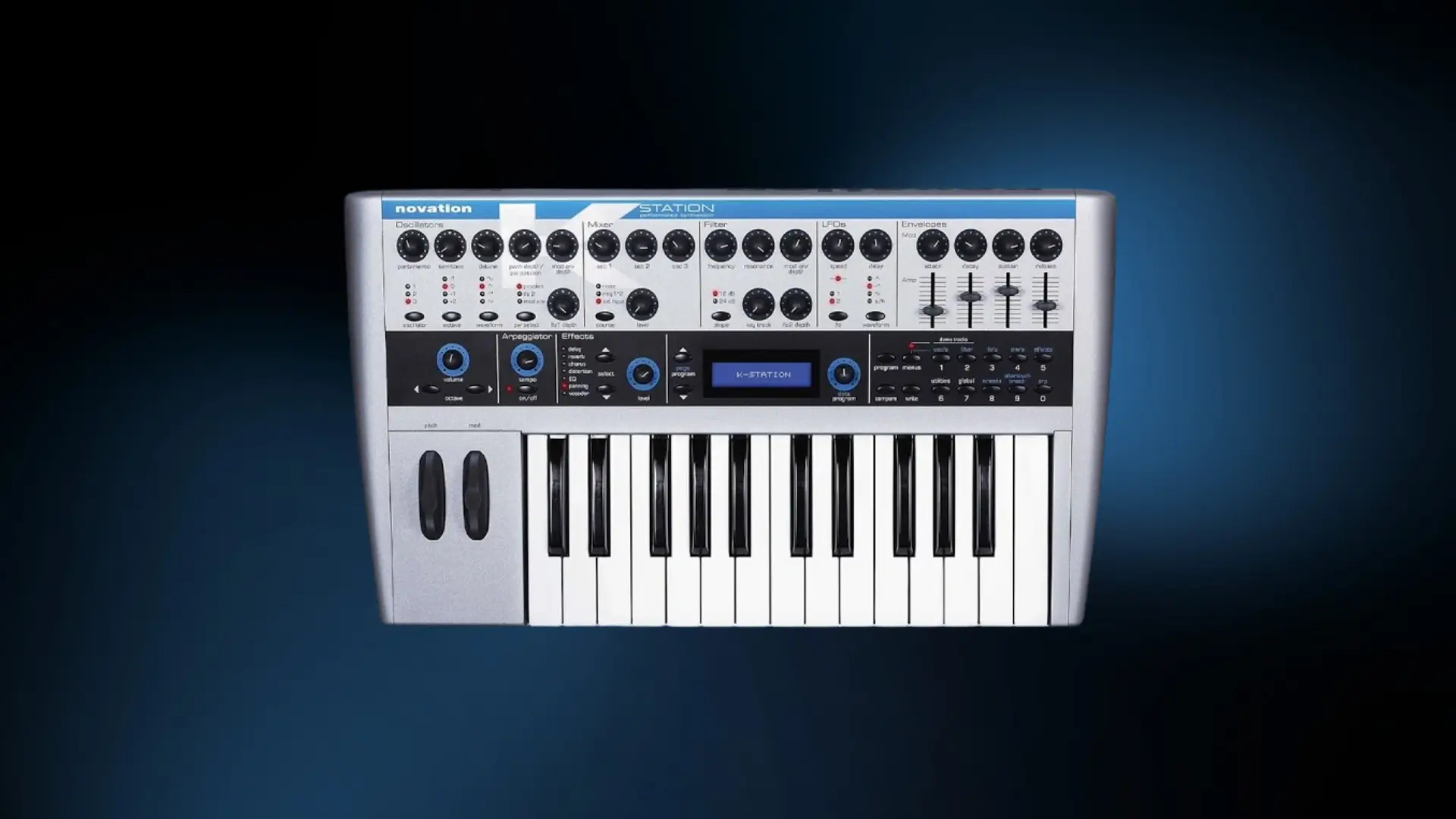
The Novation K-Station is a compact 25-key virtual analog synthesizer that appeared in the early 2000s as a keyboard version of the A-Station module. It condensed an eight-voice, three-oscillator subtractive architecture into a portable performance format, with hands-on controls, onboard effects, an arpeggiator, external audio processing, and a 12-band vocoder. Its importance lies less in brute specification and more in where it sits: between Novation’s Bass Station heritage, the Nova/SuperNova virtual analog era, and the later software world of the V-Station.
Table of Contents
Novation K-Station sound and character
The Novation K-Station sounds like an early-2000s British virtual analog synth: clean, bright, immediate, and deliberately synthetic rather than nostalgically unstable. It does not try to disappear into the illusion of vintage analog circuitry. Its identity comes from digitally modeled subtractive synthesis, fast access to oscillator layering, sync, FM-style metallic edge, ring modulation, onboard effects, and a filter that can move from rounded bass shaping to sharper resonant sweeps.
The three-oscillator design is central to its musical personality. Saw, square, variable pulse, triangle, sine, and doubled waveform options allow it to produce compact leads, trance-era stacks, animated pads, and punchy basses with more density than a small two-octave keyboard suggests. The double saw and double triangle options are particularly important because they let a single oscillator occupy more harmonic space before unison or effects are added.
Its stronger sounds are not subtle acoustic imitations. It is better understood as a direct electronic instrument for basses, arpeggiated patterns, synthetic pads, hard-edged leads, vocoded textures, and moving filter/effects patches. The Novation K-Station can be warm, but its warmth is polished and digital; it can be aggressive, but usually through oscillator sync, FM, ring modulation, overdrive, resonance, and delay rather than through analog saturation alone.
The onboard effects matter because they are part of the instrument’s finished voice. Reverb, delay, chorus/phaser, distortion, panning, EQ/filter processing, and vocoder functions mean that many patches arrive already shaped for a mix or live performance. That is historically revealing: the Novation K-Station belongs to an era when compact hardware synths were expected to sound “record-ready” without requiring a rack of external processors.
Features and architecture
- Manufacturer: Novation Electronic Music Systems.
- Year: early-2000s release context; Sound On Sound reviewed the Novation K-Station in April 2002, and Novation’s manual is copyright 2002.
- Production years: exact production end date not included because I could not verify it confidently from reliable sources.
- Synthesis type: digital virtual analog / analog-modelled subtractive synthesis, with FM-style oscillator interaction and ring modulation.
- Category: compact 25-key virtual analog keyboard synthesizer.
- Polyphony: 8 voices.
- Original price: UK launch-era price signal was around £499 / £500.
- Current market price: used-market evidence is thin; current public listing data suggests roughly low-to-mid hundreds of US dollars when examples appear, but stable price-guide data is limited.
- Oscillators: three oscillators per voice with square, saw, variable pulse, triangle, sine, double saw, double triangle, and double sine waveforms; oscillator sync, ring modulation, and FM between oscillators are available.
- Filter: resonant low-pass filter with selectable 12 dB or 24 dB slopes; resonance can reach self-oscillation in 24 dB mode; overdrive and Q-normalise controls are included.
- LFOs: two LFOs with sample-and-hold, triangle, saw, and square waveforms; speed range from 0 Hz to 1 kHz; internal or MIDI-clock sync.
- Envelopes: amplifier ADSR envelope, modulation ADSR envelope, and a two-stage FM envelope.
- Modulation system: modulation envelope routings, LFO routings, velocity response, pitch/mod wheel control, MIDI aftertouch response from an external source, and breath-control response via MIDI.
- Sequencer / arpeggiator: no onboard sequencer; arpeggiator with six pattern types, adjustable range, gate time, latch, keysync, and MIDI-clock synchronization.
- Effects: reverb, delay, chorus/phaser, distortion, panning, vocoder, and EQ/filter processing.
- Memory: 400 program locations, with 200 factory sounds and 200 additional user memory locations; factory memories can be overwritten and restored.
- Keyboard: two-octave, 25-key velocity-sensitive keyboard with pitch and modulation wheels; the keyboard itself does not generate aftertouch.
- Inputs / outputs: stereo line outputs on two mono 1/4-inch jacks, headphone output, one mono 1/4-inch line-level audio input, and power input.
- MIDI / USB: MIDI In, Out, and Thru; no USB connection is listed in the official interfacing specification.
- Display: LCD-based menu and program display with adjustable contrast and temporary parameter-value display behavior.
- Dimensions / weight: 525 mm wide, 94 mm high, 295 mm deep; 4.0 kg according to the official specification.
- Power: 9V DC, 600 mA external power supply.
Strengths
- The Novation K-Station gives a small keyboard format a real synthesizer architecture rather than treating compactness as an excuse for a preset box. Three oscillators, sync, FM, ring modulation, two LFOs, two ADSR envelopes, and a proper effects section make it far deeper than its footprint implies.
- Its interface is a major part of its value. Compared with rack modules or menu-heavy compact synths, the front panel makes oscillator, filter, envelope, LFO, mixer, arpeggiator, and effects work feel physically connected to performance.
- The sound engine is well suited to electronic genres that need direct, bright, harmonically active timbres: trance-era leads, electro basses, arpeggiated patterns, digital pads, vocoder textures, and compact live parts.
- The external audio input is more than a convenience. It lets outside material pass through the filter, envelopes, and effects, turning the Novation K-Station into a compact processing instrument as well as a keyboard synth.
- The arpeggiator and MIDI-clock-aware effects help the instrument function in groove-based music, where synchronization and repeatable rhythmic movement are often as important as raw oscillator tone.
- Data compatibility with the A-Station strengthens its ecosystem: sounds and settings could move between module and keyboard formats, making it part of a practical Novation family rather than a closed one-off device.
- Its later connection to V-Station gives the hardware an unusual software afterlife, because the Novation K-Station engine became a reference point for a Novation plug-in rather than remaining only a small hardware footnote.
Limitations
- Eight voices are enough for basses, leads, arps, and moderate pads, but layered unison patches reduce available polyphony quickly. At maximum unison, one note can consume the entire voice pool.
- The two-octave keyboard is useful for portability and programming, but it is restrictive for wide two-handed parts, extended chord voicings, and performance styles that depend on a larger playing surface.
- The keyboard transmits velocity but not aftertouch. The engine can respond to incoming MIDI aftertouch, but expressive aftertouch performance requires an external controller.
- There is no onboard sequencer. The arpeggiator is useful, but it does not replace pattern programming or multi-step composition.
- It is monotimbral, so it is not designed to perform several independent synth parts at once from the internal engine.
- There is no USB. Integration with modern DAW setups requires traditional MIDI hardware or a MIDI interface.
- The display and menu system are functional, but the synth still relies on abbreviated parameter access for deeper functions. The front panel is immediate, yet the full architecture is not completely one-knob-per-function.
- The instrument’s sonic identity is unapologetically digital virtual analog. Anyone expecting the softness, drift, and component-level irregularity of a vintage analog polysynth will probably hear it as cleaner and more controlled.
Historical context
The Novation K-Station arrived at a specific moment in Novation’s development. The company had already established itself with the Bass Station and then moved deeper into digital analog modelling through the Nova and SuperNova lines. The A-Station translated part of that virtual analog thinking into a compact rack module, and the Novation K-Station then turned that module concept into a small keyboard instrument.
This matters because the early 2000s were full of competing ideas about what a synthesizer should become. Computer instruments were gaining ground, virtual analog hardware was still culturally powerful, and compact keyboards were beginning to challenge the older expectation that a serious synth had to be physically large. The Novation K-Station sits directly inside that shift. It is not a flagship statement like a SuperNova II, but it shows how Novation tried to make its VA architecture more immediate, portable, and affordable.