

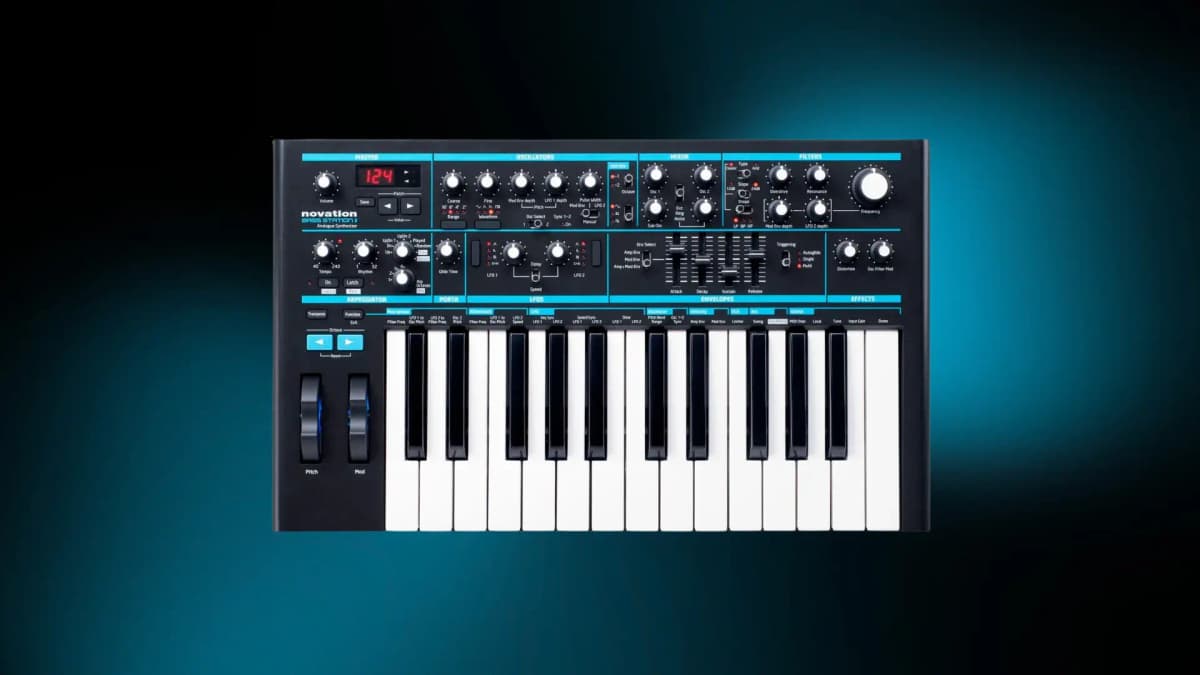
The Novation Bass Station Keyboard is a compact monophonic analogue synthesizer introduced in 1993, built around a two-oscillator subtractive architecture, MIDI control, patch memory, and a two-octave velocity-sensitive keyboard. It mattered because it arrived when affordable new analogue instruments were scarce, second-hand analogue monosynths were becoming desirable again, and electronic musicians needed hands-on bass and acid-style sounds without depending on ageing vintage machines.
Table of Contents
Novation Bass Station Keyboard sound and character
The Novation Bass Station Keyboard sounds direct, slightly unruly, and purpose-built for lines that need to move rather than merely sit underneath a track. Its identity comes from the combination of digitally controlled analogue oscillators, a resonant low-pass filter switchable between 12 dB and 24 dB slopes, and a simple modulation structure that keeps the Novation Bass Station Keyboard focused on bass, lead, and synthetic effects rather than broad workstation versatility.
Its strongest territory is bass with motion: rounded low-end pulses, sharper acid squelches, clipped electronic leads, and resonant filter sweeps that respond well to live tweaking. It does not sound luxurious or polished in the later virtual-analogue sense. Its appeal is more physical and economical: two oscillators, detune, pulse-width movement, envelope-shaped filter motion, portamento, and a panel that invites fast changes while a sequence is running.
The Novation Bass Station Keyboard’s 12 dB filter mode was explicitly associated with TB-303-style behavior in contemporary discussion, while the 24 dB mode gave it a more forceful low-pass sweep. The result is not a pure clone of a 303, a Pro-One, or a Moog monosynth. Its historical value is that it compressed several desirable analogue behaviors into a small, affordable, MIDI-equipped instrument at exactly the moment when dance music producers were rediscovering what hands-on analogue synthesis could do.
Features and architecture
- Manufacturer: Novation Electronic Music Systems.
- Year introduced: 1993.
- Production years: Introduced in 1993; the exact end of production is not confidently verified, so it should be described conservatively as a 1990s legacy model rather than assigned an unsupported production range.
- Synthesis type: Analogue subtractive synthesis with digitally controlled analogue oscillators.
- Category: Compact keyboard monosynth and MIDI controller keyboard.
- Polyphony: Monophonic internal sound engine; the keyboard can transmit polyphonic MIDI data.
- Original price: A September 1994 UK review listed the corrected price as £349.95 including VAT.
- Current market price: No reliable universal price should be claimed; recent observed used-market examples vary by region, condition, and included accessories.
- Oscillators: Two oscillators with square, sawtooth, and continuously variable pulse waveforms; oscillator 2 offers semitone tuning and detune.
- Filter: Resonant low-pass filter with cutoff from 5 Hz to 10 kHz, resonance up to self-oscillation, and switchable 12 dB / 24 dB slope.
- LFOs: One LFO with random, triangle, and sawtooth waveforms.
- Envelopes: Two ADSR envelopes with attack, decay, sustain, release, and velocity sensitivity controls.
- Modulation system: LFO and Envelope 2 modulation for oscillator pitch, pulse width, and filter cutoff; controller wheel assignable to modulation depth, filter cutoff, aftertouch, or MIDI volume.
- Sequencer / arpeggiator: No onboard sequencer or arpeggiator is documented for the original keyboard.
- Effects: No built-in effects are documented in the original keyboard specification.
- Memory: Seven storable sounds plus a manual mode; sounds can be saved and loaded externally via MIDI data storage.
- Keyboard: 25 full-size velocity-sensitive keys, transposable across eight octaves.
- Inputs / outputs: 1/4-inch line output, MIDI In, MIDI Out, external 9V DC input, battery compartment, and external controller grip connector.
- MIDI / USB: MIDI In and MIDI Out; no USB.
- Display: No screen; operation is based on knobs, switches, LEDs, and the memory selector.
- Dimensions / weight: 465 mm wide, 215 mm deep, 55 mm high; less than 2.5 kg.
- Power: Six AA batteries or optional Novation PSU-2 external power supply; the manual states approximately 40 hours of operation on alkaline batteries.
Strengths
- It captured the analogue revival early. The Novation Bass Station Keyboard appeared when used analogue machines were becoming more expensive and culturally desirable, giving producers a new, compact way into analogue bass without depending on unstable vintage hardware.
- Its panel makes synthesis feel immediate. The architecture is simple enough to understand quickly, but the combination of oscillator mix, detune, pulse-width modulation, resonant filtering, velocity response, and portamento gives it more range than its small footprint suggests.
- It works as both instrument and controller. The internal engine is monophonic, but the keyboard can transmit polyphonic MIDI data, which made it useful in small studio setups where one compact keyboard needed to serve more than one role.
- Its sound sits naturally in electronic bass music. The Novation Bass Station Keyboard is well suited to acid-influenced basslines, compact techno sequences, hip-hop low-end figures, and synthetic leads that benefit from filter movement rather than complex layering.
- Its limitations reinforce its identity. The Novation Bass Station Keyboard is not a broad workstation. It is a narrow, tactile analogue tool, and that focus is part of why it remains memorable.
Limitations
- The internal engine is strictly monophonic. It is designed for bass, lead, and effect lines, not chords or layered polyphonic parts.
- Patch memory is very limited. Seven stored sounds plus manual mode is useful, but modest even by mid-1990s standards; external MIDI storage helps but adds workflow friction.
- There is no onboard sequencer or arpeggiator. For acid-style or repeating bassline work, it depends on external sequencing or live playing.
- There are no built-in effects. Its raw tone needs external processing if the production calls for delay, chorus, distortion, or reverb.
- The interface is compact but not deep by later standards. Compared with the Bass Station Rack, Super Bass Station, and Bass Station II, the original keyboard is simpler and more limited in memory, modulation expansion, and system feedback.
- Used units require practical inspection. Because the Novation Bass Station Keyboard can run from AA batteries, the battery compartment should be checked carefully, along with keys, pots, switches, MIDI ports, memory behavior, and line output.
Historical context
The Novation Bass Station Keyboard sits at the beginning of Novation’s synthesizer identity. Novation’s earlier MM10 was a portable MIDI controller for the Yamaha QY10, and the Novation Bass Station Keyboard reused that compact keyboard-controller concept as the basis for a real analogue monosynth. Chris Huggett’s role is central to the story: Novation has stated that the Novation Bass Station Keyboard used the same filter and VCA lineage associated with his earlier Wasp design, giving the small instrument a stronger historical pedigree than its plastic shell might suggest.
Its timing was crucial. In the early 1990s, mainstream keyboard culture was dominated by sample-based workstations and digital instruments, while underground dance music was rediscovering the expressive value of resonant filters, glides, and hands-on analogue control. The Novation Bass Station Keyboard responded to that gap. It did not try to replace the workstation. It gave producers the opposite: a compact, focused analogue voice with MIDI, memory, velocity-sensitive keys, and real-time control.
The product also opened a family line. The Bass Station Rack followed in 1994 with expanded facilities, the Super Bass Station arrived later with a broader architecture, and the Bass Station II eventually returned to the idea in 2013 as a more modern successor. That lineage matters because it shows that the original keyboard was not a one-off curiosity. It became a template Novation kept revisiting whenever the company wanted to reconnect with direct analogue bass synthesis.