

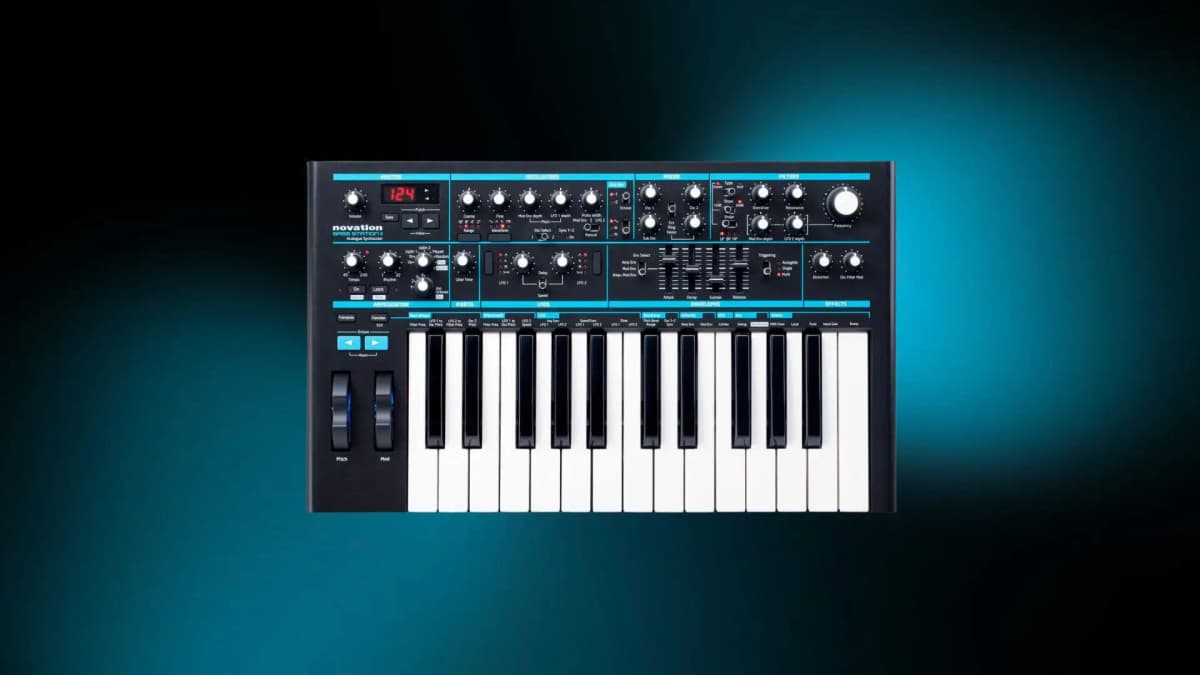
The Novation Bass Station II is a compact digitally controlled analog synthesizer introduced in 2013 as the successor to the original 1993 Bass Station. Built around two DCOs, a sub oscillator, dual filter designs, patch memory, sequencing, arpeggiation, and a 25-key keyboard with aftertouch, it arrived as an affordable analog monosynth at a moment when hardware bass synths were returning to electronic music studios. Its significance is not only that it revived a recognizable Novation lineage, but that it kept expanding through firmware in ways that made a small one-voice instrument feel unusually alive across more than a decade.
Table of Contents
Novation Bass Station II sound and character
The Novation Bass Station II has a sound that is direct, forceful, and slightly unruly. It is not the smoothest analog monosynth of its era, nor does it try to behave like a boutique vintage reissue. Its character comes from the tension between a compact, practical design and a voice architecture that can move from focused bass weight to abrasive leads, acid-like squelch, metallic filter modulation, sync tones, noise-driven percussion, and unstable rhythmic patterns.
Its low end is the obvious starting point. The two main oscillators and sub oscillator give it enough mass for bass lines that sit forward in a mix rather than disappearing under drums. But the Novation Bass Station II is more interesting when treated as a sharp-edged mono voice rather than merely a bass machine. Oscillator sync, ring modulation, external audio through the mixer, pulse-width modulation, and the filter overdrive/distortion structure let it move into harder techno, electro, industrial, acid, and aggressive synth-pop territory.
The two filter characters are central to its identity. The Classic filter is the broader shaping tool, with low-pass, band-pass, and high-pass modes plus slope options. The Acid filter is narrower in purpose but important in attitude: it gives the instrument a more cutting, diode-ladder-like low-pass behavior associated with harder, more resonant bass-line traditions. This dual-filter layout is one reason the Novation Bass Station II feels wider than its price and size suggest. It can be dry and punchy, but it can also become nasal, tearing, buzzy, or percussive.
The later firmware additions changed the perception of the Novation Bass Station II. Paraphonic mode made it possible to play the two oscillators as separately pitched elements within a shared voice path, while AFX Mode turned each key into a potential variation of the patch. That did not make the Novation Bass Station II a polysynth, but it did make it more conceptually flexible than many analog monosynths. A bass keyboard became, in effect, a bass synth, lead synth, drum source, experimental sequencer voice, and patch-performance machine.
Features and architecture
- Manufacturer: Novation.
- Year introduced: 2013.
- Production years: 2013 to present.
- Synthesis type: Digitally controlled analog subtractive synthesis.
- Category: Compact keyboard analog monosynth with paraphonic capability added by firmware.
- Polyphony: One analog voice; paraphonic mode allows the two main oscillators to be played at separate pitches through a shared signal path.
- Original price: Announced with a $629.99 MSRP and a $499.99 expected street price in 2013; UK launch pricing was widely reported around £399.
- Current market price: New units remain available, with current prices commonly appearing around the mid-$500 range in the United States and lower street prices in some European retail contexts. Used examples commonly sit below new price, often around the low-to-mid $300 range depending on condition and region.
- Oscillators: Two digitally controlled analog oscillators plus a sub oscillator; oscillator sync, pulse-width modulation, ring modulation, noise, and external input mixing are part of the voice architecture.
- Filter: Two analog filter styles: Classic state-variable filter with low-pass, band-pass, and high-pass modes plus slope options; Acid low-pass filter with fixed 24 dB/octave behavior.
- LFOs: Two LFOs with dedicated roles; LFO 1 is primarily used for oscillator pitch modulation, while LFO 2 is used for filter modulation and pulse-width modulation.
- Envelopes: Two envelopes, one for amplitude and one for modulation, with later firmware functions including retriggering and fixed-duration envelope behavior.
- Modulation system: Hands-on fixed routing rather than a large open modulation matrix; modulation sources include LFOs, envelopes, velocity, aftertouch, and mod wheel assignments.
- Sequencer / arpeggiator: 32-step sequencer with four memories; arpeggiator with multiple patterns, modes, octave settings, latch, swing, and MIDI clock synchronization.
- Effects: Filter overdrive, distortion, and oscillator filter modulation.
- Memory: 128 patch locations, with 64 factory patches and 64 user patch locations in the original structure; patch management and transfer are supported through Novation Components.
- Keyboard: 25 full-size velocity-sensitive synth-action keys with assignable aftertouch and octave shifting.
- Inputs / outputs: Mono 1/4-inch line output, 1/4-inch external input, 1/4-inch headphone output, sustain pedal input, DC power input, and Kensington security slot.
- MIDI / USB: 5-pin MIDI In and Out, USB-B for MIDI, patch transfer, and power; it does not function as a computer-to-DIN MIDI interface.
- Display: Three-character LED-style display for patch numbers, parameter values, and function feedback.
- Dimensions / weight: 457 mm wide, 273 mm deep, 76 mm high; approximately 2.48 kg.
- Power: USB power or external DC supply; Novation lists maximum consumption as 9V DC 300 mA and supplies a 9V DC power supply.
Strengths
- The Novation Bass Station II offers a strong analog voice at a practical size and price, which is why it became more than a nostalgia product. It gives musicians a dedicated hardware bass and lead instrument without requiring the cost or space of a large monosynth.
- Its two-filter design gives it more tonal range than many compact analog monosynths. The Classic filter covers broader subtractive duties, while the Acid filter pushes the instrument toward sharper, more resonant electronic bass behavior.
- The front panel encourages fast programming. It is not knob-per-function in the absolute sense, but the core oscillator, mixer, filter, envelope, LFO, arp, and sequencer areas are immediate enough to make sound design feel tactile rather than menu-dependent.
- The sequencer and arpeggiator make it useful as a pattern instrument, not just a keyboard synth. This matters because many of its best sounds come alive through repeated motion, accents, filter movement, and rhythmic variation.
- Aftertouch is unusually valuable on a compact synth of this class. Assigned to filter frequency, oscillator pitch, or LFO behavior, it gives bass lines and leads a performance dimension that many budget monosynths lack.
- Firmware support gave the Novation Bass Station II a longer creative life than its original specification suggested. Paraphonic mode, microtuning-related functions, envelope changes, filter tracking, and AFX Mode made the Novation Bass Station II feel like a platform rather than a frozen 2013 product.
- AFX Mode is a genuine creative expansion. By allowing different parameter variations per key, it turns the Novation Bass Station II into a source for analog drum kits, split behaviors, experimental arpeggios, and sound-design gestures that would not normally be expected from a compact monosynth.
Limitations
- It remains a one-voice instrument. Paraphonic mode is useful, but it does not provide independent envelopes, filters, amplifiers, or full polyphonic articulation.
- The 25-key keyboard is portable but restrictive. It is enough for bass lines, leads, and programming, but players who want two-handed performance or wider melodic range will need an external controller.
- The interface has some secondary functions placed behind key commands. That keeps the panel compact, but it also means deeper features are less visually obvious than they would be on a larger instrument.
- There are no lush onboard time-based effects such as delay, chorus, or reverb. The built-in grit tools are part of the analog character, but finished synthwave, ambient, or cinematic patches will usually need external processing.
- The sound is assertive rather than universally polite. In a dense arrangement, its gritty edge can be useful, but it may require careful filtering, gain staging, or external EQ to avoid crowding other midrange elements.
- It is not multitimbral. AFX Mode can create the impression of many sounds mapped across keys, but the Novation Bass Station II is still one shared voice path at a time.
- USB is useful for MIDI and patch work, but the instrument is not a general-purpose MIDI interface between a computer and external DIN MIDI devices.
Historical context
The Novation Bass Station II appeared in 2013, twenty years after Novation’s original Bass Station. That lineage matters. The 1993 Bass Station was an early and important product for Novation, associated with compact analog access at a time when digital instruments and workstations dominated much of the mainstream keyboard market. Its appeal was not that it was luxurious; it was that it made analog bass direct, portable, and affordable.
By 2013, the market had changed again. Analog monosynths were no longer relics from an earlier production culture. They were returning as practical tools for electronic producers who wanted hands-on control, immediate low end, and hardware character in laptop-centered studios. The Novation Bass Station II answered that moment precisely: it was not a museum-grade remake, but a modernized successor with patch memory, USB, MIDI, a sequencer, an arpeggiator, aftertouch, and a voice architecture broad enough for contemporary dance music.
Its timing was also culturally smart. Electronic music in the early 2010s was heavily invested in bass weight, rhythmic sequencing, and sound-design identity. The Novation Bass Station II did not compete by pretending to be a vintage Moog, a 303 clone, or a modular system. It offered a compact British analog voice with its own edges: aggressive, useful, sometimes nasty, and more flexible than its name suggested.