

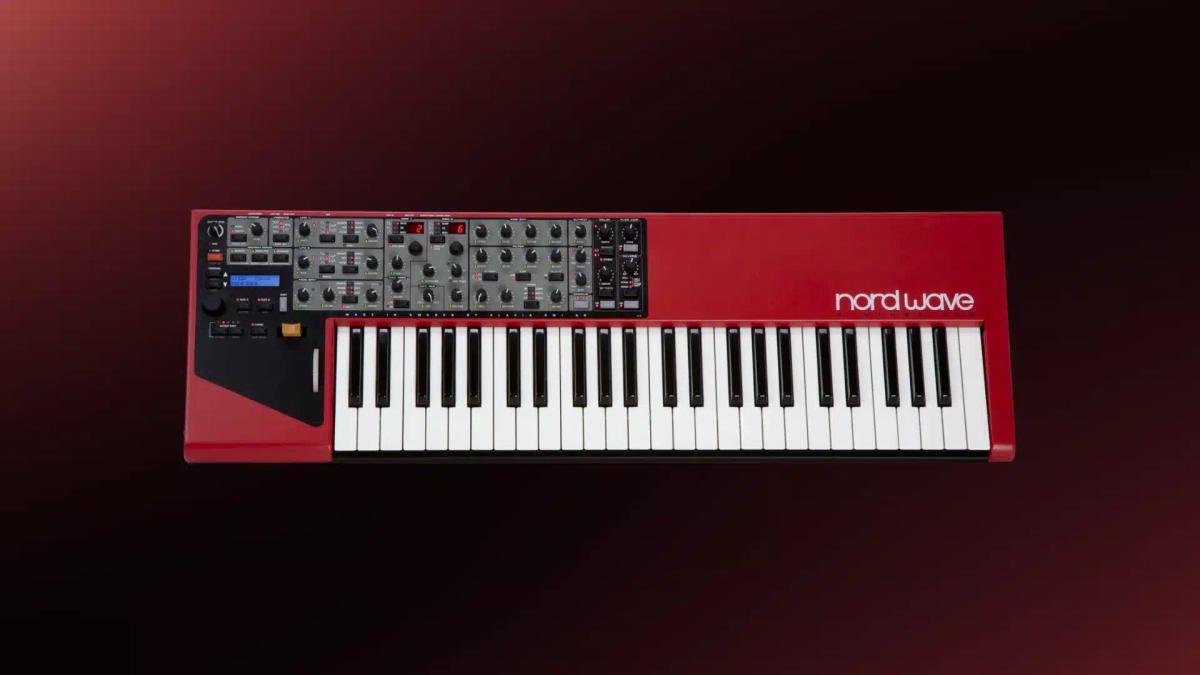
The Nord Wave is a 49-key performance synthesizer that Clavia of Stockholm unveiled at Musikmesse in April 2007 and built until 2013. It took the two-oscillator virtual analog engine of the Nord Lead family and added three new kinds of source: 62 wavetables, FM, and, most importantly, user-loadable samples held in about 180MB of flash memory that survives power-off and needs no loading time. Each patch holds two slots that can be layered or played on separate MIDI channels, with 18 voices shared between them. At a glance, the Wave matters as the hinge in Clavia’s synth line: the point where the red Nord Lead stopped being a pure analog emulation and started borrowing the sample technology of the company’s stage pianos.
Table of Contents
Nord Wave sound and character
The Nord Wave sounds like a Nord Lead first. Its analog waveforms, filters and envelopes come from the same school as the Lead 3, with a clean, bright, slightly glassy character, quick and punchy envelopes, and resonant filters that self-oscillate. Bonedo’s reviewer described the overall result as bright and fat at the same time, and noted that envelopes set very short could click, a sign of how fast they are rather than a defect most players will hear.
What changes the character is oscillator 2. Instead of a second analog-style oscillator only, it can play a multisampled instrument, a set of 22 sampled waves with a natural attack, or one of the analog shapes, while oscillator 1 offers analog waves with sync, the 62 wavetables, FM and noise. Because the sample runs through the full synth path, a Mellotron flute or a Wurlitzer can be filtered, enveloped, morphed and frequency-modulated by oscillator 2 against oscillator 1, which gives the Wave its typical sound: recognisable acoustic or electromechanical sources with a synthesizer’s movement on top. Sound On Sound’s Paul Nagle singled out the Mellotron samples, and both MusicRadar and Bonedo heard little obvious aliasing in the wavetables and samples.
The filter section widens the palette further. Six types, each available at 12dB or 24dB per octave, include low-pass, high-pass and band-pass shapes as well as a comb filter, a multi-peak filter and a vowel-style vocal filter, so the Nord Wave can move from round analog basses to nasal, formant-heavy pads without changing engine. The per-slot chorus, which Nagle compared favourably to a Roland Juno-6, does a lot of the work on pads.
Its limits are as clear as its strengths. Eighteen voices disappear quickly when both slots are layered with long releases, and the Wave is not built for dense multitimbral sequencing or deep sound design. It sits firmly in the modern digital camp: polished, controlled and immediate, more stage instrument than studio laboratory.
Features and architecture
- Manufacturer: Clavia DMI AB, Stockholm, Sweden, under the Nord brand
- Year introduced: 2007; shown as a working prototype at Musikmesse in April 2007, with reviews and wide availability following around the turn of 2008
- Production years: 2007 to 2013, according to Nord’s legacy product page
- Synthesis type: virtual analog subtractive combined with wavetable, FM and sample playback oscillators
- Category: 49-key performance synthesizer
- Polyphony: 18 voices, shared between the two slots
- Multitimbrality: 2 parts (slots A and B), layered across the full keyboard or played on separate MIDI channels; no keyboard split
- Original price: £1,395 in the UK and a US list price of $2,999, as reported by MusicRadar and Sound On Sound; Bonedo listed a German street price of €1,999
- Current market price: Equipboard’s tracking of Reverb listings showed an average around $899 in September 2026; older figures from Spectrasonics and owner forums put it nearer $1,400 to $1,500
- Oscillators: 2 per voice; OSC1 offers triangle, square and saw (with sync), 62 wavetables, FM and noise; OSC2 offers triangle, square, saw, FM, 22 sampled waves and up to 99 user-defined sampled instruments; oscillator 2 can frequency- or phase-modulate oscillator 1. Nord’s specifications describe the FM as 3-operator, while Sound On Sound counted 19 algorithms
- Sampling: no recording; samples are prepared on a computer and transferred over USB
- Sample memory: 189MB of flash, with 180MB available for user samples; Clavia’s lossless compression stretched that capacity further
- Filter: 6 types including low-pass, high-pass, band-pass, comb, multi-peak and vocal, each switchable between 12dB and 24dB per octave, with resonance, keyboard tracking and envelope amount
- LFOs: 2, each with square, saw (or inverted saw), triangle, random and soft random waves
- Envelopes: ADSR for the filter and the amplifier, plus a modulation envelope selectable as AD or AR
- Modulation system: Morph with three sources (mod wheel or control pedal, keyboard position, velocity) driving multiple panel parameters; aftertouch limited to vibrato
- Voice modes: poly, mono and legato, with glide; chord memory
- Sequencer / arpeggiator: none
- Effects: per-slot chorus (3 intensities) and fixed 2-band EQ; global tube-style overdrive, mono or stereo delay with tap tempo, and reverb with 5 algorithms
- Memory: 1,024 program locations in eight banks of 128
- Keyboard: 49 keys (4 octaves), velocity and aftertouch; wooden pitch stick and modulation wheel
- Inputs / outputs: 2 unbalanced line outputs, headphone output, sustain pedal and control pedal inputs; no audio input
- MIDI / USB: MIDI In and Out (no Thru); USB Type B for sample and program transfer
- Display: small LCD with value dial
- Software: Nord Wave Manager for building multisampled instruments (up to 91 zones) and managing the flash memory; later handled by Nord Sound Manager
- Dimensions / weight: 870 x 274 x 98 mm; 6 kg (13.3 lb)
- Power: internal power supply with IEC C7 connector
Strengths
- It put samples and synthesis in one fast instrument. A gigging keyboardist could carry a Mellotron, an electric piano and a VA lead in a 6kg case, a combination Sound On Sound considered in a league of its own at the time.
- Samples run through the whole synth path. Filtering, morphing and frequency-modulating a sampled source against a synth oscillator produces hybrids that a plain sample player cannot.
- Flash memory means no load times. Sounds survive power-off and are available the moment the instrument boots, a practical advantage over sample-RAM designs of the period.
- The panel follows the one-knob, one-function logic that made the Nord Lead popular, so editing on stage rarely involves menus.
- The filter selection is broader than on earlier Leads. Comb, multi-peak and vocal types give the Nord Wave a distinctive vocabulary for pads and textures.
- It was well built and portable. Reviewers praised the metal case, the light weight and the keyboard feel, and Nord’s legacy page lists 2009 MIPA and Future Music Platinum awards.
Limitations
- Eighteen voices is modest, and layering both slots with long releases exhausts it quickly.
- There is no keyboard split, so the two slots can only be layered or addressed over MIDI, a real constraint on a 49-key performance instrument.
- Only 99 sampled instruments can be loaded at once, regardless of how much flash memory is free, a cap both Sound On Sound and Vintage Synth Explorer flagged.
- There is no arpeggiator and no MIDI sync for the LFOs or the delay, which limits its use in tempo-locked electronic music.
- Aftertouch can only control vibrato and is not a Morph source, and the modulation destinations are few by the standards of its rivals.
- The knobs are ordinary potentiometers without LED rings or a catch mode, so parameter values jump after a program change; MusicRadar missed the LED rings of the Lead 3.
- Connectivity is thin: unbalanced outputs only, no audio input, no digital output and no MIDI Thru.
Historical context
By the mid-2000s Clavia had two businesses that barely touched each other. The Nord Lead, launched in 1995 and developed through the Lead 2 and the Lead 3, had made the company’s name in virtual analog synthesis, while the Nord Electro and Nord Stage had moved it into sample-based stage pianos and organs. The Nord Lead 3 was the flagship synth, with LED-ringed encoders, but its synthesis remained purely modelled.
The Wave was announced as a replacement for the Lead 3. CDM’s Peter Kirn reported Clavia’s Musikmesse preview on April 2, 2007, and Sonicstate followed with details from the Frankfurt show, where Clavia stressed that the unit was a fully working prototype and described it as the next generation of Nord Lead synthesizers. The preview was conceptual in places: early reports mentioned just 2MB of user sample memory, while the shipping instrument offered 180MB of flash. MusicRadar’s review appeared in January 2008, in step with Future Music issue 196, and Sound On Sound’s review followed in May 2008.