

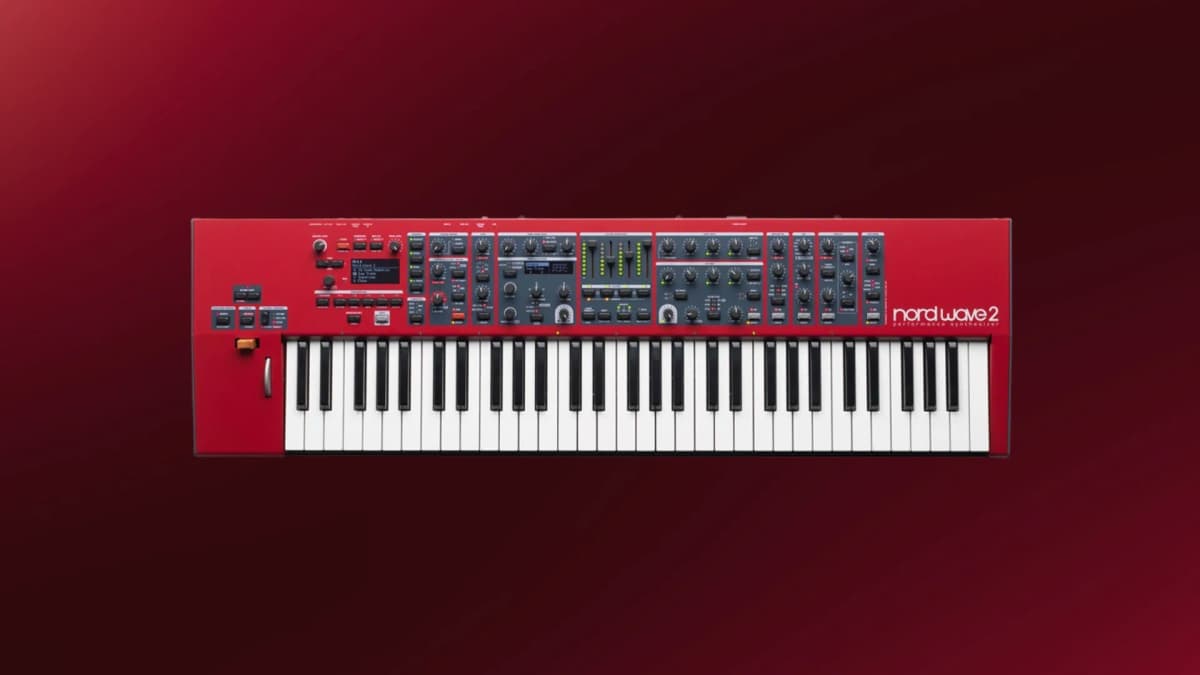
The Nord Wave 2 is a 48-voice, four-layer digital synthesizer from Clavia, announced at NAMM in January 2020 and shipping from April of that year. Each of its layers can run virtual analog, wavetable, FM, or sample-playback oscillators, with its own filter, envelopes, arpeggiator, and full effects chain, all under a 61-key semi-weighted keyboard with aftertouch. It took the place of the Nord Lead 4 in the company’s line and, six years on, is still described as the current flagship of Nord’s synth range. What makes it meaningful is the way it packages four complete synths into one fast, knob-per-function instrument built for the stage.
Table of Contents
Sound and character
The Nord Wave 2 sounds clean, confident, and finished. It chases neither vintage analog grit nor the spectral motion of modern wavetable flagships. Its strength is producing usable, well-balanced sounds quickly, and Sound On Sound’s reviewer summed up the result as a synth “capable of turning out a constant stream of classy and very usable sounds with astonishing ease.”
The Analog oscillator section is the heart of that character. Rather than exposing several oscillators with separate controls, Clavia grouped waveform behaviors into categories such as Basic, Shape, Sync, Multi, and Bell, where a single Shape, Detune, or Sync control does most of the work. Some categories mimic the sound of multi-oscillator stacks, and a three-setting unison mode thickens the result without consuming extra polyphony. The outcome is bright, defined leads, solid basses, and pads that sit well in a band mix.
The other engines widen the palette more than they deepen it. The wavetable section offers a fixed set of static waveforms with no interpolation between them, which places it closer in spirit to late-1980s digital-wave instruments than to a modern morphing wavetable synth; any sense of motion has to come from the filter, envelopes, and effects. The FM engine is deliberately simplified, with two to four operators across ten algorithms and only one modulator with variable ratio, plus harmonic and inharmonic options; Sound On Sound found it far easier to use than conventional FM.
The sample engine is where the Nord Wave 2 most clearly diverges from earlier Nord synths. With 1GB of memory for the Nord Sample Library, including Mellotron and Chamberlin sources, strings, choirs, and guitars, it can layer acoustic and tape-replay textures under synthetic tones. Playback is simple, without velocity switching or round-robin, but reviewers found the library sounds plausible and playable in practice. The six-mode filter, including a transistor-ladder emulation labeled Ladder M, and the generous per-layer effects give the Nord Wave 2 its polished, stage-ready finish.
Features and architecture
- Manufacturer: Clavia DMI (Nord), Sweden
- Year introduced: announced January 2020 at NAMM; shipping from April 2020
- Production years: 2020 to present; still presented as Nord’s current synth flagship in 2026
- Synthesis type: digital, with virtual analog, wavetable, FM, and sample-playback oscillators
- Category: four-layer polyphonic performance synthesizer
- Polyphony: 48 voices, shared across four layers
- Original price: £2,149 UK RRP at the 2020 launch, with $2,699 and £2,069 quoted in Sound On Sound’s 2020 review; $2,999 or £2,199 by 2026
- Oscillators: one oscillator section per layer, selectable among Analog (Basic, Shape, Shape Sine, Multi, Sync, Bell, Noise), Wavetable (wavetables and formants), FM (Dual, Triple, Vocal, Multi, with harmonic and inharmonic options), and Samples; unison with three settings; pitch range of plus or minus 24 semitones
- Filter: per-layer multimode filter with 12dB and 24dB low-pass, band-pass, high-pass, Ladder M, and combined low-pass/high-pass modes; keyboard tracking, velocity-controlled envelope amount, and adjustable filter distortion
- LFOs: one dedicated LFO per layer, running globally rather than per voice, with triangle, square, sawtooth, inverted sawtooth, and sample and hold waveforms, syncable to the Master Clock; separate vibrato with delay modes
- Envelopes: ADSR for filter and amplifier, an AD/AR modulation envelope, and a transient attack mode for the amplifier
- Modulation system: Nord Morph assignments from mod wheel, aftertouch, velocity, and control pedal; Impulse Morph for momentary parameter changes; layer grouping to share filter, envelope, LFO, arpeggiator, and effect settings
- Sequencer / arpeggiator: per-layer arpeggiator with up to four octaves, Poly mode for chord inversions, a rhythmic Gate mode, and a Pattern mode with editable step patterns
- Effects: per-layer modulation and drive effects (including tremolo, pan, ring modulation, chorus, ensemble, vibe, and tube-style drive), EQ, delay with tap tempo and ping-pong, and reverb from Booth to Cathedral; up to 16 effects running at once
- Memory: 400 program locations in 16 banks of 25, plus 1GB of sample memory
- Keyboard: 61 semi-weighted keys with aftertouch; three split points with crossfade
- Inputs / outputs: two unbalanced 1/4-inch line outputs, stereo headphone output, sustain pedal and control pedal inputs
- MIDI / USB: 5-pin MIDI In and Out, USB with MIDI; global and per-layer MIDI channels
- Display: two OLED displays, one for programs and one dedicated to oscillator settings; LED faders for each layer
- Dimensions / weight: 990 × 100 × 295 mm, 8.75 kg
- Power: mains power via an IEC inlet
Strengths
- Four genuinely independent layers. Each layer carries its own oscillator, filter, envelopes, arpeggiator, and complete effects chain, so splits and stacks do not compete for a shared effects bus or a single arpeggiator.
- Four synthesis methods under one consistent interface. Virtual analog, wavetable, FM, and samples share the same filter, envelope, and effects logic, which lets a player move between them without learning four different instruments.
- Speed of programming. With one knob per function and minimal menu diving, sounds can be built and adjusted live.
- A strong keyboard for a synth. The five-octave semi-weighted action with well-implemented aftertouch was a clear step up from the four-octave keybeds of earlier Nord synths.
- Effects that are part of the Nord Wave 2. Per-layer drive, modulation, delay, and reverb make a complete, mix-ready sound possible from a single program.
- Useful as a hub. Layers can transmit on their own MIDI channels, making it workable as a basic master keyboard.
Limitations
- The synthesis architecture is shallow by flagship standards. There is one oscillator section per layer, a single LFO per layer that runs globally rather than per voice, and no deep modulation matrix, so ambitious sound designers may find it limiting.
- The wavetables are preset and static, with no interpolation between waves, which rules out the evolving timbres that modern wavetable instruments are known for.
- Sample playback is basic. There is no velocity switching or round-robin, and sample start and loop points cannot be edited from the front panel.
- Program changes are not seamless. Switching programs cuts sounding notes, which can matter in live sets with sustained transitions.
- Split points are constrained to fixed positions rather than any key.
- At around $3,000 new, it is a significant investment whose value depends on whether a player actually needs its layered, multi-engine workflow.
Historical context
The Wave 2 belongs to a lineage that begins with the original Nord Lead, the virtual analog synth that gave Clavia its reputation for immediate, performance-first hardware. The Lead family continued through the Lead 4 and the Lead A1, while a parallel line began with the original Nord Wave, unveiled at Frankfurt Musikmesse in 2007, reviewed by Sound On Sound in 2008, and produced until 2013 according to the magazine. That first Wave was an 18-voice, bitimbral, four-octave synth whose novelty was a sample-based second oscillator, drawing on 180MB of flash sample memory, working alongside more conventional virtual analog sources.
The Nord Wave 2 merges those threads. It keeps the immediacy of the Lead line, inherits and greatly expands the sample idea of the original Wave, and adds the Nord Sample Library already used across the company’s stage pianos. Sound On Sound described it as a natural development of the Lead family and noted that it replaced the Lead 4 in Nord’s range. It also moved from the four-octave keyboards of earlier Nord synths to five octaves, and from two parts to four, a shift suited to the central synth in a live rig that must cover pads, leads, basses, and textures within one song.
The timing mattered in another way. By 2020, hybrids combining subtractive synthesis with sample playback, such as the Sequential Prophet X and Waldorf Quantum, occupied the top of the market; Sound On Sound noted that they cost more and offered far less polyphony. Nord’s answer was not deeper synthesis but broader coverage and faster access.