

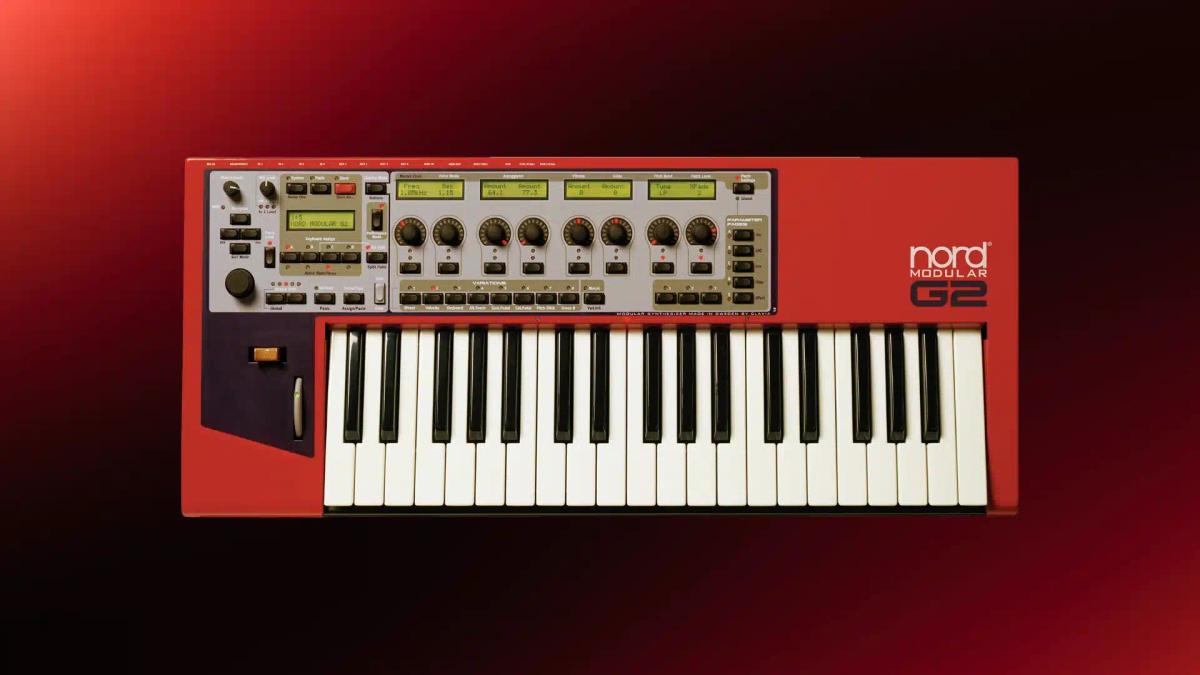
The Nord Modular G2 is a DSP-based virtual modular synthesizer that Clavia released in 2004 as the successor to the original Nord Modular. Patches are built in a computer editor from more than 150 software modules and then run entirely on the instrument’s own DSPs, with up to 32 voices across four multitimbral slots. The Nord Modular G2 keyboard has 37 keys with velocity and aftertouch, eight LED-ringed encoders, a row of small displays, four audio inputs, a microphone input, and built-in reverb and delay modules. It came in three forms, the Nord Modular G2, the five-octave G2X, and the rackmount G2 Engine, and it marks the point at which Clavia’s modular became a real performance instrument rather than a box that depended on its editor.
Table of Contents
Nord Modular G2 sound and character
Like its predecessor, the Nord Modular G2 has no fixed sound, but it does have a recognizable sonic signature. It runs at 96kHz with 24-bit converters, and Bonedo describes those converters as neutral, in contrast to the gritty, colored converters of the first generation. The result is cleaner and more hi-fi; Wikipedia notes that some users still prefer the original’s filters for their grit, and opinions on which generation sounds better remain divided. Bonedo’s author counted the Nord Modular G2 among the best virtual analog synths, capable of warm, full results, but stressed that the warmth has to be programmed in, as nothing about the G2 is preset.
What sets it apart from the first Nord Modular is the range of material beyond subtractive synthesis. A string oscillator based on Karplus-Strong delay-line modeling handles plucked and struck sounds, FM operators and a DX router arrived in the July 2004 update, and later modules added random generators, pitch shifting, and a scratch effect. The built-in reverb, which Paul Nagle measured at up to 17 seconds and longer, and delays of up to 2.7 seconds mean that a patch can be finished inside the instrument instead of relying on an external effects rack.
The four audio inputs and the microphone input change its role again. External sounds can be filtered, vocoded, granulated, or used to excite the string models, so the Nord Modular G2 can work as an effects processor as well as a synth. Its weakness is shared with all DSP modulars: elaborate patches eat processing power, polyphony falls quickly, and Bonedo found that very deep FM turns into digital noise. It sits in the clean, modern, laboratory corner of synthesis, where its character depends mostly on the person programming it.
Features and architecture
- Manufacturer: Clavia DMI AB, Stockholm, Sweden (Nord brand)
- Year introduced: 2004; Sound On Sound reviewed the Nord Modular G2 in July 2004, while Bonedo dates the line to 2003
- Production years: 2004 to 2009 according to Wikipedia, Bonedo, and Reverb’s catalog; Nord’s legacy page gives 2004 to 2007
- Synthesis type: DSP-based virtual modular (virtual analog, FM, physical modeling, and signal processing)
- Category: software-configured modular synthesizer with keyboard; variants are the G2X keyboard and the G2 Engine rack
- Polyphony: up to 32 voices for a simple patch, but Nagle typically obtained 8 to 10; the Voice Expansion board doubles DSP power and is standard on the G2X
- Multitimbrality: four slots (A to D), each a complete synth on its own MIDI channel, with an internal four-channel audio bus between them
- Original price: £1,595 in the UK for the Nord Modular G2, £795 for the G2 Engine, and £295 for the Voice Expansion; Synthtopia reported an approximate US price of $3,500 for the G2X
- Current market price: Reverb listings for the keyboard have run from about $1,985 to $2,500, with Equipboard showing $1,995 in October 2026
- Oscillators: software modules including virtual analog oscillators, noise and metallic noise, FM operators, and a Karplus-Strong string oscillator; no sample-based oscillators
- Filter: multiple modeled filter modules, including classic low-pass types, multimode filters, comb and wah-wah filters, filterbanks, and a vocoder
- LFOs: as many as the DSP budget allows, plus a built-in vibrato LFO in the patch settings
- Envelopes: multiple envelope module types, limited only by DSP resources
- Modulation system: free virtual patching with logic, sequencer, and random modules; eight morph groups, each moving up to 25 parameters; eight variations per patch
- Sequencer / arpeggiator: built-in arpeggiator in the patch settings plus control sequencer and MIDI output modules that can drive external gear
- Effects: modules for reverb, delays, chorus, phaser, flanger, frequency shifter, compressor, digitizer, pitch shifter, and scratch
- Memory: 6MB file system with 32 banks of 128 patch locations (about 1,200 practical, according to the manual) and 1,024 performances
- Keyboard: 37 keys (three octaves) with velocity, release velocity, and channel aftertouch; octave shift of two octaves either way; the G2X has 61 semi-weighted keys
- Controllers: eight endless encoders with LED rings and buttons, page and slot buttons, morph and variation buttons, pitch stick, mod wheel (three LED-lit wheels on the G2X)
- Inputs / outputs: four line inputs, XLR microphone input with preamp, four line outputs, headphone output, sustain and control pedal inputs
- MIDI / USB: MIDI In, Out, and Thru; USB 1.1 for the editor
- Display: a row of small two-line LCDs above the encoders (Sound On Sound counted five, Nord’s specification lists four)
- Dimensions / weight: G2 665 x 284 x 104 mm and 5.1 kg; G2X 1,007 x 294 x 104 mm and 8.2 kg; G2 Engine 1U rack and 1.9 kg
- Power: internal power supply
Strengths
- The hardware makes the modular playable. Up to 120 parameters can be mapped to the encoders and buttons, and the LED rings show values instantly, so a patch can be performed without the computer.
- Its range is unusually broad. Subtractive, FM, physical modeling, vocoding, sequencing, and effects can all live in one patch.
- Audio inputs and a microphone preamp turn it into a processor for external sound, something the first Nord Modular could only do in limited form.
- Variations and morph groups give it real stage flexibility, with eight parameter snapshots per patch that switch faster than loading a new program.
- Everything runs on the instrument’s own DSPs, so patches stay stable and independent of a computer’s processor once they are loaded.
- A large patch culture surrounds it, with community archives of thousands of patches, including conversions of first-generation and Yamaha DX7 sounds.
Limitations
- Polyphony shrinks quickly as patches grow, and Nagle found complex patches with effects could fall to about three voices on an unexpanded unit.
- Building or rewiring patches still requires the editor, which was designed for Windows XP-era and early OS X computers and can be fragile on current systems.
- Patches from the original Nord Modular cannot be loaded, so first-generation libraries had to be rebuilt by hand.
- Bonedo criticized the 7-bit knob resolution, which steps audibly on parameters such as coarse tuning and filter cutoff.
- There is no sample memory, and switching slots triggers a recalculation of about half a second during which the instrument is silent.
- The standard G2’s keyboard is lighter than the G2X’s, and some owners on the electro-music forum described it as feeling cheaper.
Historical context
The first Nord Modular, introduced in 1997 and covered separately on this site, had shown that a modular synth could be polyphonic, recallable, and portable, but its 18 unlabeled knobs, single display, and reliance on the editor made it hard to perform with. Its sequencing was confined to internal parameters, and many users considered that its main limitation. By the early 2000s Clavia had also designed the Nord Lead 3, whose LED-ringed encoders offered a clearer way to control deep parameters. The Nord Modular G2 brought those ideas together on more powerful DSP hardware.
Sound On Sound’s July 2004 review by Paul Nagle covered the Nord Modular G2 keyboard and G2 Engine and called the new design a logical progression rather than a revolutionary creation, but also a dream come true for adventurous sound designers and performers who wanted to leave the laptop at home. Clavia moved fast with software: the 1.20 update announced in July 2004 added Mac OS X support, FM operators, random modules, a pitch shifter, and support for the new G2X. Bengt Lilja presented G2 serial number 001 to Derek Sherinian in 2004 in recognition of his use of the company’s instruments.
The Nord Modular G2 never became a commercial hit, as Bonedo put it, despite strong reviews. It was expensive, its depth demanded time at a computer, and by the late 2000s native software modulars were improving quickly. Clavia ended the series in 2009, closing its modular line and concentrating on stage keyboards and the Nord Lead and Wave synths.