

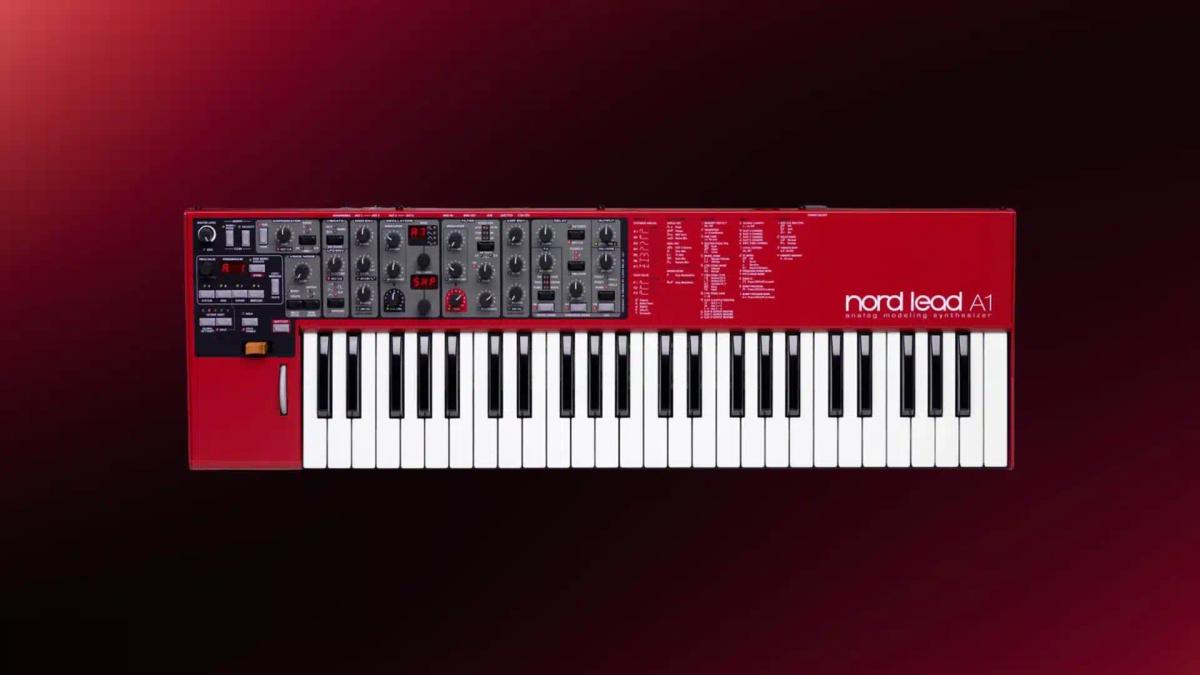
The Nord Lead A1 is a 49-key, four-part virtual analog synthesizer that Clavia announced in March 2014, ahead of that year’s Musikmesse, and still lists among its products. Rather than extending the Nord Lead 4, it took a different route: a new analog modeling engine built around a single oscillator section with 47 waveforms and eight configuration shortcuts, simplified three-stage envelopes, a pre-programmed modulation scheme and a Like function that keeps up to 50 versions of a sound in progress. Clavia’s slogan, “The Lead for Speed”, described the intent. At a glance, the Nord Lead A1 matters as the Nord Lead that traded depth for immediacy, and as the Lead that outlasted the Lead 4 in Nord’s catalog.
Table of Contents
Nord Lead A1 sound and character
The Nord Lead A1 sounds like a Nord Lead, which is to say clean, bright and articulate, with a quick response that suits stabs, plucks and basslines. Gordon Reid, reviewing it for Sound On Sound in June 2015, judged the engine at least as good as those of earlier Nord Leads. MusicTech’s Andy Jones went further, calling it one of the most creative synths he had come across, largely because of how quickly the oscillator configurations reach usable sounds.
The oscillator section explains its character. The player picks one of 47 waveforms, from analog shapes to digital harmonic and inharmonic spectra, then chooses a configuration such as detuned dual oscillators, hard sync, sub mix, FM, AM or noise, and shapes it with an Adjust control. Behind each shortcut, the A1 sets up the oscillator and modulation relationships that would take several steps on a conventional synth. The result is a palette that leans toward classic and slightly digital tones: detuned saws, sync leads, metallic FM bells and ring-modulated textures.
The filter section offers 12dB and 24dB low-pass, high-pass and band-pass modes plus two ladder emulations modeled on the Minimoog and the Roland TB-303, with a drive control. Reid noted a range of 14Hz to 35kHz and the loss of the Lead 4’s 48dB low-pass. The effects are where the Nord Lead A1 gains most over earlier Leads: chorus and ensemble models inspired by ARP and Solina string machines, plus ring modulation, phaser, flanger and overdrive, with delay and reverb that can run together.
Its limits come from the same simplification. Three-stage envelopes, one main LFO and preset modulation routings mean that very complex or unusual sounds are hard to build. Reid called it a super little synthesizer, but not one for extreme or off-the-wall sounds. It sits in the modern, clean digital camp, closer to a fast performance tool than to a sound-design workstation.
Features and architecture
- Manufacturer: Clavia DMI AB, Stockholm, Sweden, under the Nord brand
- Year introduced: 2014; announced in March 2014 for Musikmesse, with availability planned for early April (Wikipedia instead places the announcement at NAMM 2014)
- Production years: 2014 to present; Nord still lists the Nord Lead A1 and released operating system 1.36 in September 2024
- Synthesis type: virtual analog subtractive (analog modeling) with FM and AM oscillator configurations
- Category: 49-key performance synthesizer
- Polyphony: 24 voices according to the launch announcements and US dealers; Sound On Sound and Wikipedia give 26
- Multitimbrality: 4 parts (slots A to D), each with its own MIDI channel and assignable output; split and layer, with Multi Focus to edit several slots together
- Original price: £1,249 at launch according to MusicTech and €1,459 according to Bonedo; Sound On Sound listed £1,099 and $1,799 in 2015
- Current market price: about $2,199 new at major US dealers in October 2026, against a list price of $3,099 shown by Full Compass; Thomann has listed it near $1,399
- Oscillators: one oscillator section per voice with 47 waveforms and eight configuration shortcuts (including detuned dual oscillators, hard sync, sub mix, FM, AM and noise), shaped by an Adjust control
- Filter: 12dB and 24dB low-pass, high-pass and band-pass, plus Minimoog-style and TB-303-style ladder emulations; drive control; range of 14Hz to 35kHz
- LFOs: one syncable LFO with five waveforms, plus a dedicated vibrato and delayed vibrato
- Envelopes: three-stage modulation envelope and amplifier envelope, each switchable between ADR and ASR; times up to 45 seconds
- Modulation system: pre-programmed modulation routings; Morph with up to 22 parameters per program from mod wheel, control pedal and velocity; Impulse Morph from the Lead 4 was removed
- Sequencer / arpeggiator: four arpeggiators, one per slot, with up, down, up/down and random modes over four octaves; hold function
- Effects: per slot ensemble and chorus models, ring modulation, phaser, flanger or drive; delay and reverb; master clock with tap tempo syncs LFO, arpeggiator and delay
- Memory: 400 programs (8 banks of 50) and 200 Performances (4 banks of 50)
- Programming aids: Like function with 50 temporary memories for edits in progress; Mutator for generating variations
- Keyboard: 49 velocity-sensitive Fatar keys, unweighted, no aftertouch; wooden pitch stick and modulation wheel; octave shift of plus or minus two octaves
- Inputs / outputs: 4 unbalanced line outputs, stereo headphone output, sustain pedal and TRS control pedal inputs
- MIDI / USB: MIDI In and Out on 5-pin DIN; USB MIDI (no audio over USB); all knobs transmit MIDI control data
- Display: three-character LED display, with no screen for program names
- Software: Nord Sound Manager for Mac and Windows
- Dimensions / weight: 864 x 272 x 94 mm according to Full Compass (Sound On Sound’s caption gives 800 x 260 x 90 mm); published weight figures are not consistently documented
- Power: internal power supply with IEC mains input
Strengths
- It is fast to program. Oscillator configuration shortcuts, simplified envelopes and preset modulation routings let players reach a finished sound in seconds, which was the point of the design.
- The Like function encourages experimentation. Storing up to 50 temporary versions of a sound means a promising edit is never lost while tweaking continues.
- Four slots, splits, layers and four separate outputs make it a genuine multitimbral instrument, with an arpeggiator for every slot.
- The effects section is a real upgrade over earlier Nord Leads, with ensemble and chorus models that suit string-machine pads and vintage polysynth textures.
- Master clock sync with tap tempo ties the LFO, arpeggiators and delay together, useful for live electronic sets even without an external clock.
- It has proven durable in the market. More than a decade after launch it remains in Nord’s catalog and still receives operating system updates.
Limitations
- The simplified architecture limits deep sound design. One main LFO, three-stage envelopes and fixed modulation routings rule out many complex patches.
- There is no aftertouch, a frequent criticism of Nord’s 49-key synths.
- The three-character LED display cannot show program names, so navigating 400 programs relies on memory, written lists or Nord Sound Manager.
- USB carries MIDI only, with no audio interface, and there is no audio input.
- Some Lead 4 features are absent, including Impulse Morph and the 48dB low-pass filter.
- The unconventional controls take time to learn for players used to traditional two-oscillator layouts, as Sound On Sound noted.
- New pricing has risen sharply in the United States, and around $2,199 is a high price for a 49-key virtual analog synth.
Historical context
When the Nord Lead A1 appeared, Nord’s synth line was headed by the Lead 4, launched in 2013 as a deep, performance-focused virtual analog. Clavia wanted a model that would bring the Lead line to a wider range of players, and Wikipedia records that aim as making the Lead more accessible while speeding up sound design. Rather than strip down the Lead 4, Clavia developed a new modeling engine and a new front panel around it.
Bonedo reported the announcement on 13 March 2014, with prices of €1,459 for the A1 and €1,259 for the A1R desktop and rack version, which shares the engine without keyboard, pitch stick or mod wheel and is not covered here. Age of Audio described the four parts, 47 waveforms and configuration shortcuts on 14 March, and availability was planned for early April. MusicTech reviewed it in June 2014 and Sound On Sound a year later; Reid quoted Clavia co-founder Hans Nordelius as saying that the Nord Lead A1 was a good replacement for the Nord Lead 2 and that the company was very satisfied with it.