

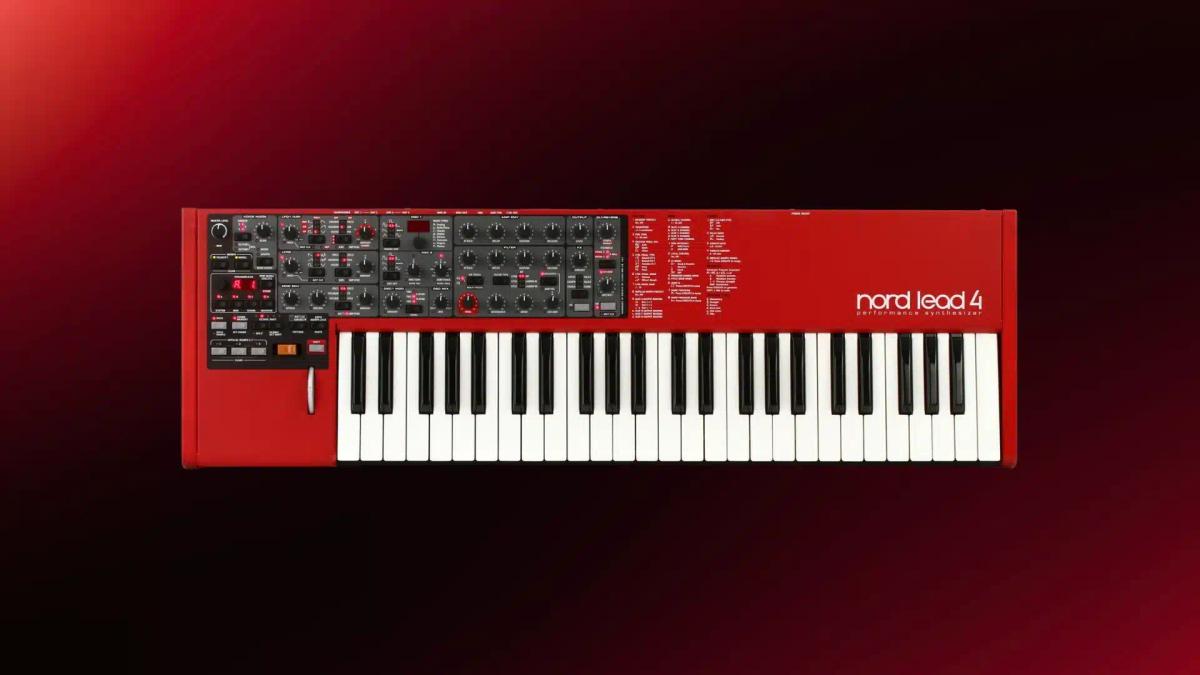
The Nord Lead 4 is a 49-key virtual analog synthesizer that Clavia announced at Musikmesse in April 2013 and built until 2020. It was the first new keyboard in the Nord Lead line since the Lead 2X of 2003, and it kept the series’ familiar recipe: two oscillators per voice, a multimode filter, three envelopes, two LFOs and a red panel with a knob or button for almost every function. What changed was the emphasis. Four program slots, with split, layer and four separate outputs, a master clock that syncs LFOs, arpeggiator and delay, and Impulse Morph buttons that change several parameters at a press made the Nord Lead 4 a synth designed around live performance more than any Nord Lead before it.
Table of Contents
Nord Lead 4 sound and character
The Nord Lead 4 sounds clean, quick and focused. MusicRadar’s Dan Goldman found the overhauled oscillators cleaner and punchier than before, with less aliasing, and MusicTech’s Andy Jones described the engine as clean and punchy across the board. Gordon Reid, reviewing it for Sound On Sound in January 2014, heard no audible aliasing and concluded that the Nord Lead still sounded good after nearly 20 years. Launch reports described the new engine as 2x oversampled, which helps explain the smoother top end.
Its strengths are classic subtractive sounds with a modern finish: tight basses, sync leads, plucks and arpeggiated parts. The filter now includes 12dB, 24dB and 48dB low-pass modes, high-pass and band-pass, and two ladder models labelled M and 303, Clavia’s emulations of transistor and diode ladder designs, with an adjustable filter distortion. True voice unison, which stacks up to four oscillators, thickens monophonic leads, and Goldman singled out the unison modes and mono glide.
Oscillator 1 adds single-cycle wavetables to the analog shapes. Clavia’s documentation quotes 128 of them, although Reid counted 92 and objected to the term wavetable, since the oscillator does not sweep through them. Three FM modes and hard and soft sync let oscillator 2 shape oscillator 1, and Goldman compared the FM results to a Yamaha SY77, while Reid felt they were simpler than the Nord Lead 3’s FM.
There are gaps. Goldman thought the low end refined but not especially deep, with no EQ to compensate, and Reid noted that the Lead 3’s waveshaping, multi-peak filters and notch filter had gone. The Nord Lead 4 belongs firmly to the modern digital school: precise, bright and stable, closer to a polished stage tool than to a characterful vintage emulation.
Features and architecture
- Manufacturer: Clavia DMI AB, Stockholm, Sweden, under the Nord brand
- Year introduced: 2013; announced at Musikmesse in April 2013, with the keyboard version due in May
- Production years: 2013 to 2020, according to Nord’s legacy product page
- Synthesis type: virtual analog subtractive with single-cycle wavetables and FM
- Category: 49-key performance synthesizer
- Polyphony: 20 voices according to Nord’s specifications and MusicRadar; Sound On Sound’s review described it as a 24-voice instrument
- Multitimbrality: 4 parts (slots A to D), layered or split, with each slot assignable to its own output
- Original price: £1,549 in the UK and €1,849 in Europe; US figures ranged from $2,299 (Sound On Sound) and $2,399 (MusicRadar) to an MSRP of $2,599 quoted by SoundProgramming
- Current market price: a Reverb listing from mid-2026 showed a price recommendation of about $1,065, and Equipboard tracked used examples near $1,000 in October 2026
- Oscillators: 2 per voice; OSC1 offers sine, triangle, saw, fixed and modulated pulse and 128 wavetables (by Clavia’s count); OSC2 offers triangle, saw, fixed and modulated pulse, or noise; hard sync, soft sync and three FM modes; true voice unison
- Filter: multimode with 12dB, 24dB and 48dB low-pass, band-pass, high-pass, Ladder M and Ladder 303; adjustable filter distortion; keyboard tracking at off, 1/3, 2/3 or full
- LFOs: 2; LFO 1 doubles as an arpeggiator; LFO 2 includes filtered noise and random staircase shapes; 128 patterns in six styles can replace the LFO cycles; both sync to the master clock; a separate delayed vibrato
- Envelopes: ADSR for filter and amplifier, plus a modulation envelope (attack and decay or release) that can also be triggered by the Impulse Morph buttons
- Modulation system: Morph plus three Impulse Morph buttons, combinable into seven states; Sound On Sound and MusicTech counted 36 continuous and 21 switch destinations
- Sequencer / arpeggiator: arpeggiator on LFO 1 with up, down, up/down, random and poly modes over one to four octaves, synced to the master clock
- Effects: one effect from Crush, Drive, two Talk formant effects, Compressor and Comb Filter, plus delay up to 1,400ms (manual or clock-synced) and reverb (Room, Stage, Hall)
- Memory: 4 x 99 program locations and 99 Performances
- Keyboard: 49 velocity-sensitive keys, semi-weighted, with octave shift; no aftertouch generation (aftertouch is received over MIDI); wooden pitch stick with no center dead zone and modulation wheel
- Inputs / outputs: 4 unbalanced line outputs, headphone output, sustain pedal and control pedal inputs; no audio input
- MIDI / USB: MIDI In and Out on 5-pin DIN; USB MIDI (no audio over USB)
- Display: three-character LED display
- Dimensions / weight: 864 x 272 x 94 mm; 5.3 kg (11.7 lb)
- Power: internal power supply with IEC power cord
Strengths
- It is genuinely multitimbral. Four slots that can be layered, split and sent to separate outputs let one 49-key instrument cover bass, pad and lead parts in a single Performance.
- Impulse Morph is a real performance tool. Three buttons that switch several parameters at once, alone or in combination, give instant variations without leaving the keyboard, and every reviewer singled it out.
- Clock sync arrived across the board. LFOs, the arpeggiator and the delay all follow the master clock or external MIDI clock, fixing one of the most criticized gaps of the earlier Nord Wave.
- The engine sounds clean and controlled, with little aliasing and a range that runs from analog-style basses and sync leads to FM tones.
- The filter choices are broader than on the Lead 2X, with the 48dB low-pass and the two ladder models giving distinctly different bass characters.
- It is compact and solidly built, at 5.3kg with a metal case, wooden end cheeks and the wooden pitch stick that Nord players expect.
Limitations
- There is no aftertouch from the keyboard, a notable omission on an expressive lead synth that both Sound On Sound and MusicRadar criticized.
- The three-character LED display makes program names, menus and values hard to read; Reid called it a serious annoyance.
- The knobs jump to their physical position rather than offering a catch or pickup mode, which can cause sudden value changes during performance.
- Some Lead 3 features disappeared, including waveshaping, the multi-peak filters and the notch filter, along with the LED-ringed rotaries.
- Polyphony is modest for a four-part instrument, so layered Performances with long releases can run out of voices.
- Monophonic playing lacks high- or low-note priority options, and there is no sample upload, no EQ and no audio over USB.
- The documentation was inconsistent at launch, with Reid noting errors over wavetable counts, sync routing and memory figures.
Historical context
By 2013 the Nord Lead line had stood still for a decade. The original Nord Lead of 1995, for which Clavia coined the term virtual analog, was followed by the Lead 2 in 1997, the Lead 3 in 2001 and the Lead 2X in 2003. The Lead 3 was discontinued in 2007, leaving the 2X as the only Lead, while the Nord Wave carried the company’s synth ambitions in a sample-based direction. Meanwhile Clavia’s Nord Stage, Electro and Piano had become its main business.
The Nord Lead 4 was revealed in the week of Musikmesse 2013. CDM and Juno Daily reported it in April 2013, with a 2x-oversampled two-oscillator engine, four-part multitimbrality, master clock sync, new filters and an effects section including Crush and Talk. Juno gave European prices of €1,849 for the keyboard, due in May, and €1,649 for a rack version, the Nord Lead 4R, due in August; the rack version is not covered here. CDM’s Peter Kirn admitted some disappointment that Clavia had not produced a successor to the Nord Modular, but predicted the Nord Lead 4 would become a leading high-end keyboard synth.