

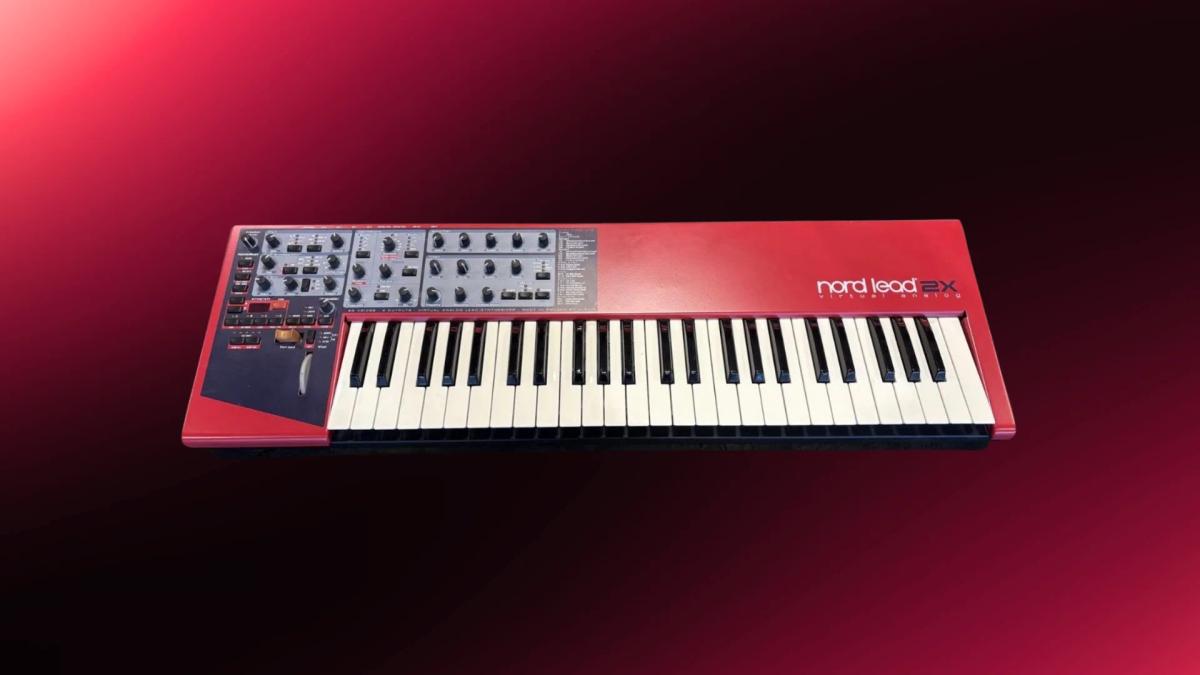
The Nord Lead 2X is a 20-voice virtual analog synthesizer that Clavia introduced in 2003 as an updated Nord Lead 2. Clavia kept the earlier model’s sound engine and front panel almost unchanged: two oscillators, a multimode filter with distortion, two LFOs, a modulation envelope, a 49-key velocity-sensitive keyboard, and 26 knobs. What changed was underneath, with faster processing, 24-bit converters running at 96kHz, four more voices, and far more internal memory in place of the old memory-card slot. It was intended as a refinement rather than a new instrument, yet it ended up as one of Clavia’s longest-running synths, outliving the more ambitious Nord Lead 3 and serving as the base for the Nord Lead 4.
Table of Contents
Nord Lead 2X sound and character
The Nord Lead 2X sounds like a Nord Lead 2, which is exactly what Clavia promised. The company’s own description says it has the same characteristic sound and functions as its predecessor, and side-by-side comparisons by Nord User Forum members found no audible difference between the two. The character is bright, direct, and slightly hard-edged: sawtooth and pulse waves with plenty of upper harmonics, a filter that is clean at low resonance and turns biting when pushed, and a distortion stage that adds grit to leads and basses. The site’s article on the Nord Lead 2 covers the engine’s origins in detail; the Nord Lead 2X is the same voice with more room to use it.
Its sweet spots are the sounds that made the line famous. Hard-synced leads, where oscillator 2 is swept by the modulation envelope, are a Nord signature, as are snappy FM-tinged basses, pulse-width pads, and the stacked unison leads used in trance and house. Bonedo’s 2009 test called the filters and modulating oscillators excellent and highlighted the factory library’s range, from Prophet-style polysynth sounds and trance pads to basses, organ-like patches, and experimental textures.
Compared with the Nord Lead 3, which several commentators found less analog-sounding, the Nord Lead 2X is the more traditional instrument. Gordon Reid suggested in Sound On Sound that the Lead 3’s reception was one reason Clavia returned to the Lead 2 engine. It is still clearly digital, closer to a punchy modern virtual analog than to a warm 1970s polysynth, and it has no effects of its own, so much of the polish heard on records comes from external processing. Its strength lies in clarity and immediacy rather than depth.
Features and architecture
- Manufacturer: Clavia DMI AB, Stockholm, Sweden (Nord brand)
- Year introduced: 2003
- Production years: 2003 to about 2013; Reverb’s product catalog lists the keyboard as 2003 to 2013, MusicTech described it as still on sale in September 2013, and Nord’s legacy page gives 2003 to 2007, which conflicts with the other evidence
- Synthesis type: virtual analog subtractive modeling with FM, sync, and ring modulation
- Category: polyphonic virtual analog keyboard synthesizer (a Nord Rack 2X module was also made)
- Polyphony: 20 voices, up from 16 on the Nord Lead 2
- Multitimbrality: four slots, with layer and split performances
- Original price: Bonedo’s 2009 test listed a German list price of 1,307 euros and a street price of 999 euros; a launch price in other markets is not well documented
- Current market price: Reverb listings for the keyboard have ranged from about $740 to $1,100, with serviced or near-new units listed higher
- Oscillators: two per voice; oscillator 1 offers sine, triangle, sawtooth, and pulse, oscillator 2 offers triangle, sawtooth, pulse, and noise; hard sync, linear FM from oscillator 2 to oscillator 1, and ring modulation
- Filter: 12dB and 24dB low-pass, band-pass, high-pass, and notch modes with resonance, envelope amount, velocity, keyboard tracking, and distortion
- LFOs: two; LFO 2 doubles as the arpeggiator, and both can sync to MIDI clock
- Envelopes: amp ADSR, filter ADSR, and a modulation envelope for FM amount, pulse width, and oscillator 2 pitch
- Modulation system: morph from the mod wheel or velocity between two settings of selected parameters, with the wheel also switchable to fixed destinations
- Sequencer / arpeggiator: arpeggiator with up, down, up/down, and random modes over one to four octaves, plus an echo function with one to eight repeats
- Effects: none, apart from the filter distortion
- Memory: 990 programs, 400 performances, and 100 percussion kits in total; Nord gives 297 user and 693 factory programs, 100 user and 300 factory performances, and 30 user and 70 factory kits, while other listings split the programs as 396 user and 594 factory
- Voice modes: poly, legato, mono, unison mono, unison poly, and portamento
- Keyboard: 49 keys (four octaves), velocity-sensitive, no aftertouch; octave shift, split mode, wooden pitch stick without a center detent, and mod wheel
- Inputs / outputs: four audio outputs, one per slot, plus headphone output; sustain and expression pedal inputs
- MIDI / USB: MIDI In and Out with clock sync, CC control of the panel, and SysEx dumps; no USB
- Display: three-digit LED display
- Dimensions / weight: 865 x 265 x 105 mm; 5.3 kg
- Power: internal power supply with mains cable
Strengths
- It delivers the classic Nord Lead sound with fewer compromises. The engine is the Lead 2’s, but with 20 voices, more stable converters, and much larger internal memory.
- Every main parameter has its own knob, and the color-coded panel is quick to read. Bonedo praised the direct layout, and the manual mode, which sets all parameters to the current knob positions, makes it behave like an unprogrammable analog synth when needed.
- Sync and FM are easy to exploit. The modulation envelope and the mod wheel can sweep oscillator 2’s pitch or FM amount, producing the aggressive leads and metallic tones the line is known for.
- The four-slot design suits live work, with layers, splits, four separate outputs, and four direct-access slots for quick sound changes.
- It is light and solid. At about 5.3 kg in a metal case, it is easy to carry to gigs and is still common in touring rigs.
- Used prices are moderate. It is often the least expensive way to own a full-size Nord Lead with this engine.
Limitations
- There are no onboard effects, so delay, chorus, and reverb must come from external units.
- The keyboard has no aftertouch, and the three-digit display shows no parameter values or patch names, which makes fine editing and sound management slower.
- Knobs work only in jump mode, so turning one after a patch change can cause an audible step; Bonedo wished for a catch mode.
- Programs are organized sequentially in banks, and scrolling through them on stage can be slow.
- There is no official editor software, and Bonedo noted the absence of velocity curve settings compared with rivals such as the Access Virus.
- The undocumented experimental mode known to owners as Pelle’s Mode, found on the Nord Lead and Nord Lead 2, was dropped, along with the Lead 2’s PCMCIA card slot.
Historical context
Clavia, founded in Stockholm in 1983 by Hans Nordelius and Mikael Carlsson, had made its name with the original Nord Lead in 1995 and refined it with the Nord Lead 2 in 1997. In 2001 it released the Nord Lead 3, with a reworked engine, FM, aftertouch, a screen, and LED-ringed encoders. The Lead 3 was considerably more expensive, so the Lead 2 stayed in demand, and some commentators preferred its rawer, more analog-sounding character.
The Nord Lead 2X arrived in 2003 as Clavia’s response. Wikipedia’s Clavia article says it was built partly because some Lead 3 components were becoming hard to source, while Gordon Reid pointed to the Lead 3’s reception and suggested rising manufacturing costs may also have played a part. The update was conservative by design: Sonic State’s listing describes it as fully patch-compatible with the Lead 2, with sounds transferable over MIDI. A rack version, the Nord Rack 2X, accompanied it.
For several years the two Leads were sold side by side. When Clavia discontinued the Lead 3 in 2007, the Nord Lead 2X became the only Nord Lead in production. In 2008 Clavia marked its 25th anniversary with a limited Anniversary Model: Sonic State reported 299 numbered units with a custom-printed panel, an inverted keyboard color scheme, and a certificate signed by Nordelius, while Wikipedia gives the run as 300. The Nord Lead 2X remained on sale alongside the Nord Lead 4 in 2013, and Reverb’s catalog dates its production to 2013 for the keyboard and 2014 for the rack.