

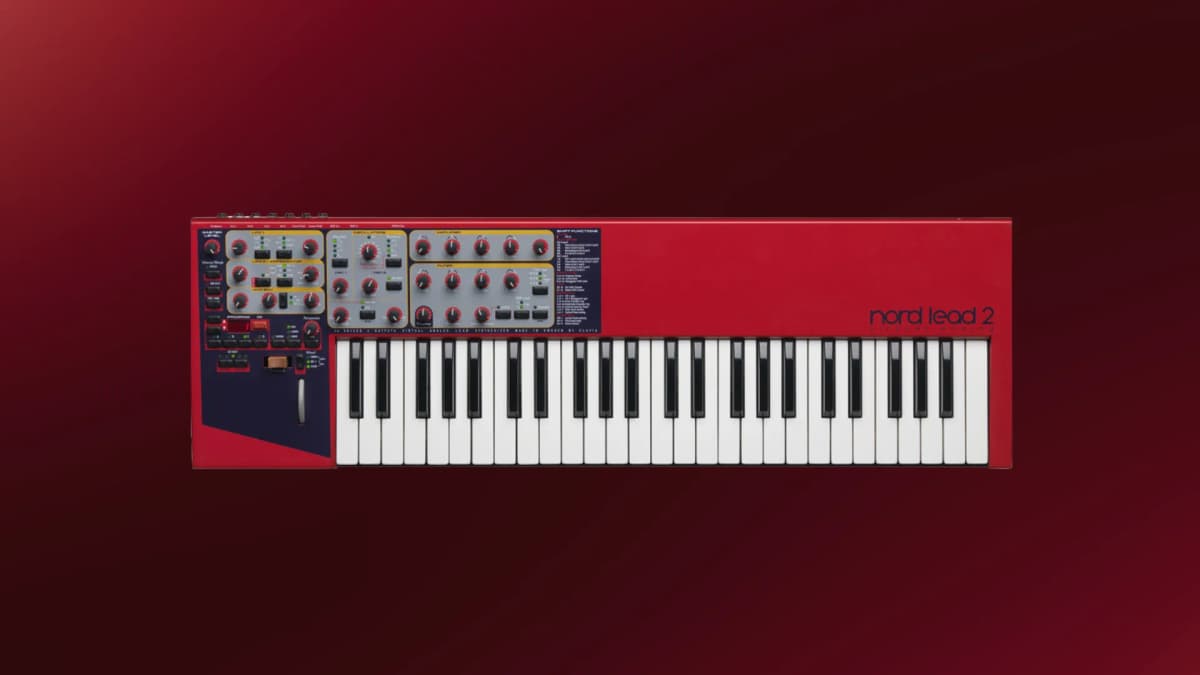
The Nord Lead 2 is a 16-voice, four-part multitimbral virtual analog synthesizer introduced by the Swedish company Clavia in 1997, built around a 49-key velocity-sensitive keyboard, two modeled oscillators per voice, a multimode filter, and a knob-per-function red panel. It followed the original Nord Lead, the DSP-based instrument that helped define the polyphonic virtual analog, and fixed its most obvious weakness: four voices out of the box. With four times the polyphony, four outputs and new oscillator options, the Lead 2 turned a surprise hit into a dependable studio and stage tool, later refreshed as the Nord Lead 2X.
Table of Contents
Sound and character
The Nord Lead 2 sounds clean, focused, and controlled. Sound On Sound’s 1997 review described its oscillators as “clean and clear” and closer in feel to DCOs than drifting VCOs: stable in pitch, with little of the wandering that defines vintage analog polysynths. That stability makes it precise in a mix and predictable on stage.
Thickness comes from what the player does with that clean source. Detuning, pulse-width modulation, unison and vibrato fatten the tone considerably, and layered performances can swell into large pads. Hard sync, linear FM, the ring modulator and noise synced to oscillator 1 for formant-like tones give it a sharper, more metallic vocabulary than the “analog emulation” label implies. Its natural territory is sync leads, resonant basses, buzzy sequences, brass and wide detuned pads.
The filter sweeps smoothly across its five modes, but reviewers found it reserved. Sound On Sound called its resonance “a little polite,” without the wild self-oscillation of classic analog filters. The new filter distortion switch adds grit and helps leads and basses bite harder. Overall, it leans polished and modern rather than vintage and unstable.
Features and architecture
- Manufacturer: Clavia DMI (Sweden), sold under the Nord name
- Year introduced: 1997
- Production years: 1997 to 2003, per Nord’s legacy product pages; succeeded by the Nord Lead 2X (2003 to 2007)
- Synthesis type: virtual analog (DSP-based modeling of subtractive analog synthesis)
- Category: polyphonic, multitimbral keyboard synthesizer; also offered as the Nord Rack 2 module
- Polyphony: 16 voices, four-part multitimbral, with poly, legato, mono, unison mono and unison poly play modes
- Original price: £1,500 in the UK at launch, according to Sound On Sound
- Oscillators: 2 per voice; oscillator 1 offers sine, triangle, sawtooth and variable-width pulse; oscillator 2 offers triangle, sawtooth, variable-width pulse and noise with a color control; hard sync, linear FM from oscillator 2 to oscillator 1, ring modulation, and noise that can be synced to oscillator 1
- Filter: 12 dB and 24 dB low-pass, high-pass, band-pass, and notch combined with 12 dB low-pass; cutoff, resonance, envelope amount with optional velocity control, keyboard tracking (off, 1/3, 2/3, full), and filter distortion
- LFOs: 2; LFO 1 has several waveforms including random types and routes to oscillators, filter, pulse width and FM amount; LFO 2 is a triangle that also sets arpeggiator rate; both can sync to MIDI clock
- Envelopes: ADSR for filter, ADSR for amplifier, plus an attack/decay modulation envelope for oscillator 2 pitch, FM amount and pulse width
- Modulation system: fixed panel routings plus velocity and wheel morphing, which fade continuous knobs between two programmed values
- Sequencer / arpeggiator: arpeggiator (up, down, up/down, random; 1 to 4 octaves; hold); Echo repeats notes 1 to 8 times using polyphony; no step sequencer
- Effects: none beyond filter distortion and the Echo function
- Memory: 99 programs, of which 40 are user-writable; 100 performances in ROM; 10 analog-style percussion kits; an optional PCMCIA card adds 297 programs, 100 user performances and percussion storage
- Keyboard: 49 keys (four octaves), velocity-sensitive, with plus or minus 2 octave shift and a two-zone split; no aftertouch transmission; modulation wheel and pitch stick with no center dead zone
- Inputs / outputs: 4 individual audio outputs (one per slot) with stereo, mono or multitimbral modes and 18-bit DACs, headphone output, sustain and expression pedal inputs
- MIDI / USB: MIDI In and Out (no MIDI Thru); all knobs and buttons send and receive control changes; SysEx dumps; no USB
- Display: 3-digit LED display, with 26 knobs and 27 buttons for editing
- Dimensions / weight: 865 × 265 × 105 mm, 5.3 kg
- Power: internal power supply with a fixed mains lead
Strengths
- Sixteen voices made the Nord practical. The original shipped with four voices and needed an expansion board to reach twelve; the Lead 2 delivered 16 as standard, enough for real pads, layers and multitimbral parts.
- The panel is fast and readable. With a dedicated control for nearly every parameter, it is quick to program from scratch, and Spectrasonics’ hardware guide still describes the layout as clear and well suited to live performers.
- Four individual outputs open up real multitimbral work, letting one Lead 2 send bass, pads and leads to separate mixer channels.
- Morphing adds hidden expressive depth. Velocity and wheel morphing move many parameters at once between two settings, approximating velocity layering.
- It is a strong MIDI citizen: every control sends and receives MIDI data, and LFOs and the arpeggiator follow MIDI clock.
- Build quality is solid. Sound On Sound called the instrument solidly constructed in its familiar red metal casing, and Spectrasonics’ hardware guide still lists good build quality among its strengths.
Limitations
- Internal storage is thin. Only 40 of the 99 internal programs are writable, user performances need the optional PCMCIA card, and there is no edit buffer or compare function. Sound On Sound criticized this at the price.
- The keyboard does not transmit aftertouch, although the engine responds to it over MIDI.
- There are no onboard effects beyond filter distortion and the polyphony-consuming Echo, while competing virtual analogs offered them.
- The filter’s resonance is restrained, which can feel too civilized for players who want screaming analog behavior.
- The 3-digit display is cryptic, and deeper functions rely on shift combinations.
- Four octaves of keys and no MIDI Thru limit its role as a main controller, and storage expansion depends on a legacy card format.
Historical context
The Nord Lead 2 arrived at the moment virtual analog became a crowded field. The original Nord Lead, launched in 1995, had repackaged the sound and interface of classic analog synths in DSP form and, in Sound On Sound’s words, “scored a surprise hit.” For roughly two years it set the standard for the polyphonic virtual analog. By 1997, however, Roland, Yamaha, Access and Quasimidi were all fielding rivals, many with onboard effects.
Clavia had already extended the original Nord through its 1996 version 2.0 software, which added a notch filter, a random arpeggiator mode, the Echo function, percussion kits and new ROM performances. The Lead 2 absorbed all of that as standard, then added what software could not: 16 voices, four outputs, a sine wave, FM, ring modulation, syncable noise, MIDI-clocked LFOs and filter distortion.
The Lead 2 was therefore a consolidation rather than a reinvention. Sound On Sound judged it “not a major step ahead for synthesis” but an ideal analog-style workhorse, effectively four original Nord Leads at the original selling price. It was also offered as the Nord Rack 2 for players who preferred their own keyboard. Its longevity shows how well that bet worked: Clavia later introduced the more expensive Nord Lead 3, yet demand for the Lead 2 persisted, and when some components became hard to source, Clavia redesigned it as the Nord Lead 2X in 2003 rather than retiring it.
Legacy and significance
The Nord Lead 2 matters because it turned the virtual analog idea from a novelty into infrastructure. The original Nord Lead showed that DSP could stand in for analog circuitry. The Lead 2 showed that such an instrument could carry an entire set: pads, basses and leads on separate outputs, from a panel that rewarded fast programming.