

Home›Synths›Nord Electro 7: The 61, 73 and HP stage keyboards that …
Synths

Nord Electro 7: The 61, 73 and HP stage keyboards that add analog and FM synthesis

The Nord Electro 7 adds the Organ 3 engine, analog and FM synthesis and per-section effects in 61, 73 and HP versions. Specs, sound and prices.

Bernardo de Azevedo
Bernardo de Azevedo
· Updated
Nord Electro 7 synthesizer

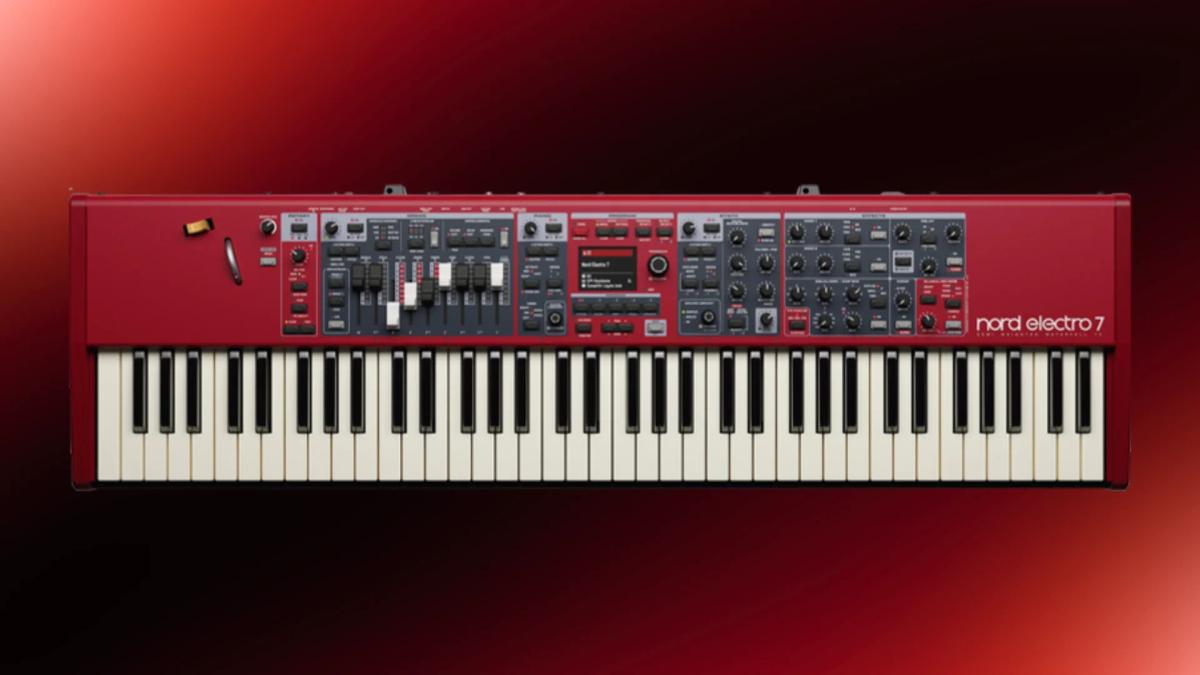
The Nord Electro 7 is a stage keyboard from Clavia, the Swedish company behind the Nord brand, combining organ, piano and synth sections in a compact red chassis. Nord announced it on January 16, 2026, ahead of the NAMM Show, in three versions: the Electro 7 61 and Electro 7 73 with semi-weighted waterfall keys, and the Electro 7 HP with 73 Kawai triple-sensor hammer-action keys. The organ section uses the engine of the Nord Organ 3, the piano section plays sounds from the Nord Piano Library, and the synth section, the largest change, now generates analog-style waveforms and FM tones alongside samples. Each section has its own effects, and all three models carry physical drawbars. Launch prices in the UK were £2,299, £2,499 and £2,799. In October 2026 Sweetwater lists the 61 at $3,299 and the 73 at $3,599, with the HP selling for about $4,000. It is the first Electro with analog-style and FM synthesis built in.

Table of Contents

Nord Electro 7 sound and character

The organ section is the clearest step up. The Nord Electro 7 inherits the engine of the Nord Organ 3, with B3, B3 Bass, Soft B3, Vox, Farfisa and Pipe models, three tonewheel modes, adjustable percussion and a vibrato and chorus section that includes a B3 Deep mode. The rotary speaker emulation comes from the same instrument and offers Close, Wide and XY microphone positions, a stereo Bass Wide option, a tube drive control and an adjustable stop angle. Anita Agathangelou of Mixdown named the organ the standout feature, and Christian Frentzen of Bonedo found it realistic and spacious, preferring the Wide setting while noting that XY holds up best in mono.

The piano section draws on the Nord Piano Library, with 120 voices of polyphony for grands, uprights, electric pianos, clavinets, harpsichords and mallet sounds. New controls for Dynamic Compression, Unison and Timbre reshape a sound quickly without a deep editor, and string resonance and three touch settings remain. Frentzen singled out the Astoria Grand, White Grand and Amber Upright among his favorites, and Agathangelou heard an ambient, expansive quality in the electric pianos through stage monitors. A Thomann customer review praised the compression feature for adding dynamics without audible artifacts.

The synth section is what separates the Nord Electro 7 from its predecessors. The Electro 6 relied mainly on samples for its synth sounds, while this one offers three sources: samples from the Nord Sample Library, analog-style waveforms and FM synthesis. Bonedo described the analog mode as two mixable, detunable oscillators feeding a low-pass filter with cutoff and resonance, shaped by separate amp and filter envelopes, and noted that pulse-width modulation is missing. The FM mode uses DX7-style operators and algorithms but exposes them through just two controls, FM Amount and FM Partial, with the display showing what each change does. Mono, Legato, Glide and Unison modes and a delayed vibrato complete the panel.

That synth is deliberately compact. Jörg Sunderkötter of Pianoo wrote that the panel gained parameters without losing its quick access, and Frentzen saw the reduced design as an advantage for less experienced players, while advising anyone who wants deep editing to look at a Nord Stage or the Nord Wave 2 instead. Mixdown found the FM presets usable as they come and easy to adjust. The expression pedal can now be assigned to the synth filter and to most effect parameters, which adds a layer of real-time control.

On the Nord Electro 7, effects are dedicated to each section rather than shared, selected with an FX Focus button. Two modulation slots cover pan, tremolo, wah, ring modulation, phaser, flanger, chorus, vibe and ensemble, each with its own Rate and Amount knobs. Amp models include Twin, Small, JC and the new Suitcase and Brit, with drive and a three-band EQ, followed by a delay, a compressor and a reverb with Spring, Room, Stage, Hall and Cathedral types. The new spring reverb is placed before the rotary speaker in the signal chain. Reverb is still global, though each layer has its own send.

At the keys, Agathangelou described the waterfall keybed as light and responsive, and Frentzen found it suited to every section. The 73 and HP gain a wooden pitch stick and a modulation wheel, which Nord added shortly after the announcement; the 61 has neither. A larger color display and three push encoders handle program, piano and synth browsing, although Frentzen found it slow to reach FM sounds because the synth list passes through sample and analog presets first, and Pianoo pointed out that the organ section has no push encoder.

Features and architecture

  • Manufacturer: Clavia DMI AB, under the Nord brand (Stockholm, Sweden)
  • Year introduced: 2026 (announced January 16, 2026, ahead of NAMM 2026)
  • Production years: 2026 to present
  • Synthesis type: Modeled organ, sample-based piano, and a synth section combining sample playback, analog-style waveforms and FM synthesis
  • Category: Stage keyboard (organ, piano and synth); three versions: Electro 7 61, Electro 7 73 and Electro 7 HP
  • Polyphony: Organ fully polyphonic; piano 120 voices; synth 30+ voices according to Nord (Bonedo reported 20 voices for the analog mode)
  • Multitimbrality: One Organ, one Piano and one Synth section, which can be layered or split at nine selectable split points; not specified further by the manufacturer
  • Original price: £2,299 (61), £2,499 (73) and £2,799 (HP) including VAT; €2,479, €2,679 and €2,979 at Thomann at launch; US list price not specified by the manufacturer
  • Current market price: $3,299 (61) and $3,599 (73) at Sweetwater; about $4,000 for the HP at US dealers; Pianoo reported the 61 at €2,199 in April 2026
  • Oscillators: Synth section with Sample, Analog and FM modes; two detunable oscillators in Analog mode per Bonedo; FM Amount and FM Partial controls
  • Filter: Low-pass filter with cutoff and resonance for Analog and Sample sounds
  • LFO: No general-purpose synth LFO listed; synth vibrato with rate, amount and delay; Mod 1 and Mod 2 effects with their own Rate controls
  • Envelopes: Amp envelope and Filter/FM envelope (ADR/ASR), with velocity and amount controls for the Filter/FM envelope
  • Modulation system: Filter/FM envelope, vibrato, modulation wheel (73 and HP), and an expression pedal assignable to synth filter and most effect parameters
  • Sequencer / arpeggiator: None
  • Effects: Dedicated effects per section; Mod 1 (pan, tremolo, wah, ring modulator); Mod 2 (phaser, flanger, chorus, vibe, ensemble); amp models (Twin, Small, Suitcase, JC, Brit) with three-band EQ; delay with tap tempo; compressor; reverb (Spring, Room, Stage, Hall, Cathedral) with per-layer send; rotary speaker with tube drive
  • Memory: 500 program locations (20 banks of 25) plus 5 Live programs; sample memory size not specified by the manufacturer
  • Keyboard: 61 (C to C) or 73 (E to E) semi-weighted waterfall keys; HP: 73-key Kawai triple-sensor hammer action; wooden pitch stick and modulation wheel on the 73 and HP only
  • Inputs / outputs: Two unbalanced 1/4-inch outputs, 1/4-inch stereo headphone output, 1/8-inch stereo monitor input, expression pedal, sustain pedal and rotary speed pedal inputs
  • MIDI / USB: 5-pin MIDI In and Out; USB-B for MIDI, updates and sound transfer through Nord Sound Manager
  • Display: High-resolution color display (size not specified by the manufacturer) with push encoders
  • Dimensions / weight: 61: 901 × 104 × 294 mm, 8.3 kg; 73: 1066 × 104 × 294 mm, 9.5 kg; HP: 1070 × 130 × 341 mm, 13 kg (manufacturer figures; Bonedo listed 8.4 and 9.7 kg for the waterfall models)
  • Power: Internal power supply with IEC C14 connector

Strengths

  • The organ engine is a real upgrade. Nord Organ 3 models and the rotary emulation, with three mic positions and tube drive, bring the Electro up to the level of Nord’s dedicated organ.
  • The synth section broadens the instrument. Analog and FM modes add basses, leads, pads and electric piano tones that no longer depend only on samples.
  • Sound libraries carry over. The Nord Piano Library and Nord Sample Library are both supported, and Nord Sound Manager handles loading and organizing sounds.
  • Each section has its own effects. Per-section modulation, amp and delay processing let organ, piano and synth layers be treated independently.
  • Physical drawbars are standard on every model. The HP version gains real drawbars with LEDs, which Gearnews noted had previously been limited to the waterfall models.
  • It remains portable. At 8.3 to 13 kg depending on the model, the Nord Electro 7 stays easy to carry for a full organ, piano and synth instrument, a point Mixdown also made.

Limitations

  • The 61 has no pitch stick or modulation wheel. Gearnews suggested that space constraints kept these controls off the smallest model, and Mixdown advised buyers to weigh that before choosing it.
  • The synth is basic by design. Bonedo noted the absence of pulse-width modulation and recommended a Nord Stage or Nord Wave for deeper sound design.
  • Reverb is global. Bonedo listed this among its criticisms, although each layer has its own reverb send.
  • Synth browsing takes time. Reaching FM sounds means scrolling past sample and analog presets, according to Bonedo, and Pianoo noted that the organ section has no push encoder.
  • Layering is limited. A Thomann customer reviewer found that two synth sounds cannot be used at once, a job that calls for a Nord Stage.
  • US pricing is high. Nord User Forum members compared US dealer prices unfavorably with European ones, and the HP sells for about $4,000 in the US.
  • Early availability was staggered. Shipping began in the second quarter of 2026, later than some launch reports suggested, and Japan received the 61 first, with other models following through the autumn.

Historical context

Clavia was founded in Stockholm in 1983 by Hans Nordelius and Mikael Carlsson and began with electronic drums before adopting the Nord name for its keyboards in 1995. That year’s Nord Lead helped popularize virtual analog synthesis, and the company later moved into modular synthesis, stage pianos and organs. The Nord Stage of 2005 combined the Electro’s organ and piano sections with synth features, separating the two lines by depth and price.

The first Nord Electro appeared in 2001 with a modeled Hammond B3 and samples of a Rhodes Stage 73, Wurlitzer, Hohner Clavinet and acoustic grand, in 61-key, 73-key and rack versions. The Electro 3 of 2009 added Farfisa and Vox models and Mellotron samples, a hammer-action HP version followed in 2011, and the Electro 5 of 2015 raised piano memory to 1 GB and allowed two sound sources at once. The Electro 6, announced in January 2018, introduced three-part multitimbrality and a Dual Organ mode, along with 512 MB of synth sample memory. Our Nord Electro 6D vs Nord Stage 3 comparison covers how that generation sat against Nord’s flagship.

The Nord Electro 7 arrived eight years later. Shimamura Music’s comparison with the Electro 6 lists the main changes: the Organ 3 engine with LED drawbars on every model, analog and FM synthesis in the synth section, effects for each section, a higher-resolution display, and a rise from 416 to 500 program locations. The timing kept the Electro in step with the rest of the range, since its organ comes directly from the Nord Organ 3 and its HP keybed comes from Kawai, the maker Gearnews linked to the Nord Grand 2.

Legacy and significance

It is too early to judge the long-term place of the Nord Electro 7. Early reviews from Bonedo and Mixdown are strongly positive, and Bonedo gave it a top rating, but the instrument has been in buyers’ hands for only a few months in most markets, and questions raised on the Nord User Forum, such as the durability of the new Kawai action, remain open.

What the release signals is clearer. With analog and FM synthesis, per-section effects and pitch and modulation controls on the 73-key models, the Nord Electro 7 moves the series closer to the Nord Stage than any previous generation, while keeping a simpler panel and a lower weight. Our Nord Stage 4 vs Yamaha Montage M8x comparison shows the flagship territory the Electro now approaches from below. The quick addition of a pitch stick and wheel, made days after the announcement in response to user requests according to Gearnews, also shows how closely Nord watches its working-player audience.

Artists, users, and curiosities

No record credits or touring users of the Nord Electro 7 are documented yet. At launch, Synthtopia embedded a performance demo by Joshua Domfeh, which should be read as promotional material rather than independent use, and Nord’s own introduction video is embedded above. Bonedo also filmed a demonstration of the instrument at Superbooth 26 in May 2026.

The launch had an unusual twist. Gearnews reported on January 21, 2026, five days after the announcement, that Nord had added a wooden pitch stick and a modulation wheel to the 73 and HP after a last-minute change, a decision that drew pointed reader comments about the 61 being left out. In Japan, Shimamura Music reported in August 2026 that the 61 had reached its Nagoya store first, with the other versions following through the autumn, and listed it at ¥440,000 including tax. The red finish remains the visual signature of the series, as Mixdown also noted.

Market value

  • Current market position: A newly released mid-sized stage keyboard positioned between Nord’s single-purpose instruments and the Nord Stage flagship
  • New price signal: £2,299, £2,499 and £2,799 UK launch prices; €2,479 to €2,979 at Thomann at launch; $3,299 (61) and $3,599 (73) at Sweetwater, about $4,000 for the HP in the US
  • Used market signal: No meaningful used market yet; Sweetwater lists a certified open-box 73 at $3,239.10
  • Availability: Shipping began in the second quarter of 2026 according to Gearnews and Bonedo; Sweetwater lists the 61 and 73 in stock in October 2026
  • Buyer notes: Within the Nord Electro 7 range, the 61 lacks a pitch stick and modulation wheel; the HP adds a Kawai hammer action at 13 kg; the synth section suits basic sounds rather than deep programming
  • Support ecosystem: Nord Piano Library, Nord Sample Library, analog and FM preset libraries, and Nord Sound Manager over USB
  • Market character: A working musician’s instrument aimed at gigging keyboard players who need organ, piano and synth in one portable unit
  • Long-term position: Too new to judge; library compatibility and the Organ 3 engine are its main long-term assets

Conclusion

The Nord Electro 7 is the most complete Electro so far. It brings the Nord Organ 3 engine to the series, keeps full access to Nord’s piano and sample libraries, gives each section its own effects and, for the first time, adds a synth that generates analog and FM tones rather than only playing samples. Its compromises are clear: the 61 lacks pitch and modulation controls, the synth is simple by design, reverb stays global and US prices are high. For players who want a portable organ, piano and synth keyboard without stepping up to a Nord Stage, the Nord Electro 7 is a considered and well-reviewed update to a long-running line.

Sources

  1. Nord Electro 7 specifications, Nord Keyboards
  2. Nord release the Electro 7, Sound On Sound
  3. Nord intros Electro 7 keyboard ahead of 2026 NAMM Show, Synthtopia
  4. Nord Electro 7 gets pitch stick and mod wheel, Gearnews
  5. Test: Nord Electro 7, stage keyboard with Organ 3, FM synthesis and new effects, Bonedo
  6. Superbooth 26 video: Nord Electro 7 keyboard series, Bonedo
  7. Review: Nord Electro 7, Mixdown
  8. Nord Electro 7 vintage-inspired stage keyboard, Pianoo
  9. Nord Electro 7 arrives at Nagoya PARCO, Shimamura Music
  10. Nord Electro 7 73-key Stage Piano, Sweetwater
  11. Nord Electro 7 61-key Stage Piano, Sweetwater
  12. Clavia Nord Electro 7 73 customer reviews, Thomann
  13. Electro 7? discussion thread, Nord User Forum
  14. Nord Electro, Wikipedia
  15. Clavia, Wikipedia
Bernardo de Azevedo
Written by
Bernardo de AzevedoFounder & Editor

His connection with music began at age 6, in the 1980s, when his father introduced him to Jean-Michel Jarre's Rendez-Vous on vinyl. He works professionally in the legal field, while synthesizers became his space for abstraction and creative exploration. Founder of The Synth Source.