

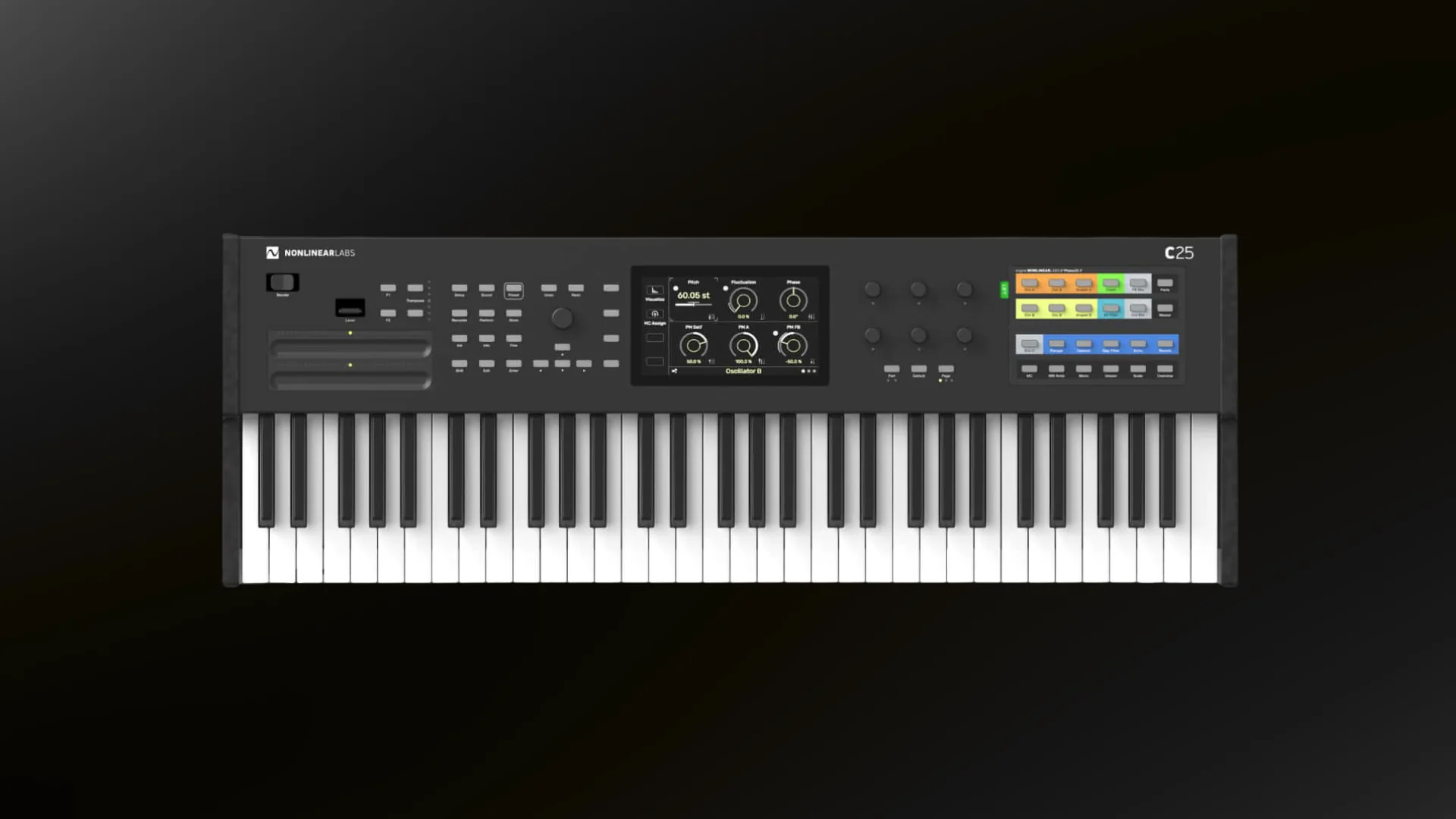
The Nonlinear Labs C25 is a digital performance synthesizer that the Berlin company announced in May 2026 and presented at Superbooth 2026, with release targeted for 2027. It is the successor to the C15 and keeps that instrument’s Phase 22 engine, a blend of phase modulation, waveshaping, physical modeling elements, and subtractive filtering, with 48 voices at 48kHz or 24 at 96kHz. Around it sit a semi-weighted Fatar TP/8S keyboard with per-key position sensing and polyphonic aftertouch, a 7-inch touchscreen, six haptic endless controls, a bender, a lever, two ribbons, and four CV inputs. At a glance it matters because it turns a bespoke, wooden studio-and-stage instrument into a more compact touring keyboard and a platform for further engines. Everything here describes an announced instrument, not a shipping one.
Table of Contents
Nonlinear Labs C25 sound and character
Because the Nonlinear Labs C25 runs the same Phase 22 engine as the C15, its sound can be described with more confidence than most unreleased instruments. On the C15 the engine starts from two sine-wave oscillators that can modulate each other’s phase, feed two shapers and a ring modulator, and then pass through a comb filter and a state-variable filter, all shaped by three ADBDSR envelopes and mixed through a feedback path. CDM reports that the Nonlinear Labs C25’s engine is identical to the C15’s, continues to receive updates, and is fully compatible with the existing C15 preset library.
That architecture is good at sounds that move and respond: bowed and plucked tones where the comb filter adds resonance, metallic and bell-like phase-modulation timbres, overdriven leads from the shapers, and evolving textures from the feedback routing. Every parameter is designed to be morphable in real time, so a single preset is meant to behave more like a playable instrument with a range of states than a static patch. It is not a sampler or a virtual analog copy of a classic, and it does not aim to imitate one.
What the Nonlinear Labs C25 changes is the link between the player and the engine. Each key senses its vertical position as well as velocity and pressure, and each of those can act as a polyphonic modulation source, so individual notes in a chord can be shaped separately. Nonlinear Labs describes this as polyphonic modulation and, according to Bonedo, avoids calling it MPE. The sound character will therefore depend as much on technique as on programming. Final audio judgments should wait for production hardware and independent reviews.
Features and architecture
- Manufacturer: Nonlinear Labs GmbH, Berlin
- Year introduced: announced May 7, 2026, and shown at Superbooth 2026 in Berlin
- Production years: not yet in production; Gearnews reported a target of early 2027, and Synth Anatomy gives 2027
- Synthesis type: digital Phase 22 engine combining phase modulation/FM, waveshaping, physical modeling elements, and subtractive filtering, with feedback routing; designed as a platform that can host further engines, including third-party ones
- Category: performance keyboard synthesizer
- Polyphony: 48 voices at 48kHz or 24 voices at 96kHz
- Multitimbrality: dual mode with splits and layers
- Original price: not officially announced; Synth Anatomy reported about €3,500, Gearnews expects it to cost less than the C15, and accounts from the booth conflict
- Current market price: none; the Nonlinear Labs C25 is not yet on sale
- Oscillators: two sine-wave oscillators with mutual phase modulation, as in the C15’s engine, plus shapers and a ring modulator
- Filter: comb filter and state-variable filter, as in the C15’s engine
- Envelopes: three ADBDSR envelopes in the C15 engine on which the Nonlinear Labs C25 is based
- Modulation system: polyphonic modulation from key position, velocity, and aftertouch; bender, lever, two ribbons, pedals, and CV, all assignable; macro controls carried over from the C15 concept
- Sequencer / arpeggiator: none announced
- Effects: two groups of five effects in the signal path
- Memory: preset and bank system compatible with the C15 library; presets and banks switchable by footswitch
- Keyboard: semi-weighted Fatar TP/8S with Nonlinear Labs sensors for key position, velocity, and polyphonic aftertouch; the key count was not stated in the announcement coverage consulted here (the C15 has 61 keys)
- Controllers: C15-style bender; new lever with magnetic return; two capacitive ribbons with 33-LED position bars; six high-resolution endless controls with touch sensing and haptic feedback; step encoder; 24 RGB-backlit page buttons with a replaceable label overlay
- Inputs / outputs: stereo audio inputs and outputs usable as an audio interface; four pedal inputs and four CV inputs
- MIDI / USB: MIDI DIN in and out; USB host and USB device
- Display: 7-inch TFT touchscreen showing parameters, presets, and signal flow; every function also reachable from hardware buttons
- Recording: onboard recorder for hours of lossless audio
- Dimensions / weight: not yet published; described as lighter, more compact, and more robust than the C15, which measures 900 x 410 x 160mm with its panel unit
- Power: not yet published
Strengths
- It inherits a mature engine. The C15’s Phase 22 architecture has been refined through years of updates, and full preset compatibility means the Nonlinear Labs C25 should launch with a deep library rather than a blank slate.
- The keyboard is designed as a polyphonic controller. Sensing key position, velocity, and pressure per note gives chords independent expression without requiring a separate MPE controller.
- The control surface is more hands-on than the C15’s. Six haptic endless controls, a touchscreen, and dedicated page buttons address the one-parameter-at-a-time editing that limited its predecessor.
- Connectivity is broad for a performance keyboard: DIN MIDI, USB host and device, four CV inputs, four pedal inputs, and a stereo audio interface, where the original C15 shipped without MIDI.
- The replaceable button overlay is a practical answer to the problem of hosting additional engines on fixed hardware; Bonedo’s author called it a first among the synths he had encountered.
- A built-in lossless recorder makes it easy to capture improvisations on stage or in rehearsal without a computer.
Limitations
- It is not yet available. At announcement the images were renderings, and price, ship date, dimensions, weight, and key count had not been officially confirmed.
- Pricing is uncertain. Reports range from about €3,500 to suggestions that it may cost more than the C15, so buyers cannot yet budget with confidence.
- The engine is shared with the C15, so current C15 owners gain new controls and connectivity rather than a new sound.
- The C15’s large 800mm ribbons give way to smaller capacitive ribbons, which may not suit players who relied on long ribbon gestures.
- There is no announced sequencer or arpeggiator, and the C15 engine lacks conventional LFOs, so its modulation depends on the player and on assigned controllers.
- Third-party engine support is a stated intention, but no partner engines had been announced in the coverage consulted for this article.
Historical context
Nonlinear Labs was founded in 2011 by Stephan Schmitt, who had earlier founded Native Instruments and developed Reaktor. The company set out to build durable, expressive instruments for performing musicians, and its first product, the C15, appeared in 2016 and opened for pre-orders in March 2017 at €4,000. That instrument used wood, steel, and aluminum, a separate panel unit with 96 selection buttons, two 800mm ribbons, a 61-key Fatar keybed, and initially 12 voices. It launched without MIDI, which was later added through an optional MIDI Bridge, and firmware updates through 2025 raised polyphony to 48 voices and added polyphonic aftertouch over MIDI. The C15 is covered separately on this site.
The Nonlinear Labs C25 was announced on May 7, 2026, with Synthtopia, Gearnews, Synth Anatomy, Bonedo, and CDM all covering it that week, and Nonlinear Labs showed it at Superbooth 2026 in Berlin, including a live performance by GESPRÄCHSKONZERT on its stand. Gearnews noted that the published images were computer renderings and that the company planned to post development updates on its website. CDM observed that Schmitt presented the Nonlinear Labs C25 in the same week that inMusic announced its acquisition of Native Instruments.
As of October 2026 the Nonlinear Labs C25 remains in development. Synthtopia’s coverage stated that pricing and availability were still to be announced, and no later price or pre-order announcement appeared in the sources consulted. Gearnews reported an early 2027 target; Synth Anatomy reported 2027 and a price around €3,500. Most components are sourced from Europe, according to CDM, while Synth Anatomy’s author suggested the Nonlinear Labs C25 will not be built entirely in-house, which would help explain a lower price than the C15.