

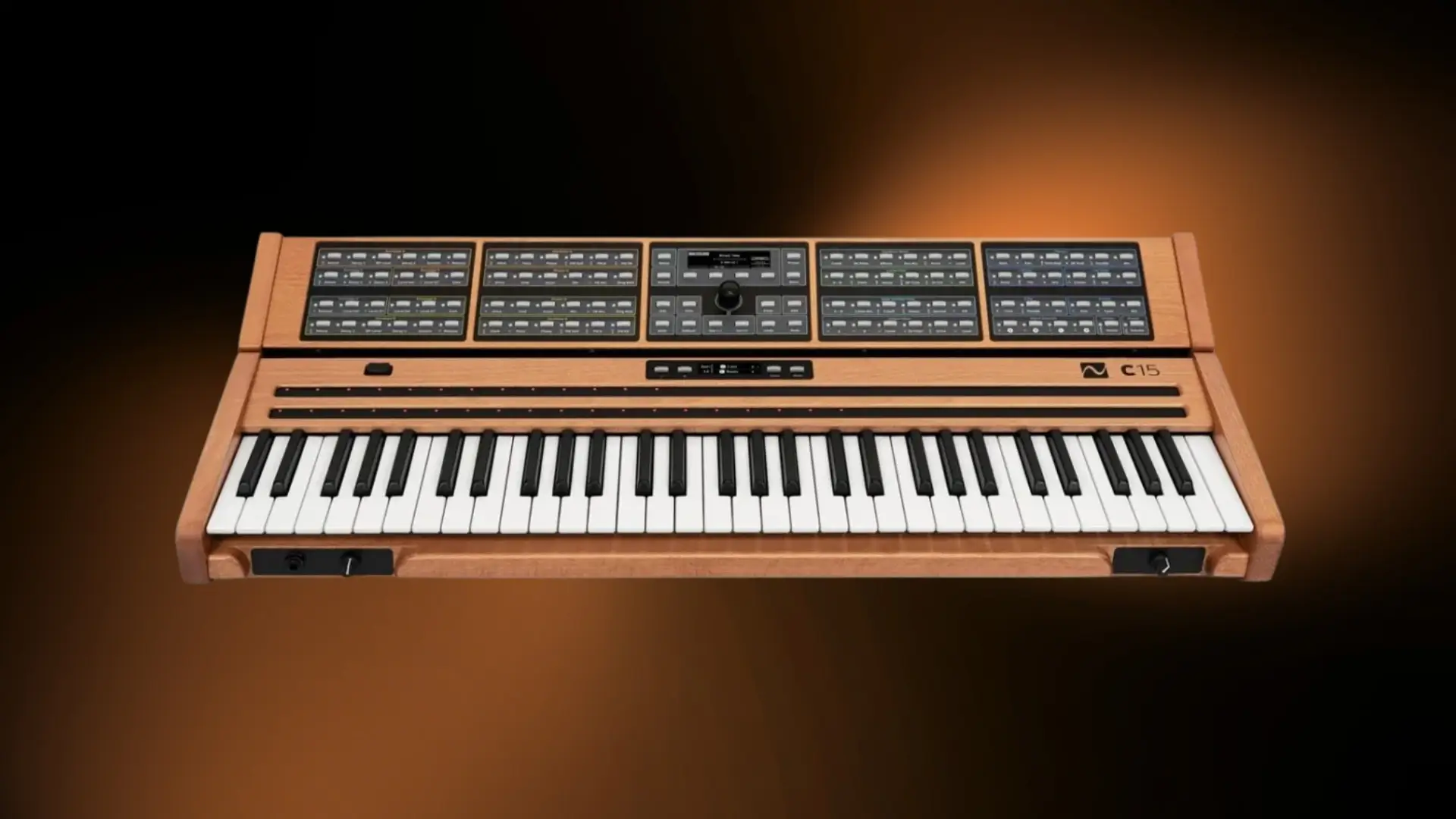
The Nonlinear Labs C15 is a digital performance polysynth first shown publicly in 2016 and brought into serial production in 2017. Built around the company’s Phase 22 synthesis engine, it uses two sine-based oscillators, phase modulation, nonlinear shaping, feedback, comb filtering and state-variable filtering rather than analog emulation, samples or wavetable playback. Its identity is inseparable from its 61-key performance interface: ribbons, pedals, aftertouch, a magnetic lever and macro control are not secondary conveniences, but the intended means of making the sound move.
Table of Contents
Nonlinear Labs C15 Sound and Character
The Nonlinear Labs C15 has a recognizably digital sound, but not the polished, preset-driven gloss often associated with digital polysynths. Its two sine oscillators begin from an intentionally restricted source material, then accumulate complexity through phase modulation, feedback paths, shapers, resonant comb filtering and filtering. The result can be unusually direct and pure at one moment, then woody, metallic, breathy, percussive or turbulent at the next.
Its comb filter is especially central to the instrument’s character. It can behave less like a conventional subtractive filter and more like a tuned resonator, allowing notes to suggest struck strings, cavities, reeds, mallets or unstable acoustic objects. This does not make the Nonlinear Labs C15 a physical-modelling synthesizer in the conventional sense. Instead, it creates acoustic implications through feedback and resonance, leaving enough ambiguity for the player to determine whether a patch feels synthetic, organic or suspended between the two.
The C15 is also less interested in imitating established synth archetypes than in preserving continuity during performance. Its engine is designed around smoothly changing relationships rather than abrupt algorithm or waveform swaps. A sound can become denser, sharper or more unstable without necessarily breaking its musical identity. That quality is especially valuable for pads, sustained harmonic textures, prepared-piano-like attacks, unstable electric-keyboard tones, spectral basses and electronically processed acoustic gestures.
The absence of a conventional internal LFO-and-sequencer culture matters here. The Nonlinear Labs C15 asks the musician to supply movement through velocity, key position, aftertouch, ribbons, pedals and the lever. That can make it feel exposed: a static C15 patch often remains static until the player intervenes. But it also gives the instrument an unusual sense of physical responsibility. The timbre is not merely selected; it is performed.
Features and Architecture
- Manufacturer: Nonlinear Labs, a Berlin-based instrument maker founded around the work of Stephan Schmitt.
- Public debut and production: First presented publicly at Superbooth in 2016; serial production began in 2017 and the instrument remains available as a built-to-order product.
- Synthesis type: Phase 22 digital synthesis, built from two sine oscillators, phase modulation, nonlinear shapers, feedback paths, a comb filter and a state-variable filter.
- Category: Premium digital performance polysynth with an unusually deep emphasis on tactile, real-time control.
- Polyphony: Current firmware supports up to 48 voices at 48 kHz, or 24 voices at 96 kHz.
- Original and current price: The original 2017 price was €4,000 including VAT. Current direct European pricing is €4,400 including VAT for the black version and €4,800 including VAT for the Cherry version.
- Oscillators: Two sine-based oscillators with adjustable fluctuation and noise behavior, connected through phase-modulation and feedback relationships.
- Shaping and feedback: Two nonlinear shapers add folding and asymmetry, while multiple feedback routes can radically reshape harmonic behavior.
- Filters: A tunable comb filter acts as a resonator or delay-derived spectral processor; the state-variable filter offers multiple modes, variable pole behavior and oscillator frequency modulation.
- Envelopes: Three ADBDSR envelopes. The third envelope can loop its decay stages, allowing repeating modulation shapes without introducing a conventional free-running LFO.
- LFOs: No standard dedicated LFO exists in the main synthesis engine. The looping third envelope and performance lever can provide recurring or LFO-like movement, while the flanger effect has its own internal modulation source.
- Modulation system: Six macro controls can address multiple synthesis parameters. Eight physical performance sources, including aftertouch, lever, ribbons and pedal inputs, can be assigned to those macros.
- Multitimbrality: Two Parts can be layered or split across the keyboard.
- Sequencer and arpeggiator: Neither is part of the core design. The Nonlinear Labs C15 deliberately avoids internal pattern-based modulation and performance automation.
- Effects: A mono modulation effect section offering flanger, chorus, phaser or tremolo; plus cabinet simulation, a gap filter, echo and reverb.
- Memory and capture: Presets can be organized through banks, tags, searching and morphing. The instrument also includes an undo tree and a continuous audio ring buffer capable of retaining extended recordings for later review or export.
- Keyboard: 61-key Fatar TP/8S semi-weighted keybed with long keys, global aftertouch and high-resolution sensing.
- Performance controls: Two 800 mm ribbon controllers with LED position feedback, a magnetic lever bender, aftertouch and four pedal, switch or CV inputs.
- Outputs: Transformer-isolated balanced stereo outputs on both TRS and XLR connectors, plus a front-panel headphone output.
- MIDI and USB: USB host support for storage, updates and MIDI devices; USB MIDI capability was added in 2021. An optional MIDI Bridge expands integration with conventional MIDI equipment.
- Display and interface: The full panel includes a 256 × 64 OLED display, encoder and 96 switches. The detachable Base Unit has its own smaller display and can operate without the main control panel.
- Dimensions and weight: Base Unit: 900 × 290 × 100 mm, 10.5 kg. Full C15 with panel: 900 × 410 × 160 mm, 13.5 kg.
- Power: External 18–20 V DC supply, rated at 2.5 A or higher.
Strengths
- A performance architecture with real musical consequences: The Nonlinear Labs C15 does not merely add expressive controllers to a conventional synthesizer. Its sound engine is structured so that pressure, velocity, ribbons, pedals and lever movement can define the timbre itself. This makes it especially rewarding for players who want gestures to alter harmonic behavior rather than only volume or vibrato.
- A distinct alternative to analog nostalgia: Its sound is not based on reviving a vintage filter, oscillator or panel layout. The Nonlinear Labs C15’s identity comes from feedback, phase modulation, resonant comb behavior and continuous transitions. It can approach delicate and organic textures without pretending to be analog.
- A sophisticated route to acoustic suggestion: The comb filter and feedback structure can create resonant, struck, bowed or cavity-like impressions without relying on samples. That gives the C15 a useful territory between conventional subtractive synthesis and explicit physical modelling.
- Continuity under pressure: The engine is unusually suited to gradual tonal transformation. A patch can travel from clarity to density, or from a soft resonant tone to a harsher electronic one, without the abrupt discontinuity that often makes complex digital patches hard to perform.
- A serious keyboard interface: The long-key Fatar action, two full-length ribbons, four pedal inputs and magnetic lever make the Nonlinear Labs C15 feel closer to a performance instrument than to a compact desktop synth with keys attached.
- Strong recall and experimentation tools: Preset morphing, tagging, an undo tree and the internal audio buffer are practical advantages for sound design. The ring buffer is particularly useful because it can preserve accidental or unplanned performances that would otherwise disappear.
- Meaningful long-term firmware development: USB MIDI in 2021 and the 2025 expansion to 48 voices at 48 kHz show that the Nonlinear Labs C15 has not been treated as a sealed 2017 design.
Limitations
- It is expensive for a single-timbral performance proposition: Even with two Parts available for splits and layers, the Nonlinear Labs C15 costs far more than many flexible workstation-style digital synthesizers. Its value depends on whether its particular relationship between sound and touch matters to the buyer.
- No internal sequencer or arpeggiator: This is a philosophical decision, but it is still a limitation for musicians who expect autonomous rhythmic motion, clock-synced modulation or instant pattern generation inside the instrument.
- The architecture is not immediately familiar: Players accustomed to subtractive synth layouts, waveform menus or traditional FM operator grids may need time before the Nonlinear Labs C15’s routing, feedback behavior and macro system become intuitive.
- Editing is deliberate rather than instant: The panel is more tactile than software alone, but deep programming still involves parameter selection, display navigation and, for detailed work, the browser editor. It is not a one-knob-per-function instrument.
- Limited conventional MIDI connectivity on the chassis: The C15’s native integration is centered on USB, with the optional MIDI Bridge handling broader legacy MIDI needs. That is less direct than built-in five-pin MIDI connections for some hardware-focused studios.
- Polyphonic aftertouch is receive-only: The 2025 firmware added incoming polyphonic-aftertouch support, but the Nonlinear Labs C15’s own keybed produces global aftertouch rather than per-note aftertouch.
- A substantial physical footprint: At 13.5 kg with the panel installed and 900 mm wide, it is portable only in the sense that a professional keyboard can be transported. It is not a casual travel synth.
Historical Context
The Nonlinear Labs C15 emerged from a specific technical and cultural lineage. Nonlinear Labs began developing instruments in the early 2010s, after Stephan Schmitt’s departure from Native Instruments. The company’s Phase 22 engine had already informed the 2014 Native Instruments Kontour software instrument, making the Nonlinear Labs C15 a rare case in which a sophisticated digital-synthesis lineage moved from software development into a purpose-built hardware performance instrument.
Its arrival in 2016 and 2017 was significant because it refused two obvious routes available to a high-end keyboard manufacturer. It was not a revival of a classic analog design, and it was not a workstation built around vast preset libraries, sampled instruments or production utilities. Instead, it proposed that digital synthesis could be valuable precisely because it could produce new behavior under the hands of a performer.