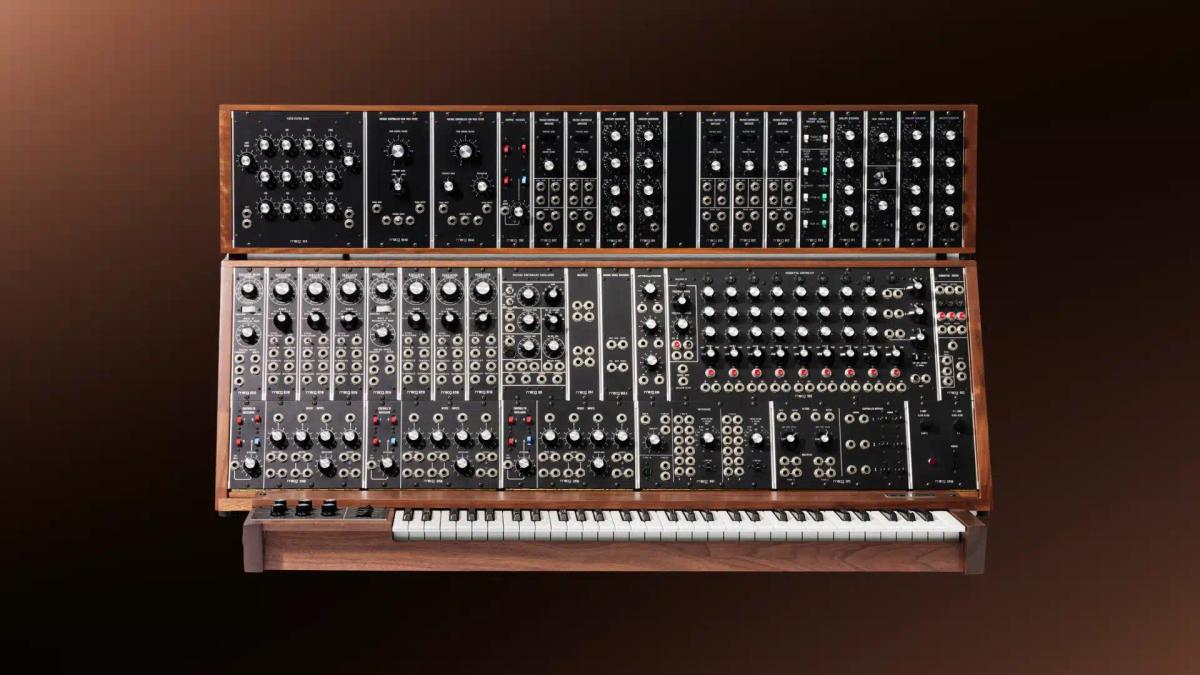
Moog System 55: The flagship modular that defined Moog’s large-format studio era
The Moog System 55 is the largest of the three standard large-format modular synthesizers that Moog offered from the early 1970s, alongside the smaller System 35 and the portable Model 15.
The Moog System 55 is the largest of the three standard large-format modular synthesizers that Moog offered from the early 1970s, alongside the smaller System 35 and the portable Model 15. Moog itself dates the line to 1973, while the earliest catalogs documented by the Bob Moog Foundation list it in 1974 under the name Synthesizer 55.
Built around a bank of 921-series oscillators, the 904A ladder low-pass filter, a 914 fixed filter bank, five envelope generators and a 960 sequential controller, all housed in two walnut cabinets, it was the most complete studio instrument in Moog’s 900 Series catalog. In 2015 Moog revived it as a hand-built limited edition of 55 units, which turned a 1970s flagship into a modern collector’s object and a working instrument again.
The Moog System 55 sounds like the classic Moog modular because it essentially is the classic Moog modular, in its most generous configuration. Its tonal center is the 904A low-pass filter, a 24 dB per octave ladder design whose resonance can be pushed into self-oscillation. That filter is responsible for the round, heavy, slightly soft-edged bass and lead tones that the Moog name still evokes.
What separates the 55 from smaller systems is scale. With one 921 oscillator plus six 921B oscillators steered by two 921A drivers, it can stack many sources in unison or detuned clusters, producing the dense, slowly beating textures heard on so much 1970s electronic music. The oscillators offer sine, triangle, sawtooth and variable-width rectangular waves, and the 921 reaches down to fractions of a hertz, so the same family doubles as the system’s modulation source. There is no dedicated LFO module: slow movement comes from oscillators, envelopes, the random generator or the sequencer.
The 914 fixed filter bank adds another layer of character. With twelve band-pass controls plus separate high-pass and low-pass sections, it acts like a fixed graphic equalizer for carving formants, nasal vocal colors and hollow, resonant spectra that a single sweeping filter cannot easily produce. Combined with the 904B high-pass filter and the 903A random signal generator (white and pink noise), it gives the 55 a wider palette for timbral sculpting and sound effects than the System 35 or Model 15.
The overall character leans vintage, warm and physical rather than clinical. Every sound has to be patched by hand, and the result depends on tuning, scaling and patience. The sounds on a Moog System 55 are built, not recalled.
Features and architecture
Manufacturer: Moog Music (originally Moog Music, Inc.; the 2015 reissue by Moog Music of Asheville)
Year introduced: 1973 according to Moog; documented in Moog catalogs from 1974
Production years: original run through the early 1980s (Vintage Synth Explorer gives 1973 to 1981; the Bob Moog Foundation’s catalog timeline still shows the 55 in a 1983 catalog); limited reissue announced in January 2015, now discontinued
Synthesis type: analog subtractive, voltage-controlled modular
Category: 5U large-format modular synthesizer, studio system
Polyphony: monophonic per keyboard voice by design; duophonic with a two-voice keyboard controller; multiple independent patched lines possible through its many oscillators, VCAs and envelopes
Original price: no confirmed 1973 list price found; one restorer documents a 1976 purchase price of $11,900 for his Moog System 55
Reissue price: $35,000 per instrument in 2015
Oscillators: 1 x 921 voltage-controlled oscillator, 2 x 921A oscillator drivers and 6 x 921B oscillators; sine, triangle, sawtooth and variable-width rectangular waves; 921 range of 0.01 Hz to 40 kHz
Noise: 903A random signal generator with white and pink noise
Filter: 904A 24 dB per octave ladder low-pass filter with regeneration; 904B high-pass filter; 914 fixed filter bank with 12 band-pass controls plus high-pass and low-pass sections
LFOs: no dedicated LFO module; 921-series oscillators serve as low-frequency sources
Envelopes: 5 x 911 envelope generators (attack, initial decay, sustain level and final decay controls), plus a 911A dual trigger delay for chaining or offsetting envelopes
Amplifiers: 5 x 902 voltage-controlled amplifiers
Modulation system: fully patchable with 1/4-inch cables; 992 control voltage panel, 993 trigger and envelope voltages panel, 994 multiples, 995 attenuators, CP3A mixer panels
Sequencer / arpeggiator: 960 sequential controller with three rows of eight steps, 961 interface and 962 sequential switch; no arpeggiator
Effects: none onboard
Memory: none; every patch is set by hand
Keyboard: none built in; 1970s systems were paired with a separate Moog keyboard controller (Vintage Synth Explorer lists the 61-note 951 for the 55); the reissue offered an optional 61-note duophonic keyboard, the 953
Inputs / outputs: 1/4-inch audio and control jacks; Moog S-trigger connections for triggers
MIDI / USB: none on the system itself; the 953 keyboard offered an optional rear expansion with MIDI and CV/gate outputs
Display: none
Dimensions / weight (reissue): main cabinet 48.5 x 15.5 x 14 in, about 100 lb; upper cabinet 48.5 x 10 x 8.5 in, about 60 lb
Power (reissue): 350 W supply, switchable between 120 V and 230 V AC
Strengths
It offers the classic Moog modular voice at its fullest. Seven audio oscillators, five VCAs and five envelopes allow layered, multi-part patches that smaller Moog systems cannot build without expansion.
The 914 fixed filter bank and 904B high-pass filter widen its tonal range well beyond the familiar ladder-filter sound, making it as useful for formant shaping and effects as for basses and leads.
The 960 sequential controller is built in. Three rows of eight steps, combined with the 962 sequential switch, made the 55 a self-contained tool for the sequenced, repetitive patterns that defined much 1970s electronic music.
The 921-series oscillators were designed as an improvement on the earlier 901 family, with Vintage Synth Explorer noting their more stable tuning, which matters greatly in a system that relies on many oscillators playing together.
The reissue was built from original circuit board films, with hand-stuffed and hand-soldered components and photo-etched aluminum panels, giving owners a new instrument with period-correct circuitry rather than a modern approximation.
Limitations
It is extraordinarily expensive. The 2015 reissue cost $35,000, and restored vintage systems have been offered at similar or higher figures, which places it far outside the reach of most musicians.
There is no patch memory. Recreating a sound means re-patching cables and resetting dozens of controls, which makes studio recall and live use demanding.
Its size and weight are considerable. The two reissue cabinets weigh about 160 lb together, before adding a keyboard.
It uses Moog’s S-trigger convention and has no MIDI of its own, so integrating it with other hardware requires adapters, converters or the optional 953 keyboard expansion.
It is fundamentally a monophonic architecture. Chords require multiple patched voices and careful tuning rather than a conventional polyphonic keyboard.
Historical context
The Moog System 55 appeared after the Moog business had changed shape. According to the Bob Moog Foundation’s catalog history, the 1972 catalog was the first printed after Bob Moog was no longer in charge of the company, and by 1974 the conglomerate Norlin had acquired Moog Music, Inc. It was under this new ownership, the Foundation notes, that the modular systems were reconfigured into three standard models.
Those three models reorganized a catalog that had previously been built around the Synthesizer I, II and III configurations of the late 1960s. The 55 took over the role of Moog’s largest standard studio system, the territory the Synthesizer III had occupied, and it updated that format with the newer 921 oscillator family, the 914 filter bank and a standard sequencer complement. It was less a new direction than a consolidation: Moog’s mature modular vocabulary, organized into a top-tier package for studios, universities and well-funded artists.
The 2015 reissue had its own logic. In 2014 Moog had recreated Keith Emerson’s modular as the Emerson Moog Modular System, and the manufacturing knowledge from that project became the basis for bringing back the Moog System 55, System 35 and Model 15. Moog announced the run at NAMM 2015 at $35,000 for 55 units of the Moog System 55, $22,000 for 35 units of the System 35 and $10,000 for 150 units of the Model 15, alongside a revived Sequencer Complement B cabinet and an optional five-octave duophonic keyboard. The timing coincided with a broad modular revival, mostly in the Eurorack format, which gave the original 5U Moog format renewed prestige.
Legacy and significance
The Moog System 55 matters because it represents the end point of the classic Moog modular idea. The early Moog modulars were open-ended research instruments. The 55 was that research distilled into a standard, orderly product: oscillators on one side, filters and envelopes above, a sequencer at hand, and everything wired around an assumption that the user would spend hours building sounds from scratch.
Its importance is also conceptual. Vintage Synth Explorer describes the 55 as “a total studio system with complete synthesizer functions,” and that is exactly what it was: a complete electronic studio in two cabinets, built for studios and institutions at a time when the studio was still the dominant way of thinking about synthesis.
The reissue added a second layer of meaning. Rather than modernizing the design, Moog chose to reproduce it as faithfully as possible, from circuit board films to hand wiring. That decision framed the Moog System 55 as heritage, an instrument whose authenticity was itself the selling point. The later appearance of Behringer’s System 55 Eurorack modules, announced at NAMM 2020 as reproductions of the 15, 35 and 55 module families, shows how far that heritage had spread: the module numbers that once belonged to an exclusive studio instrument became a reference point for affordable modular hardware.
Artists, users, and curiosities
Isao Tomita is one of the clearest documented users. A February 1983 Electronics and Music Maker profile lists a Moog System 55 among the equipment used for his 1979 album The Bermuda Triangle, alongside his older Moog IIIp, and the program for his 1982 Ars Electronica appearance with the “Plasma Symphony Orchestra” assigns the first violin part to “Moog III / Moog system 55.” The image of a synthesizer cast as an orchestral section player captures how Tomita thought about these instruments.
The reissue found its own early showcase. Craig Leon’s Bach to Moog, released on Sony Classical on May 5, 2015 with the Sinfonietta Cracovia and violinist Jennifer Pike, was promoted as the first album made with the newly reissued Moog System 55.
Moog’s launch film for the 2015 reissue featured pioneers and contemporary artists playing the revived modular systems, including Suzanne Ciani, Malcolm Cecil, David Borden, Dick Hyman and Herb Deutsch, plus Holy Ghost!, Gavin Russom, Kaitlyn Aurelia Smith, Jacques Greene and M. Geddes Gengras. Each played a patch live in one take, though coverage did not specify which system each person used.
A practical curiosity: the reissued Moog System 55 has found a second life outside private studios. The Melbourne Electronic Sound Studio lists a new-production Moog System 55 in its bookable collection, which turns one of the most exclusive synthesizers ever sold into something a visiting musician can reserve for a session.
Moog System 55 market value
Current market position: a rare, high-end collectible studio instrument in both its vintage and reissue forms
New price signal: the 2015 reissue was priced at $35,000; major retailers now list it as no longer available
Used market signal: a used reissue sold through Vintage King with the Sequencer Complement B and two 953 keyboards at $39,500; a restored vintage Moog System 55 from around 1976 was listed by RL Music at £45,000 and later marked sold
Availability: hard to find; reissue units were limited to 55, and vintage systems surface occasionally through specialist dealers
Buyer notes: verify module complement against the standard configuration, since vintage systems were often modified or combined with other modules; check power supply condition, oscillator tracking, keyboard calibration and S-trigger cabling; restoration history matters considerably
Support ecosystem: Moog published documentation for the 953 keyboard; specialist restorers and the wider community around 900 Series modules support vintage units; Behringer’s Eurorack reproductions offer an affordable route to the same module concepts
Market character: collectible and prestige-driven, priced by rarity, provenance and condition more than by function alone
Long-term position: likely to remain a top-tier collector piece, with the limited reissue sharing much of the vintage system’s status
Conclusion
The Moog System 55 is the classic Moog modular in its most complete standard form: the ladder filter, the 921 oscillator bank, the fixed filter bank and the 960 sequencer gathered into one studio-sized instrument. It arrived after Moog’s center of gravity had moved toward portable synthesizers, which makes it less a beginning than a summation of everything the company had learned about modular synthesis.
Its 2015 reissue confirmed that this summation still has value, both as a sound and as a historical object. The Moog System 55 matters because it shows, in walnut and aluminum, what a complete electronic music studio looked like before presets, MIDI and portability changed the definition of a synthesizer.
His connection with music began at age 6, in the 1980s, when his father introduced him to Jean-Michel Jarre's Rendez-Vous on vinyl. He works professionally in the legal field, while synthesizers became his space for abstraction and creative exploration. Founder of The Synth Source.