Home›Synths›Moog System 35: The mid-size 1970s modular that Moog re…
Synths

Moog System 35: The mid-size 1970s modular that Moog rebuilt by hand in 2015

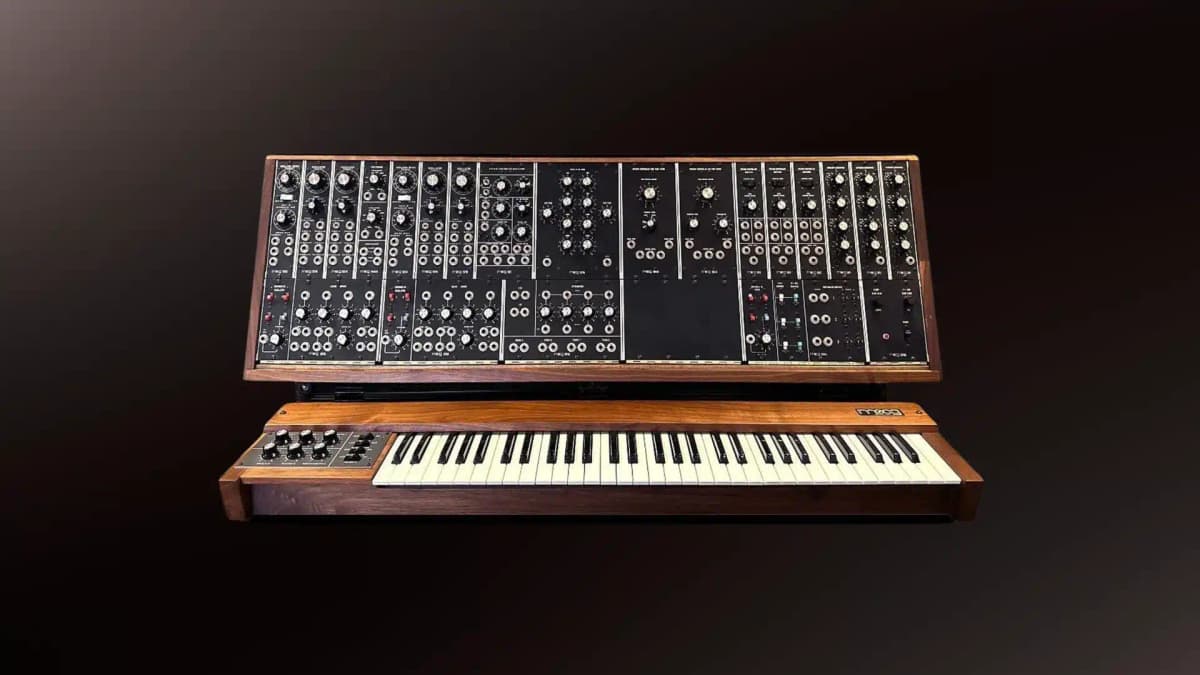
The Moog System 35 is a pre-configured, 5U large-format modular synthesizer that Moog introduced in the early 1970s (most accounts say 1973, some references 1974) as the middle model of a new line, between the suitcase-sized Model 15 and the flagship System 55.

Bernardo de Azevedo
Bernardo de Azevedo
Moog System 35 synthesizer

The Moog System 35 is a pre-configured, 5U large-format modular synthesizer that Moog introduced in the early 1970s (most accounts say 1973, some references 1974) as the middle model of a new line, between the suitcase-sized Model 15 and the flagship System 55.

In one walnut cabinet it gathers 22 modules from the 900 Series: five oscillators built around the 921 family, the 904A low-pass ladder filter and its 904B high-pass partner, a fixed filter bank, three envelope generators, three VCAs, and a noise source, all connected with patch cords. It matters at a glance as the most compact way to own a ‘proper’ Moog studio modular, and because Moog brought it back in 2015 as a hand-built edition of 35 units.

Moog System 35 sound and character

The Moog System 35 sounds like the classic Moog modular because it is built from the same circuits: thick, slightly unstable oscillators feeding a four-pole transistor ladder filter that rounds off highs without losing weight at the bottom. Five oscillators is a generous count for a single cabinet, and stacking three or four of them, slightly detuned, into the 904A produces the dense, slowly beating tone that defined much of the 1970s modular sound. The ladder filter self-oscillates at high resonance and behaves much as it does in the Minimoog, which shares its design lineage.

Where it departs from a fixed-architecture Moog is in the routing. The 921A oscillator drivers can control the frequency and pulse width of several 921B oscillators at once, so a single control voltage can move a whole bank in tune, while the standalone 921 offers an independent voice or a slow modulation source. Combining the 904A low-pass and 904B high-pass gives band-pass shaping, and the 907A fixed filter bank adds static, formant-like coloration that is useful for vocal, phaser-like and ‘telephone’ timbres. Three 911 envelopes and three 902 VCAs allow separate amplitude and timbre contours on more than one signal path, which makes simple two-voice or layered patches practical.

The limits are those of any 1970s modular. Nothing is stored, every sound is a patch, and the Moog System 35 rewards patience more than speed. There are no dedicated LFO modules in the standard configuration, so slow modulation usually comes from a 921 running at low frequency or from the noise source. It leans vintage and organic rather than precise, and it is at its best on evolving drones, sequenced basslines, sound effects, and big monophonic leads rather than on chords.

Features and architecture

  • Manufacturer: Moog Music, Inc. (later a division of Norlin); reissue built by Moog Music Inc. in Asheville, North Carolina
  • Year introduced: 1973 according to Moog’s 2015 announcement and most press coverage; some references, including Sound On Sound’s history and module documentation, date the 15/35/55 line to 1974
  • Production years: original run from the early 1970s into the late 1970s, with modular systems reportedly still available to special order as late as 1981; limited reissue announced in January 2015
  • Synthesis type: analog subtractive, voltage-controlled modular
  • Category: pre-configured 5U large-format modular synthesizer in a single cabinet
  • Polyphony: monophonic per patch; several independent voices are possible with careful patching, and the optional keyboard is duophonic
  • Original price: a consistent 1970s list price is not documented in the sources consulted; one owner recalls a 1978 dealer quote of about $4,500; the 2015 reissue cost $22,000
  • Current market price: vintage originals rarely appear in public listings; the reissue sold out at $22,000, and a UK dealer offered what it called the last new unit at £23,000 in 2017
  • Oscillators: five voices built from one 921 VCO, two 921A oscillator drivers and four 921B oscillators, with sine, triangle, sawtooth and variable-width rectangular waves
  • Filter: 904A 24dB/octave low-pass ladder filter, 904B 24dB/octave high-pass filter, 907A fixed filter bank, plus the filters in the 923 noise module
  • LFOs: none as dedicated modules; oscillators run at sub-audio rates serve the purpose
  • Envelopes: three 911 envelope generators
  • Modulation system: patch-cord routing of control voltages between all modules; three 902 VCAs; CP35 panel with linked attenuators and multiples
  • Noise: 923 random noise and filter module with white and pink noise
  • Mixers and utilities: two CP3A mixer panels, CP4A and CP8A console panels (the latter including the power switch) and a CP35 attenuator/multiple panel
  • Sequencer / arpeggiator: none built in; designed to pair with the Sequencer Complement B cabinet and 960 sequential controller
  • Effects: none
  • Memory: none; sounds are recorded only as patch charts
  • Keyboard: none built into the cabinet; period references pair the system with Moog’s 951 keyboard controller, and the reissue offered an optional 61-note 953 duophonic keyboard
  • Inputs / outputs: 1/4-inch patch jacks for audio and control voltage; Moog S-trigger connections for gates
  • MIDI / USB: none
  • Display: none
  • Dimensions / weight: reissue cabinet 48.5 x 15.5 x 14 inches, about 100 lbs
  • Power: reissue uses a 180W internal supply switchable between 120V and 230V AC

Strengths

  • It offers the authentic Moog modular sound in one cabinet. The 921 oscillators, 904A filter and 911 envelopes are the same circuit families heard on the large studio systems.
  • Five oscillators give it real depth. That is enough for thick stacked leads, a drone plus a lead, or two independent voices with their own filtering.
  • The 921A and 921B arrangement makes oscillator banks easy to control. One driver can steer several oscillators, which keeps tuning and pulse width changes coordinated across a stack.
  • Its filtering goes beyond the low-pass ladder. High-pass, band-pass by combination, and the fixed filter bank widen the palette well beyond a typical Moog monosynth.
  • It is a manageable size for a large-format system. It fits a studio desk in a way the two-cabinet System 55 does not, while still being far more capable than the Model 15.
  • It expands cleanly. The Sequencer Complement B cabinet, a 960 sequencer and additional 900 Series modules can be added without changing the system’s character.

Limitations

  • There is no patch memory. Every sound must be patched and set by hand, and recall depends on written patch sheets.
  • It has no MIDI. Integrating it with a modern setup requires a MIDI-to-CV converter that handles Moog’s S-trigger gates.
  • Dedicated LFOs are missing from the standard configuration, so slow modulation costs one of the five oscillators.
  • The mixing and attenuation resources are modest for five oscillators, and complex patches can quickly run short of VCAs and envelopes.
  • Vintage oscillators drift with temperature and age, and original units usually need a technician’s calibration.
  • It is expensive and heavy. Even the reissue weighed around 100 lbs and cost $22,000 before a keyboard or sequencer cabinet.
  • Original 1970s examples are scarce and poorly documented, which makes verifying a system’s module complement and history difficult.

Historical context

The Moog System 35 belongs to the second generation of Moog’s packaged modular systems. Through the late 1960s the company sold its 900 Series modules as the Synthesizer I, II and III and their console and portable variants. After the move from Trumansburg and the company’s change of ownership in 1971, Moog redesigned the range around the newer 921 oscillator family, which replaced the earlier 901 oscillators, and introduced three pre-configured models: the portable Model 15, the mid-size Moog System 35 and the large System 55. Sources disagree on whether the line arrived in 1973 or 1974.

The Moog System 35 was aimed at studios, universities and composers who wanted more than the Model 15 but had neither the space nor the budget for the System 55. It reused proven modules (the 902 VCA, 904A filter and 911 envelope date back to the mid-1960s) while adding newer console panels such as the CP35.

The timing was difficult: the Minimoog had already shown that most musicians preferred a portable, pre-wired instrument, and Moog’s own focus under Norlin was moving toward performance synthesizers such as the Micromoog, Multimoog and Polymoog. Sound On Sound notes that modular systems could still be specially ordered in 1981, by which time they were a niche product.

The second life began in 2014, when Moog spent three years recreating Keith Emerson’s modular and showed it at Moogfest. At the NAMM Show in January 2015 Moog announced that it would rebuild the System 55, Moog System 35 and Model 15 from original documentation, circuit board films and art files, with hand-stuffed and hand-soldered boards, traditional wiring and photo-etched aluminum panels. The Moog System 35 edition was limited to 35 units at $22,000, offered alongside the Sequencer Complement B cabinet, a dual 960 sequential controller and an optional duophonic keyboard. Buyers paid a deposit and waited for build slots, with shipping expected from spring 2015.

Legacy and significance

The Moog System 35 matters as the reasonable center of the Moog modular range. The Model 15 was a starter system and the System 55 an extravagance; the 35 was the configuration that offered most of the 55’s sonic range in half the space. That logic, a balanced set of modules sized for real studio work, still shapes how modular systems are configured and sold today.

Its 2015 reissue also changed how vintage instruments are revived. Rather than modernizing the design, Moog reproduced the original circuits, boards and panels by hand, treating the Moog System 35 almost as a historical artifact. The approach was expensive, but it confirmed a market for exact recreations and set a benchmark for authenticity that later revivals have been measured against. The National Music Centre in Calgary, which holds a large Moog collection, notes the 1973 introduction of the 15, 35 and 55 systems and their 2015 reissue as distinct chapters in the company’s history.

The design has been widely imitated. In June 2021 Behringer introduced a Eurorack System 35 in its Eurorack Go cases, with clones of the 921, 921A and 921B oscillators, CP3A-M mixers, a CP35 attenuator panel and a MIDI-to-CV converter, at $2,299. Software has followed the same modules: Arturia’s Modular V, reviewed by Sound On Sound, models the 921A drivers, 921B oscillators and 904A and 904B filters. Through these, the Moog System 35’s module set has reached many more players than the original or the reissue ever could.

Artists, users, and curiosities

Specific, well-documented recordings made on a Moog System 35 are hard to pin down, in part because many studios combined and expanded their Moog modules over time. Moog’s 2015 announcement credited the 15, 35 and 55 family as a group with shaping music by Stevie Wonder, Giorgio Moroder, Brian Eno, Yes and Tangerine Dream, without assigning particular instruments to each artist. Better-known Moog modular landmarks, such as Wendy Carlos’s Switched-On Bach and Keith Emerson’s large custom system, were made on earlier 900 Series configurations rather than on a Moog System 35.

The curiosities are mostly about numbers and scarcity. The reissue run of 35 units deliberately matched the model name, as the System 55 edition was limited to 55 units and the Model 15 to 150. In November 2017 the London dealer KMR Audio advertised what it described as the last new Moog System 35, priced at £23,000 and available for demonstration in its showroom. Owners of the original sometimes recall very different price points: one Moog forum member remembers being quoted about $4,500 for a Moog System 35 in 1978.

A further detail is the persistence of the Moog S-trigger. Even the 2015 reissue shipped with dedicated S-trigger cables and a Y-cable, preserving a gating standard that modern gear rarely uses. Period paperwork also survives: Norlin-era brochures and price lists for the Moog 15, 35 and 55 still circulate among collectors.

Market value

  • Current market position: a rare, high-end collectible modular, with the 2015 reissue now as scarce on the used market as many originals
  • New price signal: none from Moog, as the reissue is sold out; Behringer’s Eurorack System 35 clone listed at $2,299 at launch and has since been discounted, with Thomann showing $639 in 2026
  • Used market signal: public sales of original or reissued Moog System 35 cabinets are too infrequent for a reliable price guide; the reissue cost $22,000 new and a dealer asked £23,000 for the last new unit in 2017, while Reverb’s guide places a used Behringer System 35 at about $1,000 to $1,100
  • Availability: very limited; originals appear occasionally through specialist dealers, and only 35 reissues were built
  • Buyer notes: confirm the exact module complement against the documented configuration, check oscillator tracking, panel condition and cabinet, and verify whether a keyboard, sequencer cabinet and S-trigger interface are included
  • Support ecosystem: 900 Series circuits are well documented and serviceable by specialist technicians; Moog has also produced compatible keyboards and cabinets for the reissued systems
  • Market character: driven by collectors and well-funded studios rather than by everyday players, with value tied to authenticity and completeness
  • Long-term position: likely to remain a blue-chip piece of Moog history, while affordable clones and software keep its sound accessible to everyone else

Conclusion

The Moog System 35 is the Moog modular in its most sensible form: enough oscillators, filters and envelopes for serious studio work, in a single cabinet that a composer could reasonably live with. It came late to the modular era, just as portable instruments were taking over, which explains why it never became as famous as the Minimoog or the System 55. Its reputation has grown since, through Moog’s painstaking 2015 rebuild and through clones and emulations of its modules. For anyone interested in how Moog’s studio sound was built, patch by patch, the Moog System 35 remains one of the clearest and most complete examples.

Sources

  1. Moog Brings Back The Classic Moog Modular Synthesizer, Synthtopia
  2. Moog to restart production on a trio of legendary modular synths, FACT
  3. NAMM 2015: Moog Announces The Return Of The Modular, Sonic State
  4. Moog Recommences Manufacturing Large Format Modular Synthesizers, audioXpress
  5. Moog System 35, System 55 and Model 15 reissue announcement, Mix
  6. The Return of the Modular Moog, Age of Audio
  7. Moog revives three classic large format modular synthesizers, Juno Daily
  8. Moog modular reissues (System 55, System 35, Model 15), Vintage King blog
  9. Moog Music System 35, Vintage King
  10. Moog System 35 Modular Synthesizer, zZounds
  11. The last ever Moog System 35 available at KMR, KMR Audio
  12. 900 Series (Moog), Zoe Blade’s notebook
  13. Arturia Moog Modular V (review), Sound On Sound
  14. Moog Music, Inc., National Music Centre collection
  15. Moog 953 Duophonic 61-Note Keyboard, United Music
  16. Behringer Intros Knockoffs Of Moog Model 15, System 35 & System 55 Modular Synthesizers, Synthtopia
  17. Behringer System 35 listing and price guide, Reverb
  18. Behringer System 35 reviews, Thomann
  19. Any know how much?, Moog Music forum
  20. Original 1976 Moog 35 Modular Synthesizer Catalog Brochure, Matrixsynth

Bernardo de Azevedo
Written by
Bernardo de AzevedoFounder & Editor

His connection with music began at age 6, in the 1980s, when his father introduced him to Jean-Michel Jarre's Rendez-Vous on vinyl. He works professionally in the legal field, while synthesizers became his space for abstraction and creative exploration. Founder of The Synth Source.