Home›Synths›Moog System 15: The suitcase modular that closed Moog’s…
Synths

Moog System 15: The suitcase modular that closed Moog’s 900 Series era

The Moog System 15 is the smallest of the three modular synthesizers Moog introduced in 1973 alongside the System 35 and System 55, the final generation of the 900 Series that began in the 1960s.

Bernardo de Azevedo
Bernardo de Azevedo
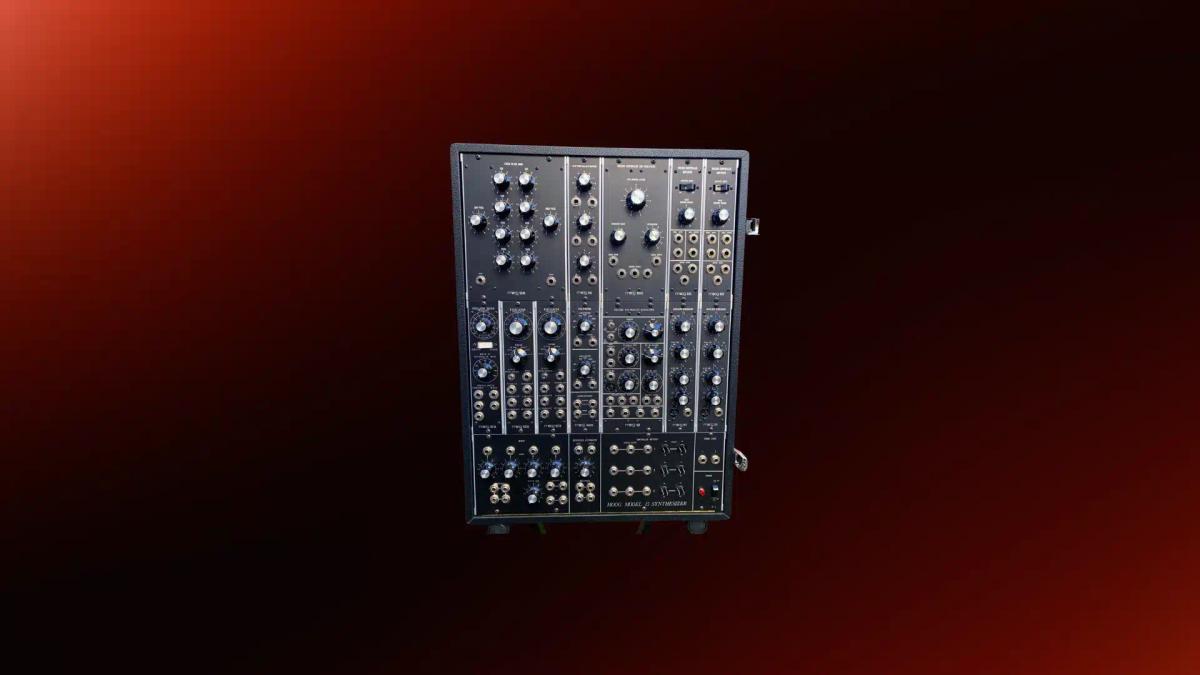
Moog System 15 synthesizer

The Moog System 15 is the smallest of the three modular synthesizers Moog introduced in 1973 alongside the System 35 and System 55, the final generation of the 900 Series that began in the 1960s.

Sold in a single Tolex-covered portable cabinet, it carried three oscillators built around the then-new 921 design, the 904A ladder filter, a fixed filter bank, two envelope generators, two VCAs and a noise source, all patched with cables and played from a separate keyboard controller. Moog’s catalogs and dealers also called it the Model 15 or Synthesizer 15. It matters as the most compact way to own a real Moog modular in its mature form, and as the system Moog chose to reissue in a run of 150 units in 2015.

Moog System 15 sound and character

The Moog System 15 sounds like the large Moog modulars in miniature, because its modules are the same ones. Three oscillators (one 921 and two 921B units slaved to a 921A driver) feed the 904A, the 24dB per octave transistor ladder low-pass filter that defined the Moog sound, and from there two 902 VCAs shaped by two 911 envelope generators. The result is the deep, round bass and thick, slightly unstable lead tone heard on countless 1970s records, with the extra weight that three oscillators through a ladder filter provide.

The 921 series is what separates this generation from the 1960s systems. Moog introduced it in 1972 to replace the 901 oscillators, with better tuning stability and the 921A driver allowing one control panel to set the frequency of several oscillators at once. Synthplex credits the revised oscillators with improving tuning stability, though a vintage Moog System 15 still needs warming up and occasional retuning. The 907 or 907A fixed filter bank adds a set of bandpass filters that carve formant-like color into a sound, and the 923 supplies white and pink noise with its own low-pass and high-pass filters, useful for wind, percussion and breathy textures.

Its limits are those of a small modular. There is no dedicated LFO module, so vibrato and slow sweeps usually mean dedicating an oscillator to modulation, and there is no sequencer: the System 35 and 55 were the systems designed to work with the 960 Sequential Controller. With two envelopes and two VCAs, more than one articulated voice is difficult, although the duophonic keyboards Moog offered allowed two notes from separate oscillators.

In character the Moog System 15 is unmistakably vintage and analog: warm, slightly loose in pitch, heavy in the low end, and capable of very large sounds from very few modules. It suits bass, leads, effects and sound design rather than chords. Gordon Reid, reviewing Moog’s app version for Sound On Sound in 2016, described the sound of the emulated system as excellent and strongly characterful, a fair description of the hardware it copies.

Features and architecture

  • Manufacturer: Moog Music (Moog Music Inc. for the 2015 reissue)
  • Year introduced: 1973, according to Moog’s 2015 announcement; several references, including surviving catalogs and Vintage King, date it to 1974
  • Production years: 1973 to 1981 for the original, according to Synthplex; reissue built in a single run of 150 units around 2015
  • Synthesis type: analog subtractive, modular (patch-cord)
  • Category: portable single-cabinet modular synthesizer (900 Series, 5U format)
  • Polyphony: monophonic as a voice; duophonic keyboard controllers allowed two notes from separate oscillators
  • Original price: not well documented; a reader comment on Synthtopia gives $3,845 for 1976, which is unverified; the 2015 reissue cost $10,000
  • Current market price: RL Music sold a restored vintage Moog System 15 with keyboard for £14,990 around 2017 and a nearly new reissue for £10,500 in 2019; current public prices are scarce
  • Oscillators: one 921 voltage-controlled oscillator, one 921A oscillator driver and two 921B oscillators (three oscillators in all)
  • Filter: 904A 24dB per octave transistor ladder low-pass filter; 907 or 907A fixed filter bank; 923 noise source with low-pass and high-pass filters
  • Amplifiers: two 902 VCAs
  • LFOs: none dedicated; oscillators can be used at sub-audio rates
  • Envelopes: two 911 envelope generators (attack, initial decay, sustain level, final decay)
  • Modulation system: free patching with 1/4-inch cables; 995 attenuators and CP-series control panels (CP3 mixer and CP4A on vintage examples, CP15 console panel on the reissue)
  • Sequencer / arpeggiator: none built in; the 960 Sequential Controller was associated with the larger systems
  • Effects: none
  • Memory: none; every sound is a patch
  • Keyboard: separate controller; vintage examples appear with the 950 or a 49-note duophonic 952, and the reissue line offered an optional five-octave (61-note) duophonic keyboard
  • Inputs / outputs: 1/4-inch patch jacks throughout, trunk lines, and S-trigger connections on Cinch-Jones sockets
  • MIDI / USB: none on the original or the reissue
  • Display: none
  • Dimensions / weight: single suitcase-style Tolex cabinet; published dimensions and weight are not consistently documented
  • Power: internal supply; vintage US units run on 110V, while the reissue has a rear voltage switch

Strengths

  • It offers the genuine Moog modular sound in the smallest original package. The 921 oscillators, 904A filter and 902 VCAs are the same modules found in the System 55.
  • It is portable in a way the big systems are not. CDM described the reissue as the one you could actually move around yourself.
  • Three oscillators through the ladder filter give it real weight. It produces bass and lead sounds as large as many far bigger systems.
  • The fixed filter bank and filtered noise source extend it well beyond basic subtractive patches, into formant shaping and effects.
  • Its compact module set makes it a readable teaching instrument. Every connection is visible, which is why Moog later used it as the basis for an educational iOS app.
  • Its modules are documented and partly shared with current reissues, which helps with service and expansion.

Limitations

  • It is monophonic in practice, with only two envelopes and two VCAs to articulate sounds.
  • There is no dedicated LFO, so modulation usually costs an oscillator.
  • It has no sequencer, and Moog positioned the sequencer cabinet and 960 controllers with the larger systems.
  • Nothing is stored. Each sound has to be patched and set by hand, which makes recall slow and live changes awkward.
  • Vintage units need care: Cinch-Jones trigger cables, aging jacks and US-only power supplies can complicate use outside North America.
  • Both the original and the reissue are expensive, and $10,000 for the 2015 Model 15 drew criticism at the time, with Great Synthesizers calling it absurdly expensive.
  • The naming is confusing. Moog System 15, Model 15 and Synthesizer 15 refer to the same line, while Behringer has sold both a Eurorack System 15 and a separate desktop semi-modular called Model 15.

Historical context

Moog’s modular systems began in the mid-1960s with the Synthesizer I, II and III, followed by console and portable versions such as the IIIc and IIIp, and smaller systems such as the 10 and 12. By the early 1970s the company was also selling the Minimoog, which had shown that a pre-wired portable instrument could reach far more musicians than any modular. The 1973 range of Moog System 15, 35 and 55 was a consolidation: a reduced, standardized set of configurations built from the newest modules, with the 921 oscillators (introduced in 1972) and later the 923 noise source replacing older designs.

The Moog System 15 was the portable entry point of that range, a single cabinet that could be carried to a session. Its contents were fixed at the factory, though owners could and did add modules. Synthplex gives a production span of 1973 to 1981, a period in which Moog passed through new ownership and shifted its emphasis toward performance keyboards and polyphonic instruments. Modular synthesizers became a small part of the business as cheaper integrated synths took over, and the 900 Series came to an end with the decade.

In January 2015, at NAMM, Moog Music announced that it would rebuild the System 55 (55 units at $35,000), System 35 (35 units at $22,000) and Model 15 (150 units at $10,000), working from 1970s schematics and the original circuit board films, with hand-stuffed and hand-soldered boards and photo-etched aluminum panels. The approach built on the Emerson Moog Modular recreation shown at Moogfest 2014. The Model 15 run was completed around 2015; by mid-2017 KMR Audio was advertising its last unit in stock. Moog followed in 2016 with the Model 15 app for iOS, priced at $29.99.

Legacy and significance

The Moog System 15’s significance lies in what it represents within the Moog story: the final, mature form of the modular that started the company, reduced to a size an individual musician could own and move. The larger System 55, covered separately on this site, is the more famous studio monument, as is the earlier Synthesizer III, but the Moog System 15 shows the same technology in the configuration most likely to be used on stage or in a small studio.

Its second life has been larger than its first. The 2015 reissue, at 150 units, was the largest of the three runs Moog announced that year, and its module set became a template for later products. Moog’s Model 15 app for iOS turned the system into a teaching tool, with Reid praising its sound while criticizing a shortage of mixers. Third parties built on the same idea: COTK in Portugal and Synth-Werk in Germany offered Model 15 recreations, the latter at 6,190 euros in 2019, and Behringer’s Eurorack System 15 reproduces the module list, including the 921, 921A, 921B, 904A and 911, for a fraction of the cost.

For the category, the Moog System 15 stands as the bridge between the Moog modular and the modular revival. Players who first met patch cables on Eurorack can trace the vocabulary of oscillator drivers, ladder filters and fixed filter banks straight back to this cabinet, and the reissue’s 150-unit run at $10,000 showed how much that lineage still counts.

Artists, users, and curiosities

Documented use of the original Moog System 15 is thinner than for the bigger systems, and many credits refer generally to Moog modulars. Larry Fast is listed as a Moog System 15 user, and Keyboard magazine reported that his live rig with Nektar was built around a Moog 15 and his prototype Polymoog.

Synthplex associates the Moog System 15 with session player Michael Boddicker’s portable studio work and with the Cheap Trick songs “Surrender” and “On Top of the World”. Harold Faltermeyer is often credited with using a Model 15 for the bass part of “Axel F” from Beverly Hills Cop (1984), and songwriter Holly Knight has said a Model 15 was her first synthesizer.

The reissue reached a newer generation. Equipboard points to video and photographs showing Model 15 systems in the studios of Trent Reznor and Pokémon composer Junichi Masuda, and Suzanne Ciani, who had worked with the original Moog modulars, has said Moog asked her to demonstrate the reissued Model 15.

Among the curiosities, CDM noted that the optional keyboard for the reissued systems could play “a whopping two notes at once”, a faithful recreation of the duophonic controllers of the 1970s. Vintage systems surfacing on the market also carry their own histories: one restored Moog System 15 sold by RL Music had spent years in the collection of London’s Turnkey music store and still ran only on US 110V power, while a reissue sold by the same dealer in 2019 had been resold after its first owner found, within an afternoon, that modular synthesis did not suit him.

Market value

  • Current market position: a collectible vintage modular in original form and a limited-edition modern instrument in reissue form, both bought by specialists
  • New price signal: none from Moog; the 150-unit reissue at $10,000 has ended (KMR Audio advertised its last unit in 2017), and the closest new hardware is third-party recreations or Behringer’s Eurorack System 15, listed at about 503 euros before VAT
  • Used market signal: RL Music sold a restored vintage Moog System 15 with keyboard at £14,990 around 2017 and a nearly new reissue (serial 123) at £10,500 in 2019; current public listings are scarce, so prices are best checked with specialist dealers
  • Availability: rare in both forms; vintage examples surface occasionally through specialist dealers and auctions, and reissues change hands privately
  • Buyer notes: check module dates and originality, oscillator tracking, filter and envelope function, jack and trigger socket condition, power supply voltage, and the included keyboard and cabling
  • Support ecosystem: good for a vintage modular, with documented 900 Series circuits, specialist technicians, the Moog community, and clones that share module designs
  • Market character: collectible and stable, driven by the Moog name and modular history rather than by practicality
  • Long-term position: likely to stay valuable as the most portable genuine 900 Series system, with the original commanding a premium over the reissue

Conclusion

The Moog System 15 is not the grandest Moog modular, and it was never meant to be. It took the modules that made the larger systems famous (the 921 oscillators, the 904A ladder filter, the 911 envelopes) and fitted them into a single cabinet that one person could carry, play and understand. That reduction gave it a long afterlife: a 150-unit reissue, an iOS app, Eurorack clones and a module list that modular players still recognize. For anyone tracing how Moog’s modular ideas reached working musicians, the Moog System 15 is the clearest and most portable example.

Sources

  1. The Moog Modular returns!, Sound On Sound
  2. Moog Model 15 app (review by Gordon Reid), Sound On Sound
  3. NAMM 2015: Moog Announces The Return Of The Modular, Sonic State
  4. Moog Brings Back The Classic Moog Modular Synthesizer, Synthtopia
  5. Moog Model 15 Modular Synthesizer Demo, Synthtopia
  6. Moog’s historic big modulars return, CDM
  7. Moog to restart production on a trio of legendary modular synths, Fact
  8. New Moog modulars: luxurious revival, Great Synthesizers
  9. Moog Modulars, Vintage King
  10. Moog System 15: the last one ever, KMR Audio
  11. Moog System 15 and 950, RL Music
  12. Moog System 15 (reissue), RL Music
  13. 1974 Moog Model 15 Synthesizer For Auction, MATRIXSYNTH
  14. 900 Series (Moog), Zoe Blade’s notebook
  15. Moog Modular 15, Synthplex
  16. Moogs Model 15 Modular im 1:1 Maßstab bei Synth-Werk, Bonedo
  17. Behringer System 15, Music Store
  18. Moog Model 15, Equipboard
Bernardo de Azevedo
Written by
Bernardo de AzevedoFounder & Editor

His connection with music began at age 6, in the 1980s, when his father introduced him to Jean-Michel Jarre's Rendez-Vous on vinyl. He works professionally in the legal field, while synthesizers became his space for abstraction and creative exploration. Founder of The Synth Source.