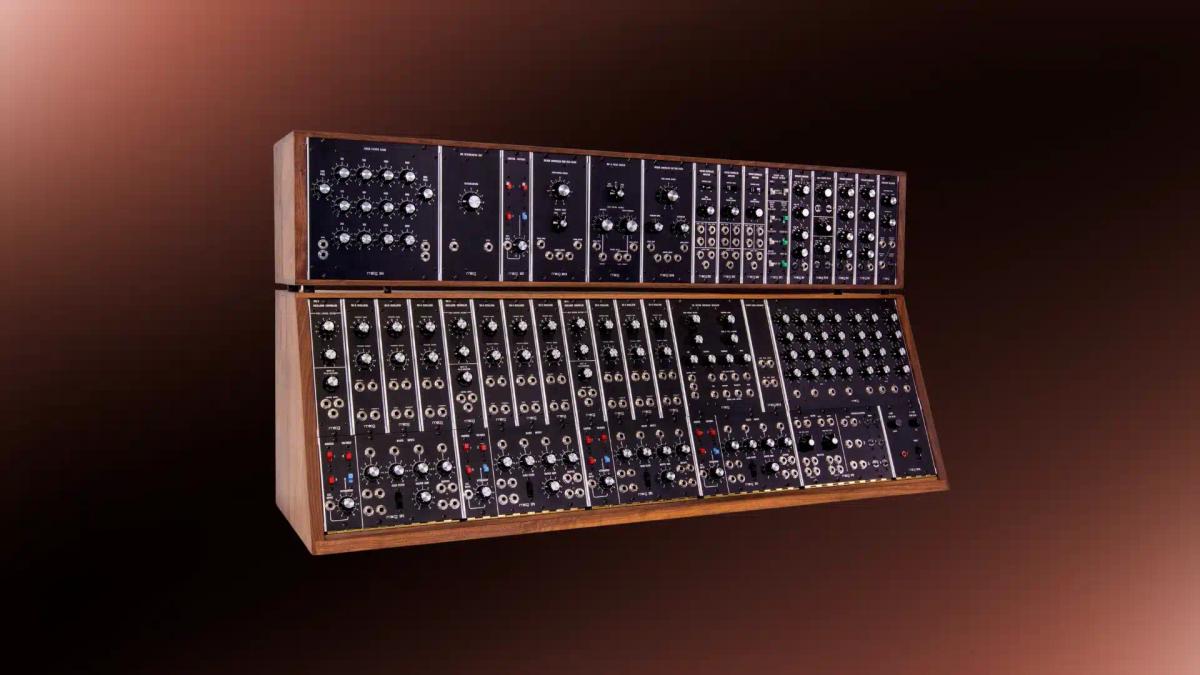
Moog Synthesizer III: The flagship catalog modular that defined the classic Moog sound
The Moog Synthesizer III is a large, monophonic, voltage-controlled modular synthesizer that R. A. Moog Co. introduced in its 1967 short-form catalog alongside the smaller Synthesizer I and II, the first time the company used the word “synthesizer” to sell a product.
The Moog Synthesizer III is a large, monophonic, voltage-controlled modular synthesizer that R. A. Moog Co. introduced in its 1967 short-form catalog alongside the smaller Synthesizer I and II, the first time the company used the word “synthesizer” to sell a product. It later split into two versions, first named in Moog’s April 1969 price list: the IIIc, housed in walnut console cabinets for the studio, and the IIIp, a portable version in covered wooden cases with handles.
Built from Moog’s 900-series modules, with banks of 901 oscillators, the 904 ladder filters, 911 envelopes and a fixed filter bank, it was the most complete of Moog’s standard packages and the configuration behind a remarkable share of the records that introduced the public to the Moog Synthesizer III.
The Moog Synthesizer III sounds big in a specific, physical way. Its core is a bank of 901-series oscillators, with nine audio VCOs and a tenth usually used as a low-frequency modulator, each able to output sine, triangle, sawtooth and pulse waves at the same time across a 32′ to 2′ footage range. Stacking several of those slightly detuned voices into the 24 dB per octave 904A low-pass filter produces the thick, slowly beating unison tone that came to be heard as “the Moog sound.” Music Technology’s 1992 retrospective called the IIIc the most impressive-looking and sounding of all the Moog modulars.
That character is inseparable from instability. The early 901 oscillators drift with temperature, and even Moog’s own 2017 reissue documentation warned that tuning instability and susceptibility to interference are inherent to the design. Players who know the Moog Synthesizer III tend to treat this as part of the sound rather than a fault: the same 1992 article argued that, in sensitive hands, the earlier VCOs are preferable to the more stable 921 oscillators that replaced them. The result leans vintage, warm and alive rather than polished.
The system is also more than a bass and lead machine. A 904B voltage-controlled high-pass filter, unusual for the period, can be coupled with the low-pass through the 904C to form band-pass and band-reject responses. The 914 fixed filter bank, with twelve band-pass sections plus low and high cut, shapes formant-like colours that a single resonant filter cannot.
Add the 905 spring reverb, the 903A noise source and the 912 envelope follower, and the Moog Synthesizer III reaches into effects, textures and processing of external sound. When Moog rebuilt the IIIp in 2018, its engineers said the sound depended on the system being fully discrete, and they had the original inductors for the filter bank re-manufactured because modern parts would change its voice.
Features and architecture
Manufacturer: R. A. Moog Co. (later R. A. Moog Inc.), Trumansburg, New York
Year introduced: 1967 as the Moog Synthesizer III; the IIIc and IIIp designations first appear in the April 1969 price list
Production years: late 1960s to around 1973 according to Moog; individual systems were configured and built to order
Synthesis type: analog subtractive, voltage-controlled modular
Category: large-format (5U) studio and stage modular system
Polyphony: monophonic in standard form; multiple oscillators can be stacked under one key
Original price: the 1969 price list put the IIIp at $7,985, according to CDM; Music Technology later gave the IIIc as approximately $8,995 in its day
Current market signal: original systems change hands at collector prices; a 1968 three-cabinet IIIc was offered by a UK dealer at £125,000 in 2025
Oscillators: ten 901-series oscillators in the classic configuration (one 901 plus three 901A controllers driving nine 901B oscillators), with simultaneous sine, triangle, sawtooth and pulse outputs; 903A random signal (noise) generator
Filter: 904A 24 dB per octave voltage-controlled low-pass ladder filter, 904B voltage-controlled high-pass filter, 904C filter coupler; fixed filter bank (907 in early systems, 914 extended-range bank in later ones and in the reissue)
LFOs: no dedicated LFO module in the base package; one 901 oscillator is typically used as a modulation source
Modulation system: patch-cord routing between modules, with 992 control voltage and 993 trigger and envelope panels for attenuation and distribution; three 902 VCAs with linear and exponential response
Sequencer / arpeggiator: none in the base package; the 960 sequential controller (three rows of eight steps), 961 interface and 962 sequential switch were sold as a sequencer complement and often fill a third cabinet
Effects: 905 spring reverberation unit
Memory: none; every sound is a physical patch
Keyboard: 950 keyboard controller, monophonic, five octaves, with variable portamento and adjustable scale for microtonal work
Inputs / outputs: quarter-inch audio patch points, Moog S-trigger connections for gates, 984 four-channel matrix mixer for routing and output
MIDI / USB: none on original systems
Display: none
Dimensions / weight: varies by configuration; the 2017 IIIc reissue used a main console cabinet of about 48.5 x 15 x 14 inches and an upper cabinet of about 48.5 x 9.5 x 8.5 inches; the IIIp is split into separate portable cases
Power: built-in supplies providing the +12 V, -6 V and -10 V rails the modules need; the reissues use a 350 W supply switchable between 120 and 230 VAC
Strengths
It offers a genuinely large voice. Nine audio oscillators feeding ladder filters and three VCAs allow layered, detuned tones and multi-part patches that small modulars and the later Minimoog could not match.
Its filtering is unusually broad for the era. The pairing of voltage-controlled low-pass and high-pass filters with a coupler, plus a fixed filter bank, gives it a range of tone shaping that goes well beyond a single resonant low-pass.
It arrived as a coherent instrument rather than a parts list. As a pre-configured package with a keyboard, cabinets and power, it let composers and studios buy a working system rather than design one from scratch.
The 900-series modules are relatively simple, discrete circuits. Restorers report that they can be serviced with ordinary components and careful hand selection of parts, which has helped many systems survive.
The IIIp made the same architecture portable. Splitting the system into cases with handles brought the full studio configuration closer to stages and touring rigs.
Limitations
It is monophonic. Even Mike Vickers, an early British owner, recalled finding it absurd that such an expensive machine played one note at a time; chords and harmony meant multitracking on tape.
Tuning drift is part of the design. The 901 oscillators need regular attention, and the original 901A controllers in some systems tracked only a limited range until Moog modifications extended them.
There is no patch memory. Every sound has to be rebuilt with cables, which made live performance slow and fragile.
It is large, heavy and expensive. In 1969 it cost several thousand dollars, and today originals sit firmly in collector territory.
Old systems need specialist care. Restorers describe failing switches and jacks, leaky capacitors, drifted resistors, obsolete edge connectors and RTL logic in the sequencer modules, and S-trigger cabling is hard to source.
Historical context
Moog began taking orders for individual modules and custom systems in 1965, after working with a circle of electroacoustic composers who had been building studios out of surplus telecom and test equipment. Those first systems were bespoke. The 1967 catalog changed the proposition by offering three standard configurations, Synthesizer I, II and III, and by giving the product a name that stuck. By that year Moog and around ten technicians were hand-building systems in a brick storefront in Trumansburg, each one taking weeks.
The Moog Synthesizer III sat at the top of that range. It bundled what a serious studio would otherwise specify piece by piece: oscillator banks, filters, envelopes, VCAs, mixing, reverb and a keyboard. By the April 1969 price list, the line had split into console (c) and portable (p) versions, a sign that the Moog Synthesizer III was moving out of university studios and into recording rooms and onto stages. The keyboard itself was part of that shift. Bob Moog’s preference for an instrument that behaved like a musical instrument, rather than a general sound-making machine, made the system legible to players.
The timing was decisive. Within two years, records made with Moog modulars were selling to mainstream audiences, and demand from pop, rock and jazz musicians was rising. The same success exposed the system’s cost and complexity, and Moog’s answer was the far simpler Minimoog. On the modular side, new 921 oscillators led to a new range of numbered systems, the 15, 35 and 55, which succeeded the I, II and III; the System 55 has its own article on this site. Moog dates the end of IIIp production to 1973.
Legacy and significance
The Moog Synthesizer III matters because it was the moment the Moog Synthesizer III stopped being a laboratory concept and became a product with a name, a catalog number and a recognizable sound. Earlier custom systems proved the principle of voltage control. The III packaged that principle into something a studio could order, install and learn, and in doing so it fixed many of the conventions later players took for granted: keyboard control of oscillator banks, the low-pass ladder filter as the central tone shaper, ADSR envelopes, and patch-cord modulation as the grammar of sound design.
Its influence also runs through the instruments that replaced it. The Minimoog distilled the III’s most common patch, oscillators into a ladder filter into an enveloped amplifier, into a fixed, portable form. The later System 55 refined its modules. Software emulations and Moog’s own reissues have kept the 900-series voice in circulation.
When Moog marked the 50th anniversary of the original systems, it chose to rebuild the IIIc in 2017 and the IIIp in 2018 from original documentation, artwork and circuit board files, in runs of 25 and 40 units at $35,000 each. That a manufacturer would treat a late-1960s package as a benchmark worth recreating, down to custom inductors and hand-crimped wiring, says a great deal about where the company locates its own origin.
Culturally, the III is also a reminder that the early synthesizer sound was not the product of a single box but of systems. Many of the most famous early Moog recordings were made on III-family instruments that their owners expanded, rewired and customized. The catalog system was a starting point, and its open architecture is part of why it became so widely heard.
Artists, users, and curiosities
Wendy Carlos built Switched-On Bach (1968) on a heavily customized Moog modular that Moog’s own reissue material describes as a customized Moog Synthesizer III. Bob Moog’s papers at Cornell include a 1967 sketch of a touch-sensitive keyboard designed for Carlos. Isao Tomita used a Moog IIIp, described by Moog as the first in Japan, alongside multitrack tape on Snowflakes Are Dancing.
In Britain, the Moog Synthesizer III’s arrival is closely tied to the Beatles. Electronic Sound reports that George Harrison’s Moog was the first in the UK, that he used it for his solo album Electronic Sound, and that Mike Vickers programmed it for a single afternoon session at Abbey Road in August 1969, producing the Moog parts on “Maxwell’s Silver Hammer,” “I Want You (She’s So Heavy),” “Here Comes the Sun” and “Because.”
Vickers bought his own IIIc in 1968 and later used it for KPM library albums such as A Moog for All Reasons. Sound On Sound adds that Jon Weiss travelled to London to deliver the Rolling Stones’ 3P modular in person.
Keith Emerson’s famous stage Moog, which Music Technology describes as a IIIC with its three consoles joined in one large walnut case, grew over years into a 400 lb instrument that was, in essence, a monosynth. Moog reproduced it in 2014. TONTO, the vast synthesizer built by Malcolm Cecil and Robert Margouleff, began life as Margouleff’s Moog Series III before other instruments and custom modules were added.
The most intriguing curiosity concerns identity. Sources disagree on exactly which III the Beatles used. Electronic Sound calls Harrison’s instrument a IIIc, while the Deutsches Museum identifies a IIIp, serial number 1095, as a Beatles instrument shipped in January 1969 and later returned to Moog after John Lennon found it too complicated. That IIIp was then bought by German composer Eberhard Schoener, who donated it to the museum in 2019, still working. The confusion is itself telling: these systems were configured, modified and resold so often that even their famous histories are hard to pin to one cabinet.
Moog Synthesizer III market value
Current market position: a blue-chip historical instrument, valued as much for provenance and completeness as for sound
New price signal: no new originals; Moog’s limited reissues sold at $35,000 for the IIIc (25 units, 2017) and IIIp (40 units, 2018), and both are listed as no longer available
Used market signal: original systems sit at the top of the vintage market; a 1968 three-cabinet IIIc with sequencer cabinet was offered by a UK dealer in 2025 at £125,000 as-is, or £130,000 with servicing
Availability: very hard to find; Music Technology estimated that only about 300 Moog modular systems of all kinds were made, and complete, all-Moog III systems surface rarely
Buyer notes: check that modules are genuine and match the claimed configuration, whether oscillator controllers have been modified, the state of power supplies, jacks, switches and capacitors, and whether the unit is a 110 V original needing step-down transformers; budget for specialist servicing and S-trigger cabling
Support ecosystem: specialist restorers, Moog’s reissue programme and documentation, third-party 5U clones, and software recreations keep the 900-series architecture supported
Market character: collectible and provenance-driven; systems linked to notable studios or artists carry extra weight
Long-term position: stable to rising as a historical artifact, with the reissues adding a second, newer tier rather than displacing originals
Conclusion
The Moog Synthesizer III is where the Moog Synthesizer III became a recognizable instrument rather than a custom research tool. In its walnut IIIc and portable IIIp forms, it combined banks of drifting discrete oscillators, the ladder filter and a five-octave keyboard into a package that studios could buy and musicians could learn.
The records made on it set the public’s idea of what a synthesizer sounds like, and its architecture became the template that the Minimoog compressed and the System 55 refined. It is monophonic, unstable, heavy and costly, and none of that diminishes its standing. The Moog Synthesizer III matters because it turned voltage control into a standard instrument, and much of the history that followed was built on that foundation.
His connection with music began at age 6, in the 1980s, when his father introduced him to Jean-Michel Jarre's Rendez-Vous on vinyl. He works professionally in the legal field, while synthesizers became his space for abstraction and creative exploration. Founder of The Synth Source.