

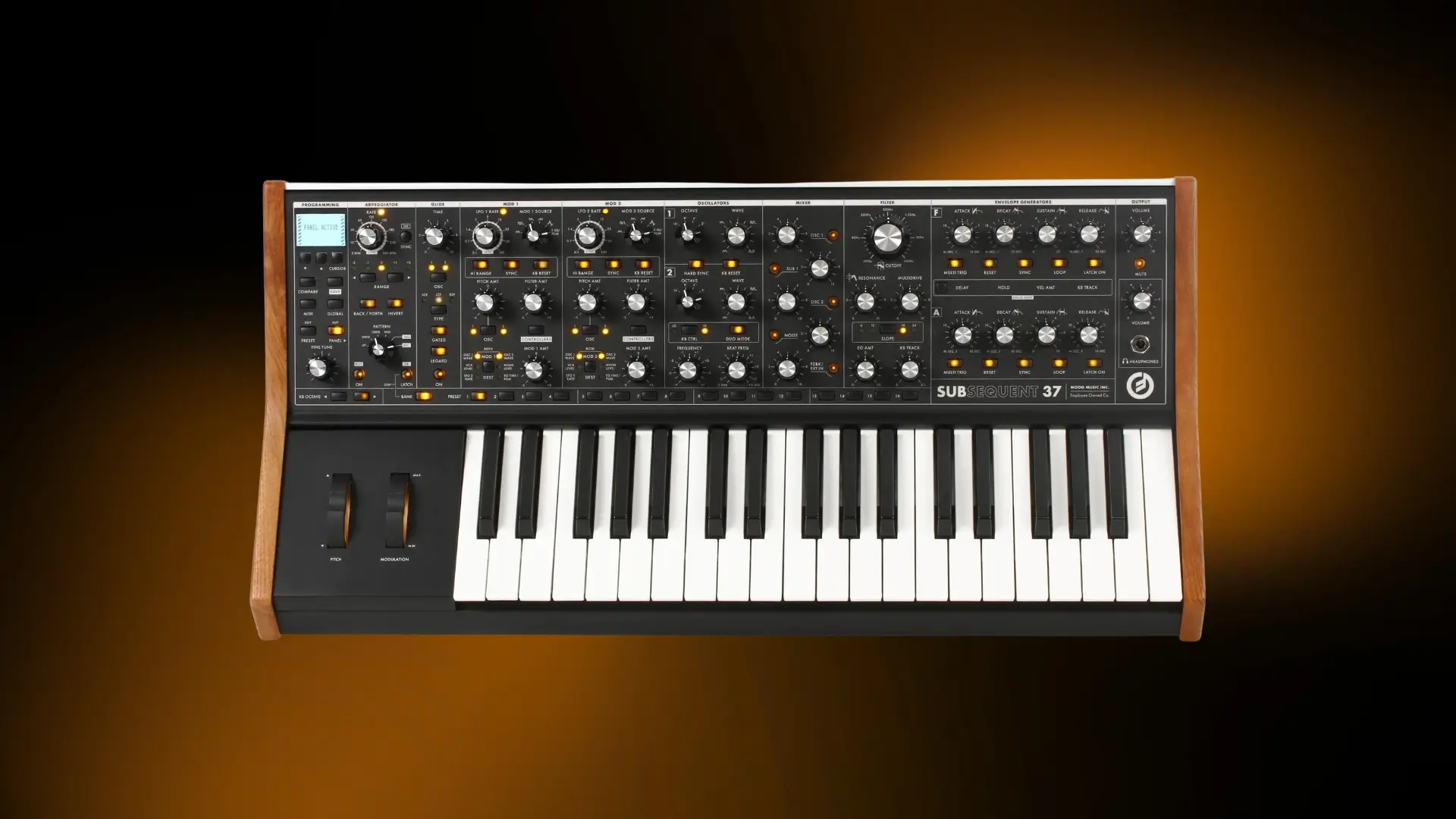
The Moog Subsequent 37 is a 37-key programmable paraphonic analog synthesizer introduced in 2017 as the successor to the Sub 37 Tribute Edition. It kept the essential Sub 37 idea: two-note paraphony, hands-on control, patch memory, modulation depth, a 64-step sequencer, and a modernized Moog ladder-filter voice. Its importance lies less in novelty than in refinement. Moog took an already successful performance monosynth and adjusted the mixer headroom, filter gain-staging, MultiDrive behavior, keybed, headphone amplifier, and software-editor integration, turning the Moog Subsequent 37 into one of the defining premium analog monosynths of the late 2010s.
Table of Contents
Moog Subsequent 37 sound and character
The Moog Subsequent 37 sounds like a Moog that has learned to manage its own excess. Its basic vocabulary is familiar: dense basses, round leads, saturated low-end pressure, resonant filter sweeps, sync tones, and muscular sequences. But compared with the earlier Sub 37, its defining character is the expanded space before distortion. The increased mixer headroom allows cleaner oscillator combinations before the signal collapses into drive, while the reworked filter gain-staging and retuned MultiDrive give the Moog Subsequent 37 a broader span between controlled warmth and aggressive clipping.
That makes the Moog Subsequent 37 unusually flexible for a Moog monosynth. It can do the expected thick basses and singing leads, but it is not only a brute-force low-end machine. The selectable ladder-filter slopes make it possible to move from gentler, more open filtering to the classic 24 dB/octave Moog low-pass response. The MultiDrive section pushes it toward harder electronic bass, industrial edges, and snarling lead tones, while the paraphonic mode gives it a strange harmonic tension that is neither true polyphony nor ordinary monophony.
The two-note paraphony is central to the instrument’s personality. Each oscillator can follow an independent pitch, but the sound still passes through one shared filter path. That means intervals, fifths, octaves, and simple two-note figures behave like fused gestures rather than separate voices. This is not a substitute for a polyphonic synth. It is more interesting than that: a way to make a monosynth momentarily argue with itself.
Features and architecture
- Manufacturer: Moog Music.
- Year introduced: 2017.
- Production years: 2017 to present, based on the original 2017 launch and current retail availability.
- Synthesis type: Analog subtractive synthesis with a 100% analog sound engine.
- Category: Programmable keyboard analog synthesizer with monophonic and two-note paraphonic operation.
- Polyphony: Selectable monophonic or duophonic/paraphonic operation.
- Original price: US $1,499 at launch.
- Current market price: New listings in 2026 commonly sit around US $1,899 in the United States, with European street pricing varying by retailer; used-market values generally sit below new pricing and depend strongly on condition, region, and whether the original box/accessories are included.
- Oscillators: Two variable-waveshape oscillators, one square-wave sub oscillator, one analog noise generator, and external-input/filter-feedback routing.
- Filter: Moog ladder filter with 20 Hz to 20 kHz range, selectable 6, 12, 18, and 24 dB/octave slopes, resonance, and MultiDrive.
- LFOs: Two modulation buses using sources such as triangle, square, saw, ramp, sample and hold, and filter-envelope/programmed modulation; LFO range extends from 0.01 Hz to 1000 Hz.
- Envelopes: Two DAHDSR envelope generators for filter and amplifier, with looping, sync, reset, latch, and multi-trigger behavior.
- Modulation system: Two assignable modulation buses with destinations including oscillator pitch, oscillator wave shape, filter, LFO rate, VCA level, noise level, envelope time, and programmable destinations.
- Sequencer / arpeggiator: Arpeggiator and paraphonic 64-step sequencer, with step editing, rests, ties, ratcheting, skipping, rotation, and sequence storage with presets.
- Effects: No onboard reverb, delay, chorus, or multi-effects section.
- Memory: 256 presets arranged as 16 banks of 16 patches.
- Keyboard: 37-note semi-weighted keyboard with velocity sensitivity and aftertouch.
- Inputs / outputs: 1/4-inch audio input, 1/4-inch audio output, headphone output, pitch CV input, filter CV input, volume CV input, and KB gate input.
- MIDI / USB: DIN MIDI In and Out, plus MIDI over USB; USB does not carry audio.
- Display: LCD display.
- Dimensions / weight: Approximately 26.375 inches wide, 14.75 inches deep, and 6.75 inches high; approximately 22 lb / 10 kg.
- Power: Universal 100–240 VAC, 50/60 Hz, 13 W power supply.
Strengths
- The sound engine covers both clean and saturated Moog territory more convincingly than a simple “fat bass” summary suggests. The extra mixer headroom gives the oscillators more room before distortion, while the reshaped filter gain and retuned MultiDrive let the player choose between polish, compression, and heavy drive.
- The interface is unusually immediate for a programmable analog synth. Forty knobs and seventy-four switches put most core functions on the front panel, which matters because the Moog Subsequent 37 invites real-time performance rather than menu-based programming.
- The two-note paraphonic mode is musically useful when treated on its own terms. It is not a polysynth, but it gives basslines, intervals, drones, and sequenced patterns a harmonic instability that ordinary monosynths cannot produce.
- The modulation system is deep without abandoning the feel of a traditional subtractive instrument. The two modulation buses, high-range LFO behavior, programmable destinations, looping envelopes, and sequencer modulation make it capable of evolving patterns and animated timbres.
- The sequencer is more than a simple note recorder. Its rests, ties, ratchets, skips, pattern rotation, and per-preset storage make it useful for live motifs, bassline variations, and DAW-synchronized hardware patterns.
- The 37-key format is a practical compromise. It is large enough for two-handed programming and expressive leads, but still compact enough to function as a studio centerpiece rather than a full-size keyboard commitment.
- Patch memory and the editor/librarian ecosystem make it more compatible with modern production than many traditional analog monosynths. It preserves a tactile front panel while still allowing preset management and DAW-oriented workflows.
Limitations
- The paraphony is limited to two notes and shares a single filter path, so it cannot replace a true polyphonic analog synthesizer for pads, independent voice articulation, or complex chord work.
- There are no onboard effects. This keeps the signal path focused, but it also means that many finished sounds need external delay, chorus, reverb, distortion, or modulation effects to sit in a modern mix.
- It is monotimbral in practical use. Even with two-note paraphony, the Moog Subsequent 37 is built around one patch at a time, so layered multi-part arrangements require recording passes or external duplication.
- The price puts it above many modern compact analog and hybrid monosynths. Its value depends on whether the buyer wants the specific Moog build, interface, tone, and performance workflow rather than simply an affordable analog bass machine.
- The lack of CV outputs on the standard Moog Subsequent 37 matters for modular users. The earlier Subsequent 37 CV edition offered expanded CV/Gate outputs, but the regular production model focuses on CV inputs rather than modular output control.
- Its strength as a character instrument can also be a constraint. The ladder-filter identity, low-end density, and drive behavior are central to its appeal, but they can dominate an arrangement if not carefully arranged or processed.
Historical context
The Moog Subsequent 37 arrived in 2017, after the Sub 37 had already proved that Moog’s modern monosynths could combine analog circuitry, patch memory, deep modulation, and a performance-oriented front panel. The earlier Sub 37 had itself expanded on the Sub Phatty era by adding more keys, more panel access, two-note paraphony, an arpeggiator, and a step sequencer.
The timing mattered because Moog was navigating a complicated space. On one side stood the company’s symbolic inheritance: the Minimoog, the ladder filter, the premium American analog monosynth. On the other side was a modern market in which musicians expected memory, MIDI, USB, DAW integration, performance controls, and deeper modulation than vintage monosynths typically offered. The Moog Subsequent 37 did not solve that tension by becoming digital or by pretending to be vintage. It solved it by making a modern analog performance instrument that still behaved like a Moog.
Its launch also followed the limited Subsequent 37 CV, which introduced several of the same sonic and playability updates but added expanded CV/Gate outputs and a limited-edition presentation. The standard Moog Subsequent 37 then brought the main sound-engine and keyboard improvements into regular production while omitting the extra CV-output architecture. In that sense, the Moog Subsequent 37 was not a radical new branch. It was a market correction, a refinement, and a consolidation of what users had already signaled they wanted from the Sub 37 platform.