Home›Synths›Moog Subsequent 37 CV: The limited-edition analog synth…
Synths

Moog Subsequent 37 CV: The limited-edition analog synth that bridged Moog and modular

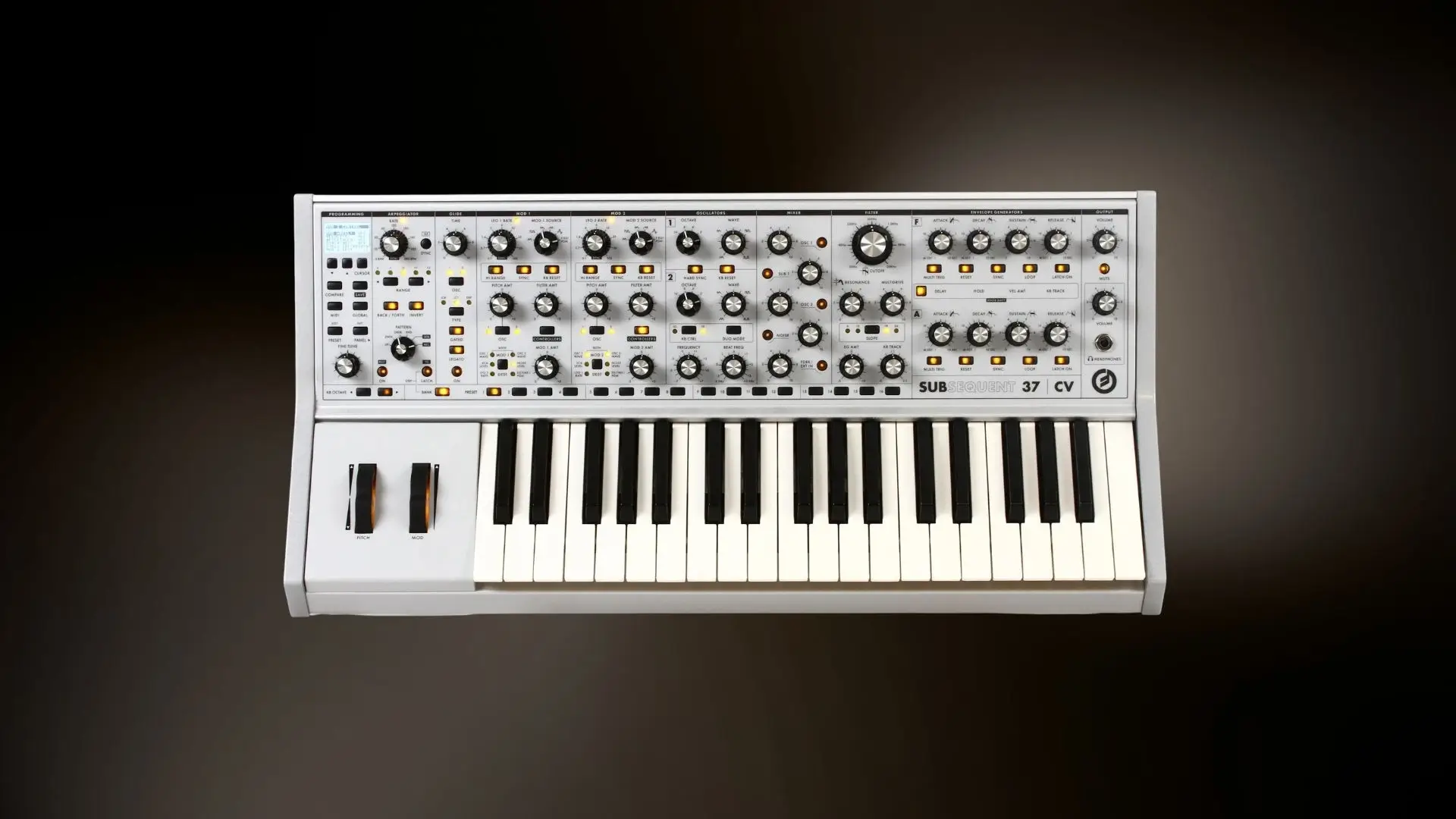
The Moog Subsequent 37 CV is a limited-edition 37-key paraphonic analog synthesizer introduced in 2017 as a redesign of the Sub 37 Tribute Edition.

Bernardo de Azevedo
Bernardo de Azevedo
· Updated
Moog Subsequent 37 CV: The limited-edition analog synth that bridged Moog and modular

The Moog Subsequent 37 CV is a limited-edition 37-key paraphonic analog synthesizer introduced in 2017 as a redesign of the Sub 37 Tribute Edition. It kept the Sub 37’s hands-on performance architecture, two-note paraphonic behavior, 256-preset memory, arpeggiator, and 64-note step sequencer, but added four assignable CV outputs, two assignable gate outputs, an upgraded keybed, a high-powered headphone amplifier, a modified analog signal path, and a custom aluminum-and-wood exterior.

Its importance lies less in being a radically new Moog voice than in how it repositioned a modern Moog keyboard as a control center for voltage-based systems at a moment when modular synthesis had moved back into the center of electronic-music culture.

Moog Subsequent 37 CV sound and character

The Moog Subsequent 37 CV has the unmistakable density of a modern Moog monosynth, but it is not simply a raw bass machine. Its architecture gives it a wide span between clean, rounded analog tone and heavily saturated aggression. The two variable-waveshape oscillators, square-wave sub oscillator, pink-noise source, external-input path, mixer feedback, ladder filter, and MultiDrive circuit form a voice that can be smooth, compressed, unstable, or forceful depending on how hard the mixer and filter are driven.

Compared with the original Sub 37, the key sonic change is headroom. Moog reshaped the mixer and gain staging so the instrument could move more gracefully between cleaner tones and harmonic saturation. That matters musically because paraphonic playing is more exposed than monophonic bass: when two oscillators are playing independent pitches through a shared filter and amplifier path, excess gain can quickly turn intervallic movement into blur. The Moog Subsequent 37 CV’s expanded headroom gives Duo Mode more room to breathe while still allowing the filter and MultiDrive to compress, bite, and growl when pushed.

Its strongest sounds are basses, sync leads, sequenced patterns, acidic filter movements, overdriven drones, and animated two-note paraphonic figures. It is not a lush polysynth, and it should not be judged as one. Its personality comes from pressure, routing, and controlled instability: a compact keyboard that can behave like a precise analog instrument one moment and like a semi-modular command surface the next.

Features and architecture

  • Manufacturer: Moog Music.
  • Year introduced: 2017.
  • Production years: 2017 limited run.
  • Synthesis type: analog subtractive synthesis with digital control and patch memory.
  • Category: limited-edition 37-key paraphonic analog keyboard synthesizer.
  • Polyphony: selectable monophonic or duophonic operation, with two-note paraphonic behavior in Duo Mode.
  • Original price: $1,799 street price in the United States.
  • Current market price: used-market signals commonly sit around the high-$1,000 range, with Reverb Price Guide estimates in the $1,663 to $1,962 range for Good to Mint examples.
  • Oscillators: two variable-waveshape oscillators, one square-wave sub oscillator, one analog pink-noise generator, and external input or filter feedback as an additional sound source.
  • Filter: Moog ladder filter covering 20 Hz to 20 kHz, with selectable 6, 12, 18, and 24 dB-per-octave slopes and MultiDrive.
  • LFOs: two modulation buses with LFO waveforms including triangle, square, saw, ramp, and sample-and-hold; LFO range specified from 0.01 Hz to 1000 Hz.
  • Envelopes: two looping DAHDSR envelopes.
  • Modulation system: two fully assignable modulation buses, assignable modulation destinations, velocity, aftertouch, modulation wheel, and controller-based modulation.
  • Sequencer / arpeggiator: arpeggiator with paraphonic 64-note step sequencer and synchronization options.
  • Effects: no onboard effects section listed in the specifications.
  • Memory: 256 presets arranged as 16 banks of 16 patches.
  • Keyboard: 37 semi-weighted keys with velocity sensitivity and after pressure.
  • Inputs / outputs: audio input, audio output, headphone output, pitch CV input, filter CV input, volume CV input, keyboard gate input, four assignable CV outputs, and two assignable gate outputs.
  • MIDI / USB: 5-pin DIN MIDI In and Out, plus class-compliant MIDI over USB; USB does not carry audio.
  • Display: LCD display used for preset selection, menu navigation, and parameter editing.
  • Dimensions / weight: 6.75 inches high, 26.375 inches wide, 14.75 inches deep; approximately 22 lb, or 10 kg.
  • Power: universal 100 to 240 VAC, 50 to 60 Hz, 13 W.

Strengths

  • The Moog Subsequent 37 CV and gate outputs make it more than a self-contained Moog keyboard, allowing the instrument to drive large-format and Eurorack modular systems from its keyboard, sequencer, modulation, and performance controls.
  • The revised gain structure gives the instrument more usable dynamic range than the original Sub 37, especially when playing Duo Mode intervals where uncontrolled saturation can flatten harmonic detail.
  • The one-knob-per-function panel gives it a directness that many hybrid analog instruments lack, and the combination of 40 knobs, 74 switches, memory, MIDI automation, and CV output makes it both immediate and recallable.
  • The 64-note paraphonic step sequencer gives the synth a compositional role, not merely a sound-generator role, which is crucial for basslines, Berlin-school patterns, techno sequences, and modular clocked setups.
  • The upgraded keybed, velocity, aftertouch, and stronger headphone amplifier make it more credible as a performance instrument than a studio-only monosynth.
  • The limited 2,000-unit run gives the CV version a clearer collector identity than the standard Subsequent 37, especially because the Moog Subsequent 37 CV and gate outputs were not carried over to the regular production model.

Limitations

  • It is not a true polyphonic synthesizer; Duo Mode lets the two oscillators play independent pitches, but both pass through a shared filter and amplifier path.
  • The instrument has no onboard effects, so spacious pads, delays, chorus, and reverb-dependent textures require external pedals, rack gear, or DAW processing.
  • The Moog Subsequent 37 CV version is meaningfully rarer than the standard Subsequent 37, which makes replacement units harder to find and can make pricing inconsistent.
  • Buyers who do not use modular or CV-controlled gear may pay a premium for the feature that most clearly distinguishes this edition.
  • The shared paraphonic voice architecture can be expressive, but it also means two-note playing has envelope and filter compromises that a true two-voice or polyphonic synth would avoid.
  • Its size and weight are moderate by vintage standards but substantial compared with compact modern monosynths and desktop analog modules.
  • The small display is useful for deeper functions, but the instrument’s deeper editing still depends on menu navigation for some parameters.

Historical context

The Moog Subsequent 37 CV appeared in 2017, three years after the Sub 37 Tribute Edition had been shown at Winter NAMM 2014. The Sub 37 had already represented an important step for Moog because it brought extensive hands-on control, patch memory, sequencing, and two-note paraphonic behavior into a modern performance keyboard format. The Moog Subsequent 37 CV edition did not reject that design; it sharpened it.

Its timing mattered. By the mid-2010s, Moog had already moved into the contemporary semi-modular conversation with instruments such as the Mother-32, while Eurorack had become a major force in electronic-music production. The Moog Subsequent 37 CV answered a specific opportunity: many musicians wanted the authority and playability of a Moog keyboard, but also wanted voltage outputs that could command modular systems without treating the keyboard as an isolated island.

Later in 2017, the standard Subsequent 37 replaced the Sub 37 as Moog’s regular production model, carrying forward many of the Moog Subsequent 37 CV edition’s sonic and functional improvements, but without the aluminum aesthetic and without the CV and gate outputs. That makes the Moog Subsequent 37 CV model historically interesting: it was both a limited edition and a bridge prototype for the broader Subsequent 37 line.

Legacy and significance

The Moog Subsequent 37 CV matters because it captures a particular moment in Moog’s modern history. It stands between two ideas of the company: Moog as the maker of self-contained expressive keyboards, and Moog as a participant in the renewed culture of patch cables, control voltage, and modular interaction. In that sense, it is less a nostalgic reissue than a negotiation between the Minimoog-derived performance tradition and the modular habits that preceded it.

Its significance also comes from its restraint. Moog did not turn the Sub 37 into a full semi-modular synth with a patchbay. Instead, it added outputs that let the instrument project control outward. That decision preserved the Sub 37 workflow while allowing the keyboard, sequencer, wheels, aftertouch, and modulation system to become part of a larger voltage-controlled environment.

As a collector piece, the Moog Subsequent 37 CV has a cleaner identity than many cosmetic limited editions because its rarity is tied to functional hardware. The Moog Subsequent 37 CV outputs are not merely visual decoration; they change how the instrument participates in a studio. For players who use modular gear, the Moog Subsequent 37 CV edition is not just the rarer Subsequent 37. It is the version that most fully explains why the Sub 37 architecture remained relevant after the first wave of its popularity.

Artists, users, and curiosities

The Moog Subsequent 37 CV is associated less with a single famous recording than with its Moogfest launch ecosystem. The Moogfest Edition was preloaded with presets by S U R V I V E, Simian Mobile Disco, 808 State, Syrinx, and Zola Jesus, which gave the instrument a direct link to contemporary electronic, industrial, experimental, and club-adjacent music rather than only to Moog’s classic rock and prog inheritance.

A useful curiosity is the launch itself. The Moogfest Edition was a 125-unit version built on-site at Moogfest 2017 by Moog production engineers and marked with a custom badge. That turned the synthesizer into both an instrument and a festival artifact. 808 State later described working with Moog on a secret project to launch a new synth at the festival, which fits the way the Moog Subsequent 37 CV functioned culturally: not just as a product announcement, but as a symbolic meeting point between Moog history, live electronic performance, and the modular revival.

Market value

  • Current market position: limited-run modern Moog with stronger collector appeal than the standard Subsequent 37 because the CV and gate outputs were unique to this edition.
  • New price signal: the original U.S. street price was $1,799; the Moog Subsequent 37 CV model is no longer a normal new-stock item.
  • Used market signal: Reverb’s visible price-guide signal places Good to Mint examples around $1,663 to $1,962, though asking prices can vary because supply is thin.
  • Availability: harder to find than the standard Subsequent 37 because production was limited to 2,000 units worldwide.
  • Buyer notes: the Moog Subsequent 37 CV edition makes the most sense for users who want to integrate a Moog keyboard with Eurorack or other voltage-controlled systems; buyers who only need the internal sound engine may find the standard Subsequent 37 more rational.
  • Support ecosystem: the Subsequent 37 family benefits from Moog documentation, editor and librarian support, MIDI implementation, and a large user base around the Sub 37 and Subsequent 37 architecture.
  • Findability: intermittent rather than constant; listings appear, sell, and disappear more quickly than standard production models.
  • Long-term position: stable to mildly collectible, with value tied to functional rarity rather than nostalgia alone.

Conclusion

The Moog Subsequent 37 CV represents a precise kind of modern analog instrument: not a museum piece, not a full modular system, and not a true polysynth, but a performance-centered Moog that learned to speak fluent control voltage. Its importance is in the way it expands the Sub 37 idea outward. It keeps the immediacy of a playable Moog keyboard while making that keyboard a conductor for modular systems. For musicians who care about that bridge, the Moog Subsequent 37 CV edition remains the most historically distinctive member of the Sub 37 and Subsequent 37 lineage.


Bernardo de Azevedo
Written by
Bernardo de AzevedoFounder & Editor

His connection with music began at age 6, in the 1980s, when his father introduced him to Jean-Michel Jarre's Rendez-Vous on vinyl. He works professionally in the legal field, while synthesizers became his space for abstraction and creative exploration. Founder of The Synth Source.