

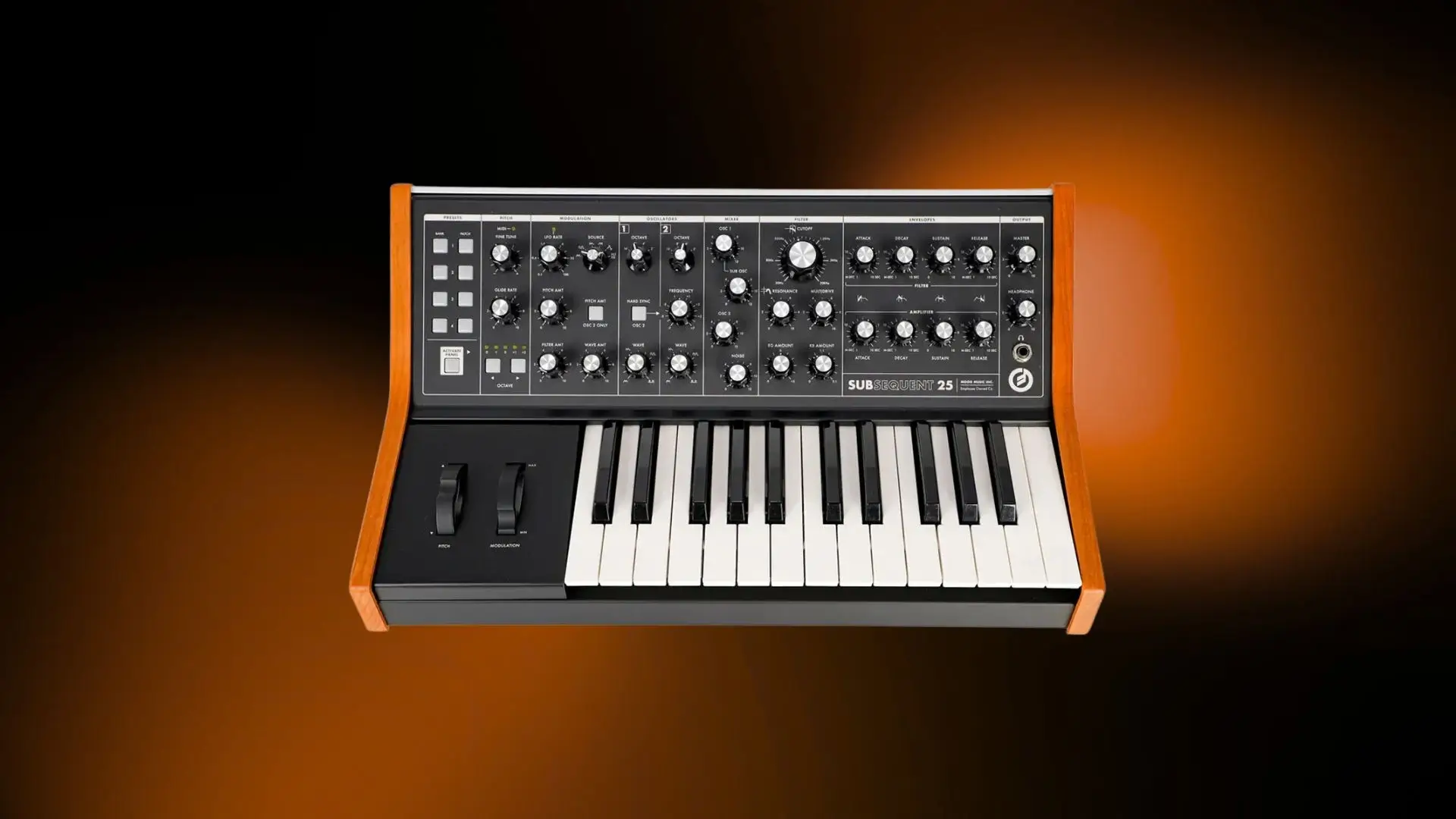
The Moog Subsequent 25 is a compact 25-key analog synthesizer introduced in 2020 as the successor to the Sub Phatty, carrying Moog’s modern Sub-series architecture into a smaller paraphonic performance instrument. It combines two variable-waveform VCOs, a sub oscillator, noise, a selectable-slope Moog ladder filter, MultiDrive, 16 onboard presets, MIDI and USB integration, and two-note paraphony. Its importance lies less in radical invention than in compression: it places a dense, aggressive, modern Moog voice into a format that is immediate, portable, and still physically serious.
Table of Contents
Moog Subsequent 25 sound and character
The Moog Subsequent 25 sounds like a compact instrument with a large low-frequency center. Its voice is built around a familiar Moog principle: oscillators, mixer, ladder filter, envelopes, and drive, arranged so that tone is shaped as much by gain staging as by pitch and cutoff. The result is not a polite monosynth. It can be round and smooth, but its identity becomes more distinctive when the mixer and MultiDrive are pushed into saturation.
Its basses are the obvious attraction. The sub oscillator reinforces the fundamental, while the ladder filter gives the sound a rounded, weighty contour rather than a brittle edge. It can do the classic Moog bass role, but the Moog Subsequent 25 is more explicitly modern than a Model D-style instrument. MultiDrive gives it a harder surface, capable of moving from warmth into clipped, compressed aggression. That makes it useful for electronic bass lines that need to occupy the front of a mix rather than simply sit beneath it.
Leads are equally central to its personality. The two oscillators can be detuned for beating and width, hard sync can sharpen harmonic movement, and Duo Mode lets the two oscillators split into separate pitches under a shared filter and amplifier path. This is not polyphony in the conventional sense, because both notes still pass through one filter and amplitude structure, but it does create a useful tension: the player can imply harmony while retaining the force and focus of a monosynth.
The Moog Subsequent 25 is best understood as gritty, dense, and direct. It is less spacious and exploratory than Moog’s semi-modular instruments, less fully appointed than the Subsequent 37, and less historically pure than a Minimoog. Its character is the sound of Moog’s modern compact era: analog weight, preset convenience, MIDI control, and distortion as a core part of the Moog Subsequent 25 rather than an afterthought.
Features and architecture
- Manufacturer: Moog Music.
- Year introduced: 2020.
- Production years: 2020 to 2025, with production indefinitely suspended effective March 13, 2025.
- Synthesis type: Analog subtractive synthesis with a 100% analog audio signal path.
- Category: Compact 25-key analog keyboard synthesizer; monophonic and two-note paraphonic.
- Polyphony: Monophonic, with two-note paraphonic Duo Mode.
- Original price: Reported launch street price of $849, with MSRP reported at $999.
- Current market price: Discontinued; prices are listing-dependent, with remaining new-old-stock and used units varying by region and condition.
- Oscillators: Two variable-waveform voltage-controlled oscillators, one square-wave sub oscillator, and one noise generator.
- Filter: Moog ladder low-pass filter with selectable 6, 12, 18, and 24 dB-per-octave slopes; capable of self-oscillation.
- LFOs: One LFO with triangle, square, sawtooth, ramp, and sample-and-hold waveforms; MIDI sync and extended range settings are available through hidden parameters.
- Envelopes: Two ADSR envelope generators, one for the filter and one for the amplifier.
- Modulation system: LFO or filter envelope modulation routed to pitch, filter, and waveform destinations, with additional hidden parameters for Duo Mode behavior, LFO range, LFO reset, MIDI sync, filter poles, envelope reset, trigger modes, and related functions.
- Sequencer / arpeggiator: No onboard sequencer or arpeggiator.
- Effects: MultiDrive analog drive circuit; no onboard delay, reverb, chorus, or multi-effects section.
- Memory: 16 user-rewritable presets arranged as four banks of four patches; editor/librarian software expands computer-based storage and editing.
- Keyboard: 25 full-size semi-weighted velocity-sensitive keys.
- Inputs / outputs: 1/4-inch external audio input, 1/4-inch audio output, headphone output with separate level, Pitch CV input, Filter CV input, Volume CV input, and KB Gate input.
- MIDI / USB: 5-pin MIDI In and Out, plus USB Type-B MIDI; USB does not transmit audio.
- Display: No conventional screen; navigation and status are handled through front-panel controls and illuminated bank/patch buttons.
- Dimensions / weight: 6.75 inches high, 20.25 inches wide, 14.75 inches deep; 16.5 lb / 7.48 kg.
- Power: Internal universal AC power supply, specified as 110V AC to 240V AC.
Strengths
- Strong bass authority in a compact format: The combination of two VCOs, sub oscillator, ladder filter, and drive gives the Moog Subsequent 25 a much larger sonic footprint than its size suggests.
- MultiDrive gives the Moog Subsequent 25 a modern Moog edge: It can move from smooth saturation to aggressive clipping, making it more useful in contemporary electronic, industrial, synthwave, techno, and soundtrack contexts than a purely vintage-voiced monosynth.
- Duo Mode adds musical tension without diluting the monosynth identity: Two-note paraphony allows harmonic gestures while preserving the pressure and focus of a shared filter and amplifier path.
- The front panel is direct and performance-friendly: The Moog Subsequent 25 avoids deep menu dependence for core synthesis, which matters when shaping basses and leads in real time.
- Preset memory makes it more practical than a fully manual monosynth: Sixteen onboard patches are limited, but still valuable for live sets, recurring studio sounds, and fast recall.
- MIDI and USB integration are stronger than the vintage-looking layout suggests: The Moog Subsequent 25 can sit comfortably inside a DAW-based or hardware-sequenced setup.
- External audio input and CV inputs broaden its role: It can process other sources through the Moog filter and drive path, while also responding to modular or semi-modular control signals.
Limitations
- Two-note paraphony is not true polyphony: Both notes share the same filter and amplifier behavior, so chords, independent articulation, and sustained harmonic pads remain outside its natural role.
- The 25-key range is restrictive: It suits bass lines, leads, and compact performance, but it is not ideal for players who rely on extended keyboard technique.
- No onboard sequencer or arpeggiator: Compared with the Subsequent 37 and many competing analog monosynths, the absence of built-in pattern tools limits self-contained rhythmic use.
- Only 16 onboard presets: The editor/librarian helps, but the internal memory is small by modern standards.
- Many useful parameters are hidden: Shift functions and editor access make the architecture deeper, but they also mean the panel is less complete than it appears.
- No onboard time-based or modulation effects: The raw sound is strong, but delay, reverb, chorus, and spatial treatment require external pedals, plugins, or mixer processing.
- It occupies a difficult middle ground: It is more expensive and heavier than many compact monosynths, but less expansive than the Subsequent 37.
- Its historical position is transitional rather than definitive: It refined a lineage, but it did not redefine Moog’s identity in the way the Minimoog, Voyager, Grandmother, or Muse did.
Historical context
The Moog Subsequent 25 belongs to Moog’s modern compact monosynth lineage. It followed the Sub Phatty and shared conceptual ground with the Subsequent 37, but it reduced the format to 25 keys and a simpler panel. That reduction is central to its historical meaning. It was not a reissue, and it was not a semi-modular experiment. It was a compact modernization of a modern Moog bass-and-lead voice.
Its arrival in 2020 mattered because Moog was balancing several identities at once: the prestige of its historical analog legacy, the accessibility of compact instruments, and the expectations of contemporary musicians who wanted presets, MIDI, USB, and studio integration. The Moog Subsequent 25 answered that tension by preserving a traditional subtractive signal path while accepting that modern players often work inside hybrid systems.