

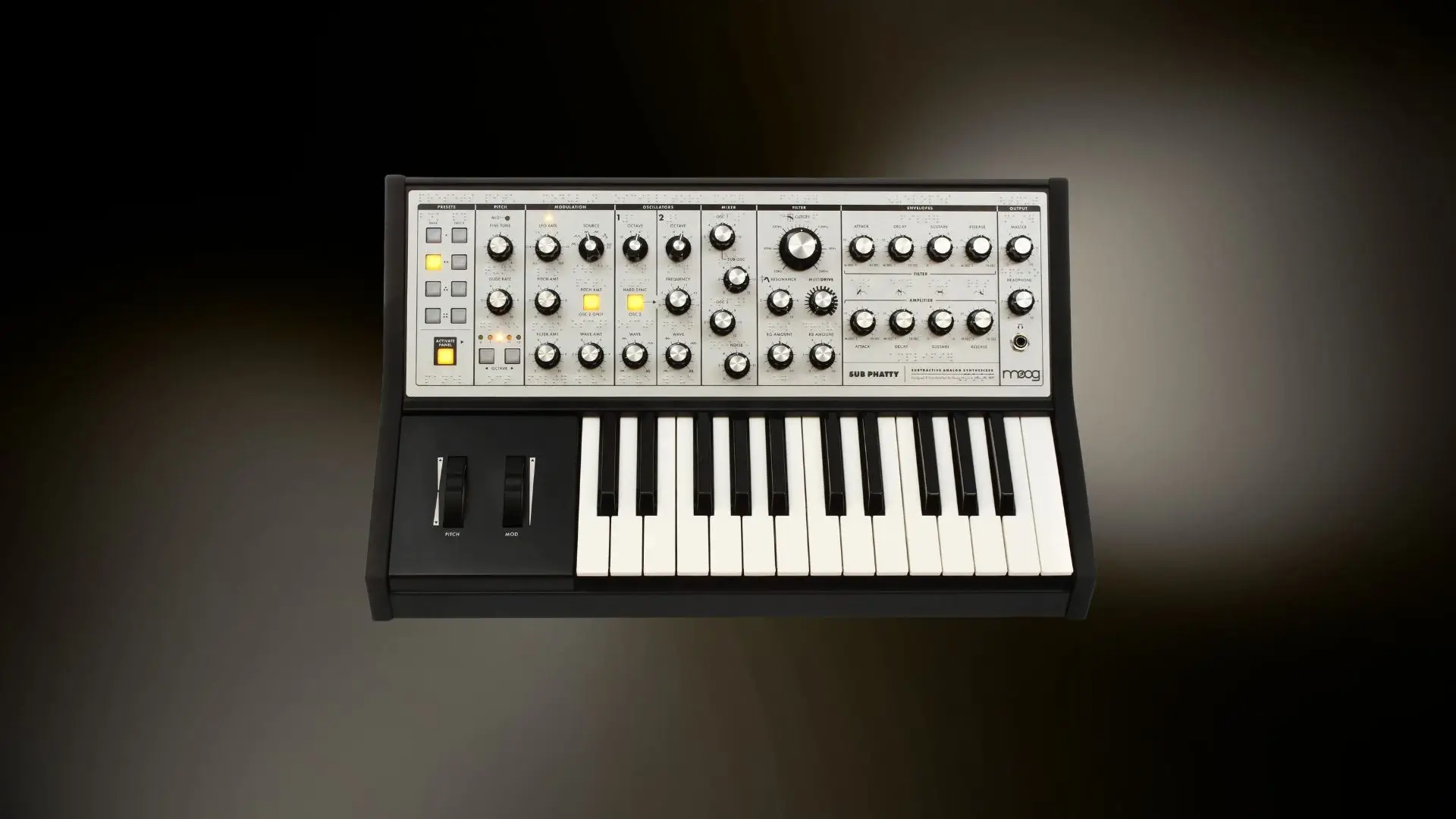
The Moog Sub Phatty is a 25-key monophonic analog synthesizer introduced in 2013, built around a compact keyboard format, a fully analog signal path, two variable-waveshape oscillators, a square-wave sub oscillator, pink noise, a Moog ladder filter, and the MultiDrive saturation circuit. It matters because it did not simply miniaturize the Moog monosynth idea. It pushed the company’s modern keyboard line toward a more aggressive, club-ready, digitally integrated form while keeping the immediate physical grammar of analog subtractive synthesis intact.
Table of Contents
Moog Sub Phatty sound and character
The Moog Sub Phatty sounds like a Moog with less politeness. Its center of gravity is still bass, lead, and filtered analog motion, but its character is more clenched, saturated, and forward than the smoother image many players associate with earlier Moog Sub Phatty instruments. The two oscillators provide the expected Moog weight, but the instrument’s identity comes from how that weight can be thickened and stressed: the sub oscillator sits one octave below oscillator 1, the mixer can be driven into filter coloration, and MultiDrive adds a second stage of tone-shaping pressure after the ladder filter.
In practical terms, the Moog Sub Phatty excels at compact but forceful basses, sharp sync leads, percussive analog hits, growling resonant sweeps, and distorted sequences that need to occupy a mix rather than merely sit inside it. It can still produce round, classic low-pass Moog tones when the mixer and MultiDrive are kept under control, but its more distinctive voice appears when the signal path is allowed to overload. The result is not the wide, unstable drift of a vintage polysynth, nor the polished versatility of a workstation. It is a tight, concentrated monosynth built around voltage-controlled mass, filter movement, and controlled aggression.
That aggression has musical consequences. On bass patches, the square sub oscillator reinforces the fundamental instead of just adding harmonic decoration. On leads, oscillator sync and oscillator 2 tuning make the sound more cutting and vocal. On percussion and effects, the pink noise source and fast envelopes let the Moog Sub Phatty move beyond the usual “bass-and-lead only” role. The Moog Sub Phatty’s personality is therefore not simply “fat”; it is compressed, immediate, and often deliberately dirty.
Features and architecture
- Manufacturer: Moog Music.
- Year introduced: 2013.
- Production years: Introduced in 2013 and discontinued by January 2020, when the Subsequent 25 was presented as its successor.
- Synthesis type: Analog subtractive synthesis with digitally stored presets and MIDI control.
- Category: Compact keyboard monosynth.
- Polyphony: Monophonic, one voice.
- Original price: Launch information listed an MSRP of US$1,099 and an expected street price of US$999.
- Current market price: Used-market values vary by condition and location; recent Reverb price-guide signals place many examples in the mid-hundreds of US dollars rather than at original launch price.
- Oscillators: Two variable-waveshape voltage-controlled oscillators with triangle, sawtooth, square, and pulse regions; oscillator 2 includes tuning offset and hard sync to oscillator 1.
- Additional sound sources: One square-wave sub oscillator fixed one octave below oscillator 1, plus a pink-noise generator.
- Filter: Moog ladder low-pass filter with selectable slopes through hidden parameters, including 1-pole, 2-pole, 3-pole, and 4-pole modes; cutoff range specified from 20 Hz to 20 kHz; resonance can reach self-oscillation.
- Drive architecture: Mixer gain can push the filter input, while MultiDrive adds variable saturation and clipping between the filter and amplifier.
- LFOs: One LFO with a specified range from 0.01 Hz to 1000 Hz; modulation sources include triangle, square, saw, ramp, sample-and-hold, and filter envelope.
- Envelopes: Two ADSR envelopes, one for filter and one for amplifier; additional hidden/shift functions expand envelope behavior with delay, hold, looping, reset, triggering, gate, and keyboard-tracking options.
- Modulation system: LFO and filter-envelope modulation can target pitch, oscillator 2 pitch only, filter, and waveshape; hidden parameters add deeper behavior such as LFO MIDI sync, LFO range, LFO tracking, and oscillator reset.
- Sequencer / arpeggiator: No built-in note sequencer or arpeggiator is part of the core design; rhythmic integration is centered more on MIDI-clocked modulation than onboard sequencing.
- Effects: No conventional onboard effects such as delay, chorus, or reverb; the main onboard coloration tool is MultiDrive saturation/distortion.
- Memory: 16 onboard rewritable presets arranged as four banks with four patches each; the editor/librarian allows larger computer-based preset management.
- Keyboard: 25 semi-weighted, velocity-sensitive keys; no aftertouch.
- Inputs / outputs: One 1/4-inch TS audio input, one 1/4-inch TS audio output, one 1/4-inch TRS headphone output, plus Pitch CV, Filter CV, Volume CV, and KB Gate inputs.
- MIDI / USB: 5-pin DIN MIDI In and Out, plus MIDI over USB; USB does not carry audio.
- Display: No digital display.
- Dimensions / weight: 20.25 inches wide, 14.5 inches deep, 6.25 inches high; 16.5 lb.
- Power: Internal universal power supply, 100–240 V AC, 50/60 Hz, 8–12 W, via IEC power connection.
Strengths
- It delivers a concentrated Moog voice in a small footprint. The Sub Phatty keeps the essential performance controls close to the hands, making it practical for small studios and live rigs where a larger Moog keyboard would be less convenient.
- The sub oscillator gives bass patches real structural authority. Because it is fixed one octave below oscillator 1, it reinforces the fundamental in a direct, musically useful way rather than behaving like a decorative third oscillator.
- MultiDrive gives the Moog Sub Phatty a distinct identity within the Moog line. The Moog Sub Phatty is not only smooth and rounded; it can become gritty, clipped, and modern without relying on external distortion pedals.
- The front panel is immediate enough for classic subtractive programming. Oscillator, mixer, filter, envelope, and modulation sections are logically arranged, so the Moog Sub Phatty remains approachable even though deeper features live behind Shift mode.
- The hidden parameters are not superficial extras. Filter slope selection, envelope looping, oscillator reset, LFO behavior, glide types, and beat-frequency control extend the synth beyond what its small front panel initially suggests.
- It integrates well with modern setups. MIDI DIN, USB MIDI, preset storage, CC transmission from knobs, and the editor/librarian make it less isolated than a purely vintage-style monosynth.
- It is strong for bass, leads, sync tones, percussive patches, and aggressive electronic music. Its architecture favors sounds that need focus, harmonic density, and tactile movement.
Limitations
- The 25-key range is restrictive for players who think pianistically. The octave controls help, but the format is better suited to bass lines, leads, sequences, and studio overdubs than broad keyboard performance.
- It is monophonic only. Chords, pads, and independent two-note playing require another instrument; the later Subsequent 25 addressed this partly by adding Duo mode.
- There is no aftertouch. Velocity can be used in programming, but the keyboard does not offer the extra expressive pressure control found on some performance-oriented synths.
- The 16-preset internal memory is limited. The editor/librarian helps, but the onboard patch capacity is modest compared with many later digital-control analog synths.
- Shift mode is powerful but not elegant. Important parameters are hidden behind button-and-key combinations, which can interrupt the immediacy that the front panel otherwise promises.
- The lack of a display keeps costs and visual clutter down, but it also makes deeper editing less transparent. This is a defensible design decision, not a universally convenient one.
- There are no conventional onboard effects. The raw sound is strong, but finished ambient, cinematic, or polished studio textures require external processing.
- Used buyers must think like used-instrument buyers. Since the Moog Sub Phatty is discontinued, condition, calibration, pots, keys, firmware/editor access, and general maintenance matter more than they would on a current production model.
Historical context
The Moog Sub Phatty appeared during the early-2010s analog revival, a moment when musicians were again treating dedicated hardware synthesizers as musically and culturally important rather than obsolete. Its timing mattered because Moog was no longer only defending its historical prestige. It was competing in a market where smaller, more affordable analog instruments were becoming credible studio tools.
Within Moog’s own lineage, the Moog Sub Phatty sits after the Little Phatty and before the larger Sub 37 family. It kept the idea of a relatively accessible Moog keyboard but changed the attitude of the sound. The Little Phatty had already translated Moog design into a modern preset-capable monosynth; the Sub Phatty made that language more compact, more saturated, and more explicitly contemporary. The later Sub 37 expanded the idea with more keys, deeper controls, and duophonic behavior. The Subsequent 25, introduced in 2020, then returned to the 25-key format while updating the Moog Sub Phatty concept with features drawn from the Subsequent line.
The market around it also shaped its reception. The Moog Sub Phatty was affordable by Moog keyboard standards, but it arrived when musicians were recalibrating value because new analog instruments were becoming cheaper and more common. That tension is part of its history: it was both an accessible Moog and not the cheapest analog monosynth of its era. Its significance lies in that middle position. It was not a budget clone, not a vintage reissue, and not a flagship. It was a compact modern Moog built to prove that the company’s monosynth voice could adapt to a more aggressive, computer-connected, performance-aware age.