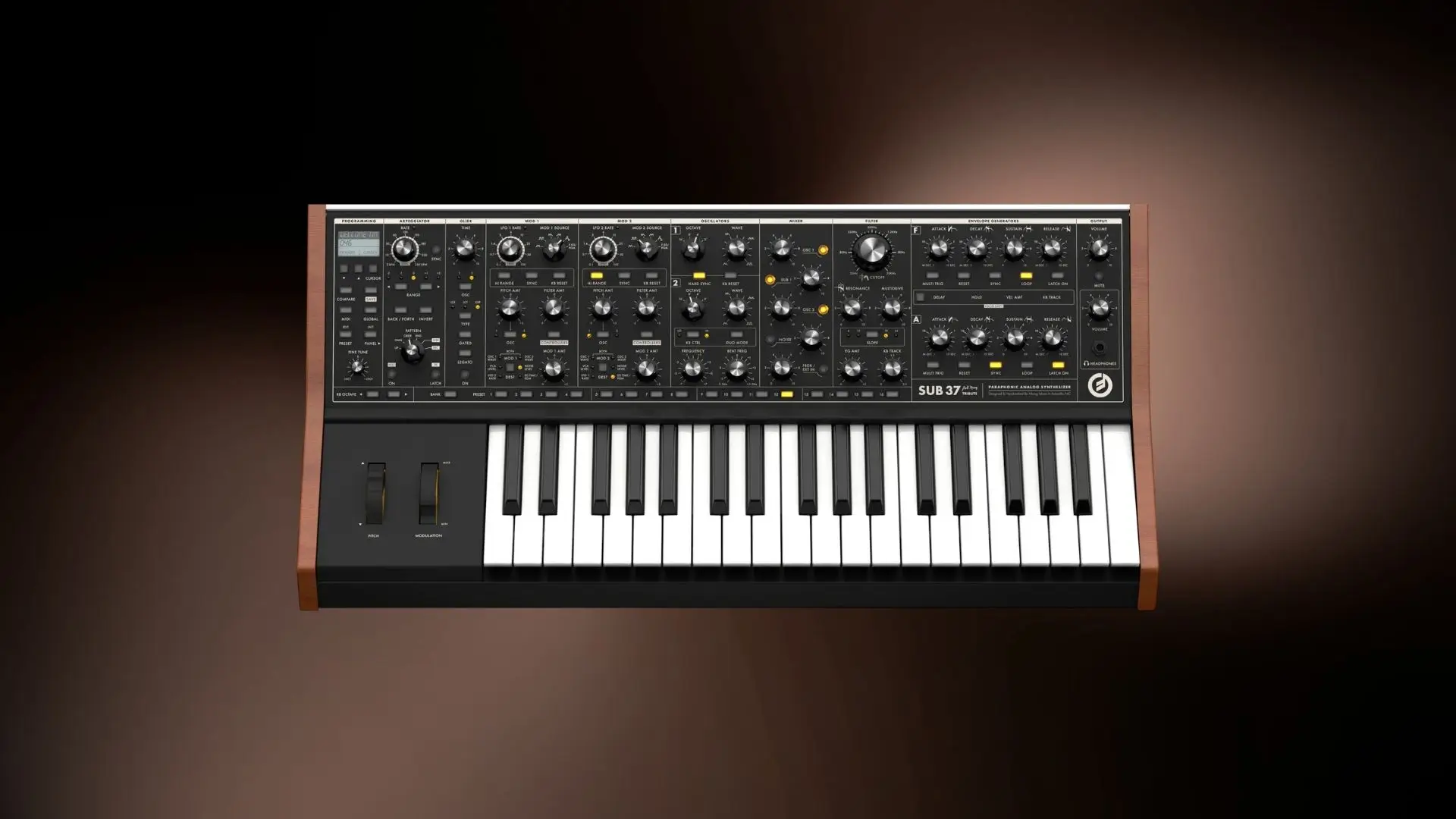
The Sub 37 Tribute Edition matters because it helped define what a modern Moog monosynth could be in the 2010s. It did not abandon the classic ingredients: oscillators into a ladder filter, tactile controls, expressive playing, and a bass/lead vocabulary rooted in the company’s history. But it reorganized those ingredients around contemporary expectations: preset memory, USB MIDI, DAW editor integration, assignable modulation, tempo sync, sequencing, and paraphonic performance.
Its legacy is also visible in what came after it. The Subsequent 37 did not erase the Moog Sub 37 Tribute Edition concept; it refined it, adding more headroom, a revised filter/gain structure, retuned MultiDrive, and an upgraded keybed. That makes the Moog Sub 37 Tribute Edition the first major statement in a lineage rather than a dead end. It is the model that proved the format: a compact Moog keyboard could be simultaneously old-fashioned in signal path and modern in control philosophy.
Culturally, the Moog Sub 37 Tribute Edition arrived when many musicians were rediscovering the value of limits. It offered only one main analog voice architecture, no full polyphony, and no onboard ambience, yet it gave that voice enough control depth to become a serious composition tool. In that sense, its significance is not that it solved every problem. It showed how far one analog voice could be pushed when performance control, modulation, sequencing, and memory were treated as central parts of the instrument rather than as accessories.
The most clearly documented names associated with the original Moog Sub 37 Tribute Edition are demonstrators rather than recording artists. Moog Product Development Specialist Amos Gaynes demonstrated the instrument at NAMM 2014 and in early product videos, helping establish the public understanding of Duo Mode, the panel layout, and the Sub Phatty-derived architecture. That matters because the Moog Sub 37 Tribute Edition’s early reputation was strongly shaped by demonstrations of workflow and sound design, not by a single famous record.
A useful caution follows from the later history of the line: Cory Henry appeared in Moog’s Subsequent 37 launch context, but that belongs to the successor model rather than to a verified original Moog Sub 37 Tribute Edition usage claim. It is better to be precise here than to inflate the instrument’s artist mythology. The Sub 37 Tribute Edition is memorable enough without unsupported name-dropping.
The strongest curiosity is the Moog Sub 37 Tribute Edition’s educational link. Moog described the instrument as honoring Dr. Robert Moog’s passion for education and music, and stated that part of the proceeds from each sale would support Asheville Area School Music Programs. That makes the “Moog Sub 37 Tribute Edition” label more than a cosmetic badge: it connects the synth to the local educational ecosystem around Moog’s Asheville identity.
- Current market position: Discontinued original model with an established used-market presence, no longer a current new-production Moog product.
- New price signal: The original Moog Sub 37 Tribute Edition launched at a reported U.S. price of $1,579; its successor, the Subsequent 37, is currently listed by Sweetwater at $1,899 and marked as “Available Soon.”
- Used market signal: Reverb currently estimates the used value of the Moog Sub 37 Tribute Edition at roughly $863 to $1,447, with limited active listing volume shown in the search result.
- Availability: Easy enough to encounter on the used market, but not available as a normal new item; archived retail listings mark the original Tribute Edition as no longer available.
- Buyer notes: Compare any used Moog Sub 37 Tribute Edition directly against the Subsequent 37, because the later model’s headroom, keybed, and drive/filter revisions are real specification differences, not just cosmetic updates.
- Support ecosystem: inMusic/Moog support still documents troubleshooting, calibration, factory preset reload, and firmware reload procedures for Moog Sub 37 Tribute Edition and Subsequent 37 instruments.
- Ease of ownership: The combination of MIDI, USB MIDI, presets, editor history, and documented support procedures makes it easier to integrate and maintain than many older analog synths, although discontinued-product realities still apply.
- Long-term position: The Moog Sub 37 Tribute Edition looks stable rather than wildly speculative: historically important, musically respected, and discontinued, but moderated in collectible value by the existence of the technically improved Subsequent 37.
The Moog Sub 37 Tribute Edition represents a decisive turn in the modern Moog story. It did not try to be a vintage reissue, a true polyphonic synth, or a minimalist bass box. Instead, it made the Moog monosynth broader, more performable, more programmable, and more compatible with the realities of contemporary production.
Its limitations are real, especially its paraphonic architecture and lack of conventional effects, but they are part of the same design logic that gives it focus. The Moog Sub 37 Tribute Edition matters because it captured a crucial balance: classic analog authority, modern control depth, and a performance identity strong enough to become the foundation for one of Moog’s most recognizable 21st-century keyboard lines.