

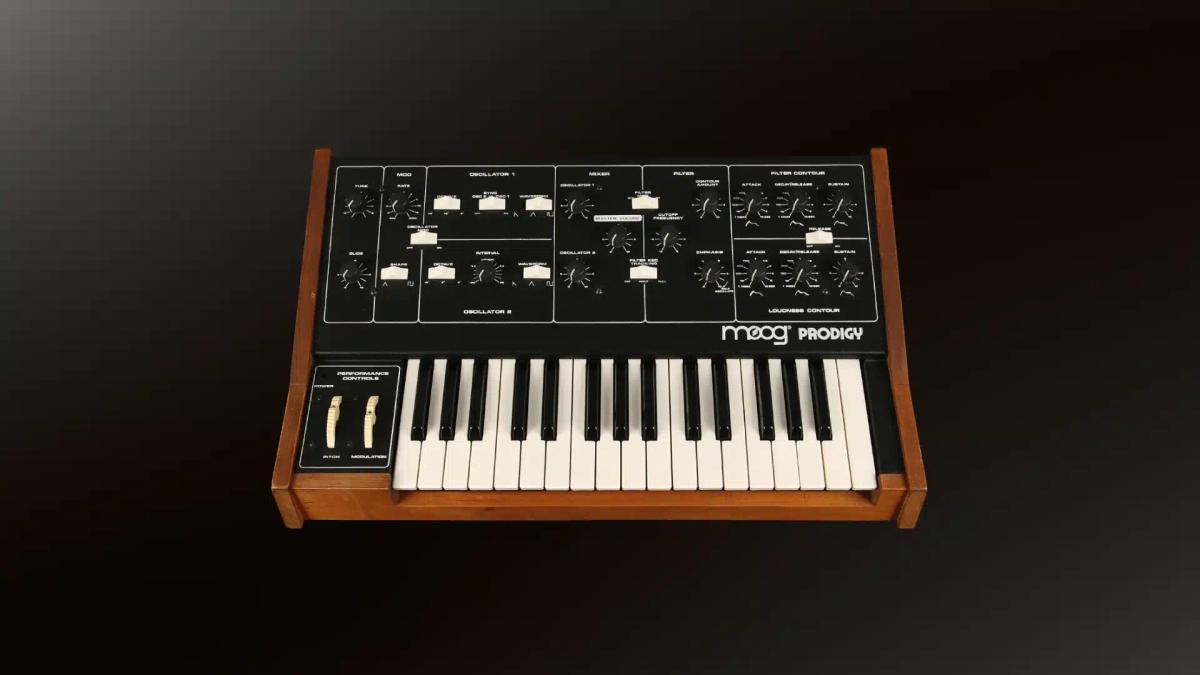
The Moog Prodigy is a two-oscillator monophonic analog synthesizer that Moog Music put into production in June 1979 and built until 1984. Designed by engineers Rich Walborn and Tony Marchese during the Norlin era, after Bob Moog had left the company, it compressed the essentials of the Minimoog into a small 32-key instrument: two VCOs with hard sync, a 24dB/octave ladder low-pass filter, two simple envelopes, an LFO and pitch and modulation wheels, all in a metal case with wooden end cheeks. Around 11,000 were made. It matters as one of the instruments that made the genuine Moog sound affordable at the end of the 1970s, and later as a staple of 1990s electronic music, to the point of giving The Moog Prodigy their name.
Table of Contents
Moog Prodigy sound and character
The Moog Prodigy sounds unmistakably like a Moog, with a slightly leaner, more direct character than the Minimoog. The ladder filter is the core of it: four poles, 24dB per octave, with emphasis that can be pushed into self-oscillation and that, as Bonedo points out, keeps the low end warm and full even at high resonance. Basses are punchy and well defined, and a single sawtooth through a partly closed filter gives the round, weighty tone associated with the brand. Attack Magazine noted the family resemblance to the Minimoog but suggested it may not quite match the Minimoog or the Source for bass.
Oscillator sync is its signature. Oscillator 2 can be locked to oscillator 1, and with sync engaged the pitch wheel sweeps the synced oscillator so that the wheel changes timbre rather than pitch. This produces the tearing, vocal sync leads that made Attack Magazine call it one of the best lead synths ever made. The two oscillators can also be detuned by more than a fifth for thick unisons and fixed intervals, and the octave ranges are staggered (32 to 8 feet for oscillator 1, 16 to 4 feet for oscillator 2) so the pair covers sub-bass to bright leads.
The palette is narrow. There is no noise generator, no external audio input and no pulse-width modulation, the envelopes are three-stage, and the LFO only reaches pitch and filter. Within those limits, the Moog Prodigy is very good at bass, sync leads, simple wobbles and squelchy sequenced lines once fed by an external CV source. Users on Audiofanzine describe it as pure Moog with little finesse, which is a fair summary: vintage, warm, aggressive and focused rather than flexible. Glide, adjustable up to about three seconds, adds the portamento slides that suit its lead role.
Features and architecture
- Manufacturer: Moog Music, Inc. (a division of Norlin at the time)
- Year introduced: 1979; production began in June 1979
- Production years: 1979 to 1984, with approximately 11,000 units built
- Synthesis type: analog subtractive
- Category: compact, pre-wired keyboard monosynth
- Polyphony: monophonic, low-note priority
- Original price: £295 in the UK; a reliable original US list price could not be confirmed
- Current market price: Reverb listings in October 2026 start around $760 and commonly run to about $2,300, with exceptional or modified units asked higher
- Oscillators: 2 VCOs with temperature compensation; oscillator 1 offers sawtooth, triangle and narrow pulse with 32′, 16′ and 8′ ranges; oscillator 2 offers sawtooth, triangle and square with 16′, 8′ and 4′ ranges and an interval control of more than a fifth either way; switchable hard sync
- Mixer: levels for the two oscillators; no noise source and no external audio input
- Filter: 24dB/octave four-pole Moog ladder low-pass with cutoff, emphasis, contour amount and keyboard tracking; self-oscillates
- LFOs: one LFO with triangle or square wave, roughly 0.3 to 30 Hz, routable to oscillators, filter, or both; depth on the modulation wheel
- Envelopes: two attack, decay and sustain contour generators (filter and loudness), with a switch that applies the decay time as release
- Modulation system: LFO to pitch and/or cutoff via the mod wheel; filter contour amount; glide
- Sequencer / arpeggiator: none
- Effects: none; glide (portamento) up to about three seconds
- Memory: no patch memory
- Keyboard: 32 keys (F to C), no velocity or aftertouch; pitch bend and modulation wheels
- Inputs / outputs: single audio output; later units add rear-panel keyboard CV in/out, oscillator and filter CV inputs and S-trigger in/out at 1V/octave
- MIDI / USB: none; aftermarket MIDI-to-CV conversions are common on units with CV/gate
- Display: none
- Dimensions / weight: approximately 23.25 x 14.94 x 5.625 in; about 16 lb (7.2 kg)
- Power: internal power supply, under 10 W, with detachable mains cable
- Versions: model 336A (US domestic) and 336BX (export); CV/gate connections were added around serial 4610 and on units built from 1981, and earlier units can be retrofitted
Strengths
- It delivers the real Moog ladder filter in an inexpensive, compact form. That was the point of the design in 1979, and it remains the reason players buy one now.
- Oscillator sync is excellent. Combined with the pitch wheel, it produces some of the most distinctive lead sounds available from a vintage monosynth.
- The bass is strong and well defined, which made it a favorite bass synth in techno and electronic music, as Vintage Synth Explorer notes.
- The panel is simple and logical. Its left-to-right layout makes it a good instrument for learning subtractive synthesis, and the Bob Moog Foundation credits it with helping set a template for affordable synths.
- It is portable. At about 16 lb with an internal power supply, it travels far more easily than larger vintage Moogs.
- Around 11,000 were built, so units are relatively easy to find and spare parts such as keys, knobs and recapping kits are available.
Limitations
- The architecture is spare: no noise generator, no external input, no pulse-width modulation and only three-stage envelopes, which limits percussive, noisy and evolving sounds.
- Modulation is basic. The LFO reaches only pitch and filter, and the mod wheel controls only LFO depth.
- The 32-key keyboard is short and has no velocity or aftertouch, and some owners find the keybed cheap in feel.
- Early units are known for tuning instability; later circuit revisions improved it, and documented modifications exist for older serial numbers.
- Early units have no CV/gate, which complicates MIDI conversion and lowers value; adding control usually requires internal modification.
- There is no patch memory and no MIDI from the factory.
- Used prices have risen well beyond its budget origins, so it is no longer the bargain it was in the 1990s.
Historical context
By the late 1970s Moog Music belonged to Norlin, Bob Moog had left in 1977, and the company faced growing competition from cheaper monosynths, many from Japan. The Minimoog was still in production but expensive. The Moog Prodigy was Norlin-era Moog’s answer: a deliberately affordable instrument with the core of the Minimoog’s signal path, designed by Rich Walborn and Tony Marchese without input from Bob Moog. It went into production in June 1979, pitched as a smaller, portable and much cheaper way to get the Moog filter sound, with the cost savings coming from what was left out: flexible modulation routing, noise, an external input and any form of sequencing or memory.
Its manufacturing was more modern than its panel suggests. According to the Bob Moog Foundation, it was the first Moog synthesizer to use a microcomputer in its test process: each test station used a Tandy TRS-80 to step the technician through checks, and the temperature-compensated oscillators were calibrated using the fixture’s ambient temperature reading. The instrument was revised during its run. From 1981, or roughly from serial 4610, units gained rear-panel CV and gate connections, and later circuit boards addressed the tuning drift of early production.