

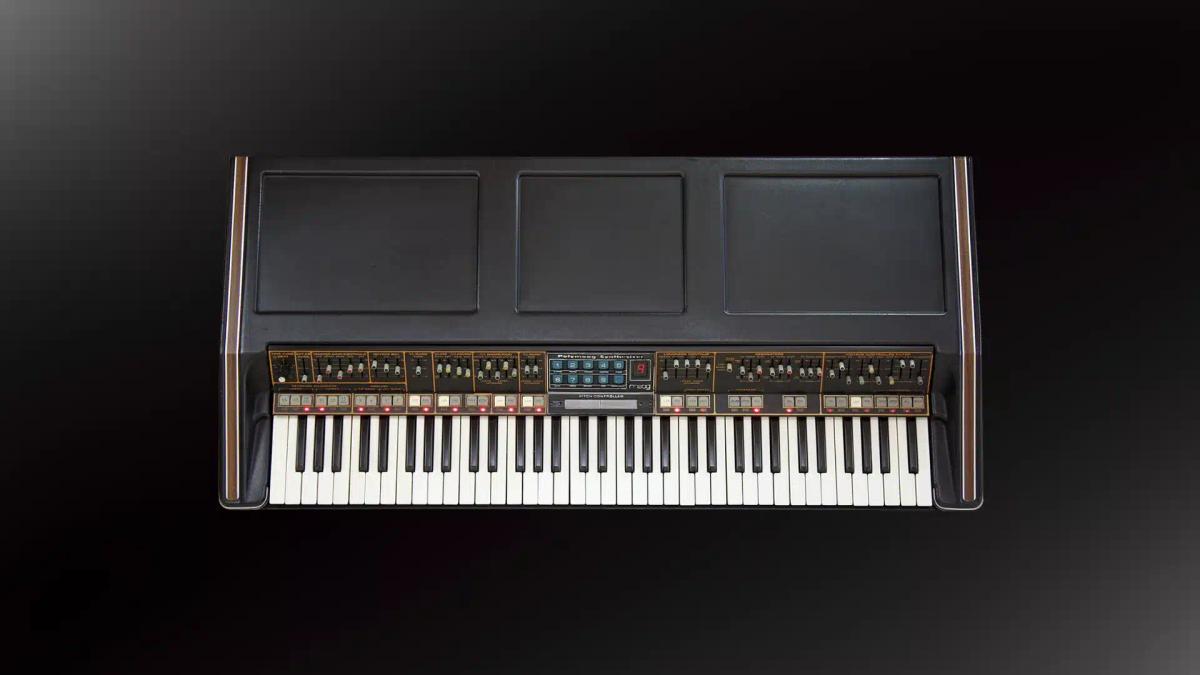
The Moog Polymoog Synthesizer, model 203a, is a fully polyphonic analog keyboard introduced by Moog Music in 1975 and produced until 1980. Designed mainly by David Luce rather than Bob Moog, it borrowed divide-down oscillator technology from electronic organs so that every one of its 71 weighted, velocity-sensitive keys could sound at once, then added Moog filtering, eight preset “Modes,” and a programmable variation mode. It was expensive, heavy, and notoriously hard to keep running, yet it gave the late 1970s one of its defining string sounds and marked the moment Moog first tried to turn the Moog Polymoog into a true chordal instrument.
Table of Contents
Sound and character
The Moog Polymoog’s reputation rests above all on strings. A 1978 history of Moog in the British press singled out the string Mode as sounding beautiful both live and on record, and later writers still rank it as the Moog Polymoog’s most convincing preset. The sound is wide, soft-edged, and gently animated, closer to the string ensembles of the period than to the heavy single-voice tone of the Minimoog.
That contrast is also the source of the most persistent criticism. Sound On Sound described the Moog Polymoog as thin, arguing that its divide-down oscillators could not deliver the powerful timbres expected from the Moog name. Other writers call its pads airy and lively, and note that the Resonators and main filter can push it toward far more aggressive, overdriven, and funky territory.
The character comes directly from the architecture. Because all notes derive from shared master oscillators, chords lock together with an organ-like coherence rather than the shifting beating of independent voices. Each key, however, has its own articulation circuitry, so the factory Modes shape the attack and tone of every note individually and respond to touch. The Resonators, a three-band filter bank with emphasis controls, add a formant-like coloration that gives many patches a vocal, slightly hollow quality. It leans lush rather than punchy, and its best sounds are ensemble textures rather than solo voices.
Features and architecture
- Manufacturer: Moog Music (then part of Norlin), with David Luce as lead designer
- Year introduced: 1975
- Production years: 1975 to 1980 according to most sources (some listings give 1975 to 1978)
- Synthesis type: analog subtractive with divide-down oscillators and per-key articulation circuits
- Category: fully polyphonic preset and programmable keyboard synthesizer
- Polyphony: 71 notes, one per key, with a single shared VCF that makes filter articulation paraphonic in programmable use
- Original price: commonly cited around $5,000 in the US, with some sources giving $5,295; £3,195 in the UK
- Oscillators: two banks of twelve master oscillators, one sawtooth and one pulse, divided down to cover the keyboard; sawtooth at 4′ and 8′, pulse at 8′ and 16′; detune between the two ranks; pulse-width modulation
- Filter: one 24 dB/octave Moog ladder-style VCF with cutoff, emphasis, keyboard tracking, and its own contour; plus the Resonators, a three-band filter bank with frequency, emphasis, and level per band, switchable to low-pass, band-pass, or high-pass
- LFOs: separate modulation sources for the sawtooth and pulse ranks, a dedicated pulse-width LFO, and a VCF LFO with sample-and-hold
- Envelopes: a Loudness Contour with attack and sustain plus separate decay controls for the upper and lower keyboard zones; a separate contour for the VCF
- Modulation system: fixed front-panel routing, velocity response for attack, timbre, and volume, a ribbon controller instead of wheels, and the optional Polypedal Controller (model 285) for pitch, filter, volume, and sustain
- Sequencer / arpeggiator: none
- Effects: none as such; a phase shifter is built into the oscillator section, but there is no chorus or time-based effect
- Memory: no user patch memory; eight factory Modes (String, Piano, Organ, Harpsi, Funk, Clav, Vibes, Brass) on internal circuit cards, plus VAR mode for programmable sounds and live variation
- Keyboard: 71 keys (six octaves), Pratt-Read weighted action, velocity-sensitive, split into an upper zone of four octaves and a lower zone of two, with octave-balance sliders across three registers
- Inputs / outputs: six audio outputs (Mix in balanced and unbalanced form, Mode, Direct, Res, VCF), external audio inputs into the Resonators and VCF, CV and trigger outputs for driving a monosynth such as a Minimoog, an S-Trig input, and a rear panel of control jacks for the Polypedal
- MIDI / USB: none
- Display: none
- Dimensions / weight: listed at roughly 116 × 57 × 15 cm and about 37 kg (around 82 lb)
Strengths
- Full polyphony across the whole keyboard was genuinely unusual in 1975. Players could hold two-handed chords without voice stealing.
- The string sound is one of the classic synthetic string textures of the decade. It sits easily under rock and pop arrangements and remains the main reason people seek the Moog Polymoog out.
- Per-key articulation and velocity sensitivity gave the factory Modes a touch response that most string machines and organs of the time lacked.
- The Resonators and separate Mode, Resonator, and VCF outputs make it more flexible than its preset reputation suggests, letting engineers process parts of the signal independently.
- It was designed as the center of a rig: the flat top and CV and trigger outputs let a player stack and drive a Minimoog or similar monosynth.
Limitations
- The single VCF is the core compromise. New notes retrigger the shared filter contour, or receive no filter articulation at all depending on the trigger setting, so programmed sounds tend to drift toward string-ensemble behavior rather than true polysynth voicing.
- Divide-down oscillators lock every note to a shared source, which limits the movement and weight that independent voices provide. Critics have repeatedly described the result as thin by Moog standards.
- There is no user memory. Anything built in VAR mode has to be recreated by hand.
- Reliability was a serious problem from the start. Sound On Sound wrote of a near-200% failure rate and constant modifications, and later owners report trouble with the Mode cards losing contact and the Moog Polymoog’s sensitivity to transport.
- At around 37 kg and with a price around $5,000, it was a heavy commitment both physically and financially.
Historical context
The Moog Polymoog grew out of Moog’s Constellation project of the early 1970s, a planned stage system made up of the Apollo polyphonic keyboard, the Lyra monosynth, and the Taurus bass pedals. Only the Taurus reached the market as a standalone product. Keith Emerson toured with Constellation prototypes, and the Apollo was reworked repeatedly by David Luce, who had joined Moog in 1972 with a brief to design a polyphonic synthesizer, until it emerged as the Moog Polymoog.
Luce’s key contribution was a custom integrated circuit, described in 1978 as “the polyphonic chip,” that packed per-key wave shaping, filtering, contour generation, and amplification into one part. The divide-down principle was not new, since organs and string machines already used it, but combining it with per-key shaping and a Moog filter path was a serious attempt to bring synthesizer control to full polyphony.
The timing explains both its appeal and its short life. In 1975, keyboardists wanted chords from their synthesizers. The competition arrived quickly: Yamaha’s GX1 in 1975, the CS-80 in 1976, and Sequential Circuits’ Prophet-5 in 1978. Moog’s own response that year was the Polymoog Keyboard (model 280a), a cheaper, largely preset version with 14 sounds, while the original was renamed the Polymoog Synthesizer. Production of both ended in 1980, and Moog’s next polyphonic instrument, the Memorymoog, followed in 1981. Keith Emerson later argued that the Moog Polymoog failed largely because Norlin, Moog’s parent company, wanted quick sales.