

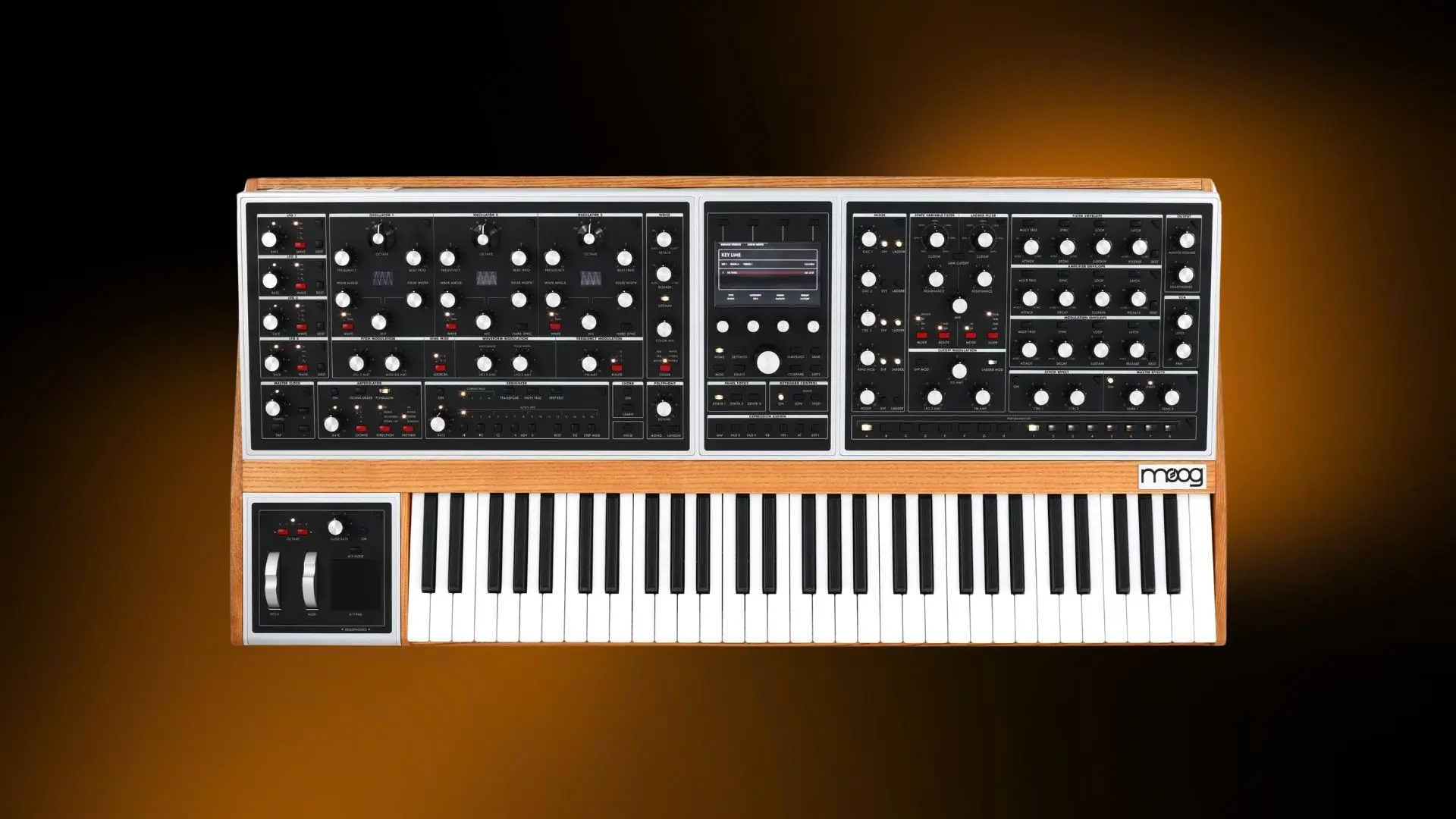
The Moog One 8-voice is a tri-timbral polyphonic analog synthesizer introduced in 2018 as part of Moog’s return to large-format analog polyphony after more than three decades. With eight analog voices, three VCOs per voice, two independent filters per voice, three synth parts, deep modulation, onboard sequencing, digital effects including Eventide reverbs, and a 61-note Fatar keyboard, it was not conceived as a nostalgic reissue. It was Moog attempting to build a modern flagship around the idea that a polyphonic analog instrument could still be physically imposing, technically excessive, and musically personal.
Table of Contents
Moog One 8-voice sound and character
The Moog One 8-voice does not sound like a simple multiplication of a Minimoog voice. Its character is broader and more architectural than that. The three-oscillator-per-voice design gives it a dense harmonic foundation, but the Moog One 8-voice’s identity comes from how that density can be sculpted: oscillator waveshape mixing, hard sync, FM, ring modulation, dual-source noise, and flexible filtering allow it to move beyond the expected warm-brass-and-bass vocabulary of classic Moog instruments.
Its strongest territory is large, animated analog sound: cinematic pads, wide chordal textures, heavy unison leads, evolving drones, expressive basses, resonant sweeps, and multilayered performance patches. The eight-voice model has enough polyphony for substantial pads and chords, but its tri-timbral architecture means the player must think carefully about allocation. Layer three synth engines together and the available voices disappear quickly. This is not a flaw so much as a compositional pressure: the Moog One 8-voice asks the user to balance thickness against playability.
The dual-filter structure is central to its voice. The Moog ladder filter supplies the familiar rounded authority associated with the brand, while the state-variable filter gives the One a more open, precise, and sometimes more modern vocabulary. Used together, the filters make the Moog One 8-voice more flexible than a pure vintage homage. It can be huge and polished, but it can also become unstable, glassy, metallic, percussive, or strangely hybrid in character.
The digital effects are also part of the real-world sound, even though the core voice path remains analog when the effects are bypassed. The Eventide reverbs help the Moog One 8-voice inhabit cinematic space, and the per-synth plus master-bus effects structure encourages treating the Moog One less like a single keyboard and more like a self-contained analog production environment.
Features and architecture
- Manufacturer: Moog Music.
- Year introduced: 2018.
- Production years: introduced in 2018; now officially discontinued and no longer manufactured. A precise official production end date is not stated in the current support article.
- Synthesis type: analog subtractive synthesis with digital effects.
- Category: flagship polyphonic analog keyboard synthesizer.
- Polyphony: eight voices.
- Timbrality: three-part multitimbral, with three independently addressable synth engines sharing the available voice count.
- Original price: US$5,999 at launch for the Moog One 8-voice version.
- Current market price signal: used-market values vary by region and condition; recent used-price tracking places Moog One units around the low-to-mid £5,000 range, while individual Moog One 8-voice listings and remaining dealer/demo stock can sit substantially higher.
- Oscillators: three triangle-core analog VCOs per voice with waveshape mixing, variable-width pulse wave, hard sync, FM, and analog ring modulation.
- Noise: dual-source analog noise generator with dedicated shaping possibilities.
- Mixer: analog mixer with routing options for oscillators, noise, ring modulation, and external audio.
- Filter: two independent analog filters per voice, including a state-variable multimode filter and a Moog ladder filter with low-pass/high-pass behavior.
- LFOs: four assignable LFOs per synth engine.
- Envelopes: three DAHDSR envelope generators per voice with user-definable curves.
- Modulation system: deep modulation matrix with extensive routing, hardwired front-panel routings, and assignable internal and external sources.
- Sequencer / arpeggiator: sequencer and arpeggiator per timbre.
- Effects: digital synth and master-bus effects, including chorus, delay, phaser, bit reduction, vocoding, and Eventide reverbs such as Blackhole, Shimmer, Plate, Room, and Hall.
- Memory: tens of thousands of presets, with Performance Sets allowing up to 64 presets to be recalled from the front panel.
- Keyboard: 61-note Fatar TP-8S keybed with velocity and monophonic aftertouch.
- Performance controls: pitch wheel, modulation wheel, and pressure-sensitive X/Y pad.
- Inputs / outputs: two 1/4-inch headphone outputs, two pairs of assignable 1/4-inch outputs, four 1/4-inch hardware inserts, one 1/4-inch line-level external audio input, one XLR/1/4-inch combo mic/line input with trim, five CV/Gate inputs, four CV/Gate outputs, sustain pedal input, and two expression pedal inputs.
- MIDI / USB: 5-pin DIN MIDI, USB MIDI, USB drive support for backup and updates, and LAN port for future expansion/service-related use.
- Display: three OLED displays and one central LCD.
- Dimensions / weight: approximately 42 x 20 x 7 inches, or 106.7 x 50.8 x 17.8 cm; approximately 45 lb, or 20.4 kg.
- Power: supplied external power adapter.
Strengths
- The analog voice architecture is unusually deep for a keyboard polysynth, giving each voice three VCOs, two filters, four LFOs, three envelopes, noise, FM, sync, and ring modulation rather than relying on a simpler vintage-style signal path.
- The tri-timbral design makes the Moog One 8-voice feel closer to three interconnected analog polysynths than to a conventional single-layer keyboard, allowing splits, layers, stacked sounds, and independent sequencing approaches.
- The combination of ladder and state-variable filtering expands the Moog vocabulary beyond the expected thick low-pass sweep, making the Moog One 8-voice capable of both classic weight and more surgical, animated, or modern tones.
- The front panel is physically generous, with a large number of dedicated controls that make deep synthesis more tactile than menu-driven flagship designs.
- The Eventide reverbs and onboard effects make the One especially strong for cinematic pads, ambient textures, and finished-sounding performance patches.
- The 61-note Fatar keyboard, velocity, aftertouch, X/Y pad, pedal inputs, and CV/Gate connections make it a serious performance instrument rather than only a studio programming machine.
- Its historical position gives it unusual cultural weight: it was not just another expensive analog polysynth, but Moog’s attempt to answer decades of expectation around a true modern polyphonic flagship.
Limitations
- Eight voices can become restrictive when using long releases, dense chords, stacked unison, or all three synth engines at once.
- The Moog One 8-voice version is less forgiving than the 16-voice model for players who want large layered pads, three-part arrangements, or heavy unison while retaining chordal playability.
- It is physically large and heavy, making it better suited to a dedicated studio or serious stage rig than to casual portability.
- It has monophonic aftertouch, not polyphonic aftertouch, which matters for players expecting per-note expression from a modern flagship.
- The depth of the architecture can slow down casual sound design; it rewards users who are willing to learn the Moog One 8-voice rather than those who want instant vintage presets.
- Gain staging matters. Moog’s own support material notes that the master volume reaches unity around 50%, and higher settings can raise the perceived noise floor.
- Because the Moog One 8-voice is discontinued, buyers must pay more attention to condition, firmware state, seller reputation, warranty status, service access, and shipping risk.
- Its price places it outside the practical range of most musicians, and its market identity is closer to a professional or collector-level instrument than to a broadly accessible polysynth.
Historical context
The Moog One appeared at a moment when analog polyphony had returned to the center of the Moog One 8-voice market. By 2018, instruments from Sequential, Dave Smith Instruments, Korg, Waldorf, and boutique manufacturers had already shown that musicians still wanted voltage-controlled or analog-voiced polyphonic instruments in a digital production world. The difference was that Moog carried a particular historical burden: the company’s identity was rooted in modular systems, the Minimoog, basses, leads, and the cultural mythology of analog synthesis, but its polyphonic history had been comparatively brief and complicated.
That is why the Moog One mattered before anyone played a note. The Moog One 8-voice reopened a chapter associated with machines such as the Polymoog and Memorymoog, but it did so from a very different technological and cultural position. The Polymoog belonged to a period when full polyphony often required divide-down architectures and organ-derived thinking. The Memorymoog represented a more direct attempt at a programmable analog polyphonic Moog, but it also carried the maintenance and reliability anxieties of early-1980s analog complexity.
The Moog One was built in a later era, when musicians expected preset management, modulation depth, effects, USB, MIDI, CV integration, and modern performance workflows. Its design was therefore not simply a revival of Moog polyphony. It was a maximalist answer to the question of what a Moog flagship could mean after decades of synthesizer evolution.