

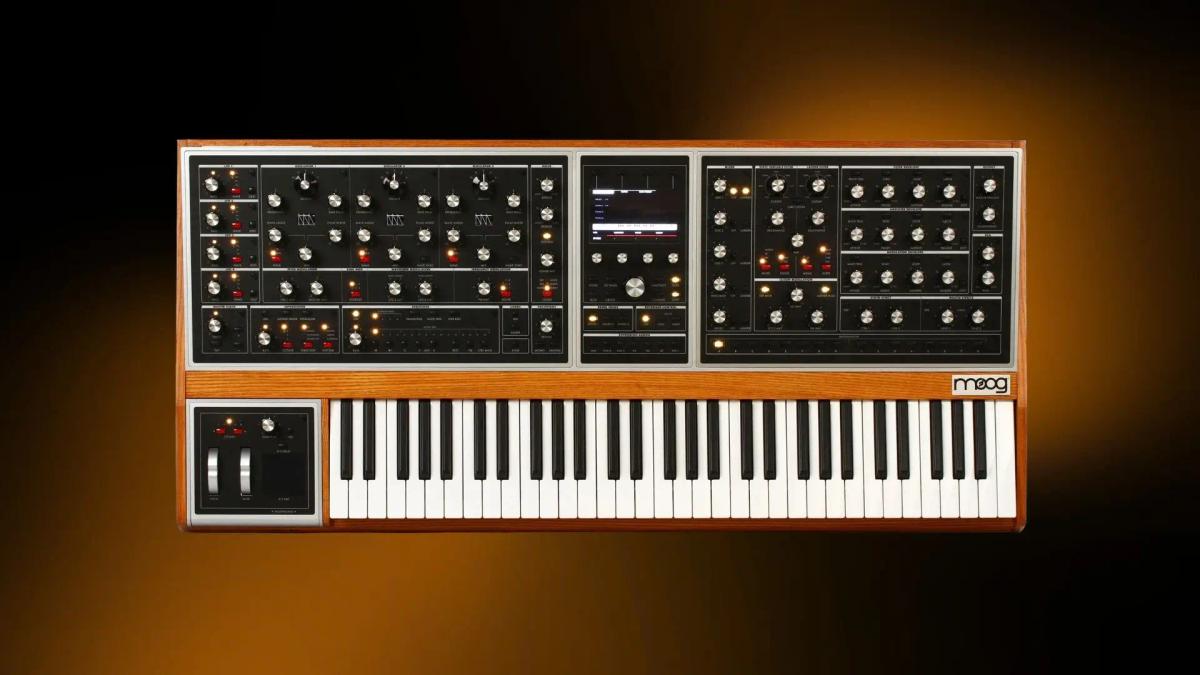
The Moog One 16-Voice is a 61-key, tri-timbral analog polysynth introduced in 2018 as Moog’s modern flagship polyphonic instrument. Built around 16 voices, three voltage-controlled oscillators per voice, dual analog filters, deep modulation, sequencing, performance control, and onboard digital effects that can be bypassed for an all-analog signal path, it was not a simple nostalgic revival. It was Moog attempting to build a contemporary analog polysynth at the highest end of the market, while carrying the historical weight of a name associated more strongly with monophonic synthesis than with modern polyphonic keyboards.
Table of Contents
Moog One 16-Voice sound and character
The Moog One 16-Voice sounds less like a single “big vintage poly” and more like a layered analog ecosystem. Its character comes from the tension between mass and detail: three VCOs per voice give each note density, while the filter architecture lets that density be sculpted in ways that range from familiar Moog low-end weight to more open, vocal, or glassy textures.
Its strongest sounds are large without being merely loud. Pads can move from dark, slow-breathing harmonic clouds to bright, cinematic sheets of tone. Bass sounds have the authority expected from a Moog, but the Moog One 16-Voice is not limited to monosynth gestures translated into chords. Leads can be rounded and expressive, especially when the keyboard aftertouch, wheels, X/Y pad, and modulation matrix are used as part of the patch rather than as decoration.
The dual-filter system is central to its identity. The Ladder filter supplies the historical Moog reference point: weight, saturation, and the familiar sensation of harmonics being pulled into a muscular low-pass frame. The State Variable Filter broadens the palette, allowing band-pass, high-pass, notch, and more flexible shaping. Running the filters in series or parallel changes the Moog One 16-Voice’s behavior substantially. In series, the sound can become sculpted, focused, and almost architectural. In parallel, it can feel wide, animated, and internally layered.
The Moog One also has a modern, complex side. Oscillator FM, hard sync, ring modulation, multiple LFO shapes, looping envelopes, per-Synth sequencing, and extensive modulation routing push it beyond a conservative analog polysynth. It can sound lush, expensive, unstable, polished, aggressive, or cinematic depending on how much of that architecture is used. Its best patches often feel less like static presets and more like performances waiting to happen.
Features and architecture
- Manufacturer: Moog Music.
- Year introduced: 2018.
- Production years: 2018 to discontinued. Official inMusic/Moog support confirms that the Moog One is discontinued and no longer manufactured, but the public support article does not state the exact final manufacturing date.
- Synthesis type: Analog subtractive synthesis with digital effects that can be bypassed to preserve an all-analog signal path.
- Category: Flagship polyphonic analog keyboard synthesizer.
- Polyphony: 16 voices on the 16-voice model.
- Original price and current market price: The 16-voice version launched with a reported US list price of $7,999. Later new or remaining-stock price signals commonly reached US$9,999. Used-market guidance in 2026 shows a broad range roughly between US$5,199 and US$7,699, depending on condition, market, and availability.
- Oscillators: Three VCOs per voice, each offering selectable sawtooth or triangle behavior, variable wave shaping, variable-width pulse, oscillator FM, hard sync, and wave blending. Additional sound sources include ring modulation, dual-source noise, and external audio input.
- Filter: Dual analog filter architecture with a State Variable Filter and a Moog Ladder Filter. The filters can be mixed and operated in series or parallel.
- LFOs: Four assignable LFOs, with multiple waveform categories and variable shaping.
- Envelopes: Three DAHDSR envelopes with variable curves, plus advanced behavior such as looping, latching, multi-triggering, and synchronization.
- Modulation system: Programmable modulation matrix with assignable sources, destinations, controllers, and transforms. Common routings are available from the front panel, while deeper assignments are handled through the central interface.
- Sequencer / arpeggiator: Per-Synth arpeggiator and 64-step per-Synth sequencer, allowing each of the three timbres to have its own motion and rhythmic behavior.
- Effects: Dedicated Synth effects per Synth and Master effects shared through send-style routing. Eventide reverbs are available on the Master Bus.
- Memory: Tens of thousands of Presets and Timbres, searchable with tags and categories, plus up to 128 Performance Sets with access to up to 64 presets each.
- Keyboard: 61 full-size Fatar TP-8S keys with velocity and aftertouch.
- Performance controls: Pitch wheel, modulation wheel, pressure-sensitive X/Y pad, sustain input, and two assignable expression pedal inputs.
- Inputs / outputs: Main left and right balanced audio outputs, two balanced Sub outputs, four insert send/return jacks that can also serve as monaural outputs, external mic/line input, external line input, two headphone outputs, two dedicated CV inputs, four CV outputs, sustain input, and two expression inputs.
- MIDI / USB: Five-pin DIN MIDI In, Out, and Thru; MIDI over USB; USB Host; USB Client; LAN port for service or expansion-related functions.
- Display: Central LCD interface, with additional OLED waveform displays associated with oscillator sections.
- Dimensions / weight: Approximately 42 x 20 x 7 inches, or 107 x 51 x 18 cm; approximately 45 lb / 20.4 kg.
- Power: Universal external power supply for 100–240 V AC, 50/60 Hz, feeding the Moog One 16-Voice through a 19 V DC locking connector.
Strengths
- The 16-voice architecture makes the Moog One unusually capable for dense analog chords, layered splits, evolving pads, and arrangements where separate timbres need to coexist inside one instrument.
- The tri-timbral design is not cosmetic. Because each Preset can contain up to three Synths, the Moog One 16-Voice can behave like a layered performance workstation, a split keyboard, or a self-contained analog ensemble.
- Three VCOs per voice give the Moog One 16-Voice harmonic mass before filtering, which is a major reason its pads, brass-like sounds, sync leads, basses, and cinematic textures can feel physically substantial.
- The dual-filter architecture expands the Moog One 16-Voice beyond the expected Moog ladder-filter vocabulary, allowing classic low-pass weight and more open, multimode filtering within the same patch.
- The modulation matrix, X/Y pad, aftertouch, wheels, and assignable pedals make the Moog One 16-Voice unusually expressive for a large analog polysynth, especially when patches are built around movement rather than static tone.
- Per-Synth sequencing and arpeggiation make the Moog One useful for evolving performances, layered rhythmic patches, and self-contained compositional sketches.
- The ability to bypass the digital effects section matters philosophically and practically: it lets purists keep the analog path intact while still giving modern players access to onboard ambience and processing.
- The interface balances a large physical control surface with deeper screen-based editing, which suits an instrument whose architecture would be almost impossible to expose entirely through one-knob-per-function design.
Limitations
- It is physically large and heavy, so it is more naturally a studio centerpiece than a casual gigging keyboard.
- Its price placed it in a narrow high-end category from the beginning, and the later market has not made it a broadly accessible instrument.
- The depth that makes it powerful also makes it demanding. It rewards serious programming, but it is not the fastest route to a simple bread-and-butter analog patch.
- The three-part multitimbral structure is powerful, but the 16 voices still have to be allocated across those parts, so dense layered patches can consume polyphony quickly.
- Early professional reviews and user discussion identified fan noise and firmware maturity as real concerns. Later firmware activity shows continued support, but the Moog One 16-Voice’s reputation remains partly shaped by those early operational issues.
- It does not have polyphonic aftertouch on its own keyboard. It has channel aftertouch, which is expressive, but not the same as per-note pressure control.
- The discontinued status changes the buying calculation. A used unit is a major investment, and buyers need to think about condition, firmware version, service access, shipping risk, and long-term parts/support availability.
Historical context
The Moog One appeared in 2018, at a moment when the market for analog polysynths had already been revived by instruments from Dave Smith Instruments, Sequential, Korg, Behringer, and boutique manufacturers. That timing mattered. Moog was not merely re-entering an empty field; it was reasserting itself in a field that had become technically ambitious and historically self-aware.
Moog’s name is inseparable from the Minimoog, modular systems, voltage control, and the popular image of analog synthesis. Yet the company’s strongest mythology has often been monophonic: basses, leads, filters, knobs, and voltage-driven immediacy. Polyphonic Moog instruments existed before, but they did not occupy the same unchallenged mythic space as the Minimoog Model D. The Moog One therefore carried an unusual burden: it had to satisfy modern expectations for a flagship polysynth while also answering the question of what a contemporary Moog polyphonic instrument should be.
Its answer was not minimalism. The Moog One was not a restrained Memorymoog-style homage, nor a simple analog keyboard with presets. It was an attempt to build a maximal Moog: polyphonic, programmable, multitimbral, highly modulatable, deeply performable, and physically imposing. In that sense, it belonged less to the market category of “vintage-inspired analog poly” and more to the tradition of prestige instruments that try to define the outer edge of what a company can make.
The later arrival of Moog Muse also changes how the Moog One is now viewed. The Muse offers a different kind of modern Moog polyphonic identity: smaller, less expensive, and more practical for many players. That does not make the Moog One obsolete. It makes the One look more clearly like what it always was: a flagship statement, not a mass-market template.