

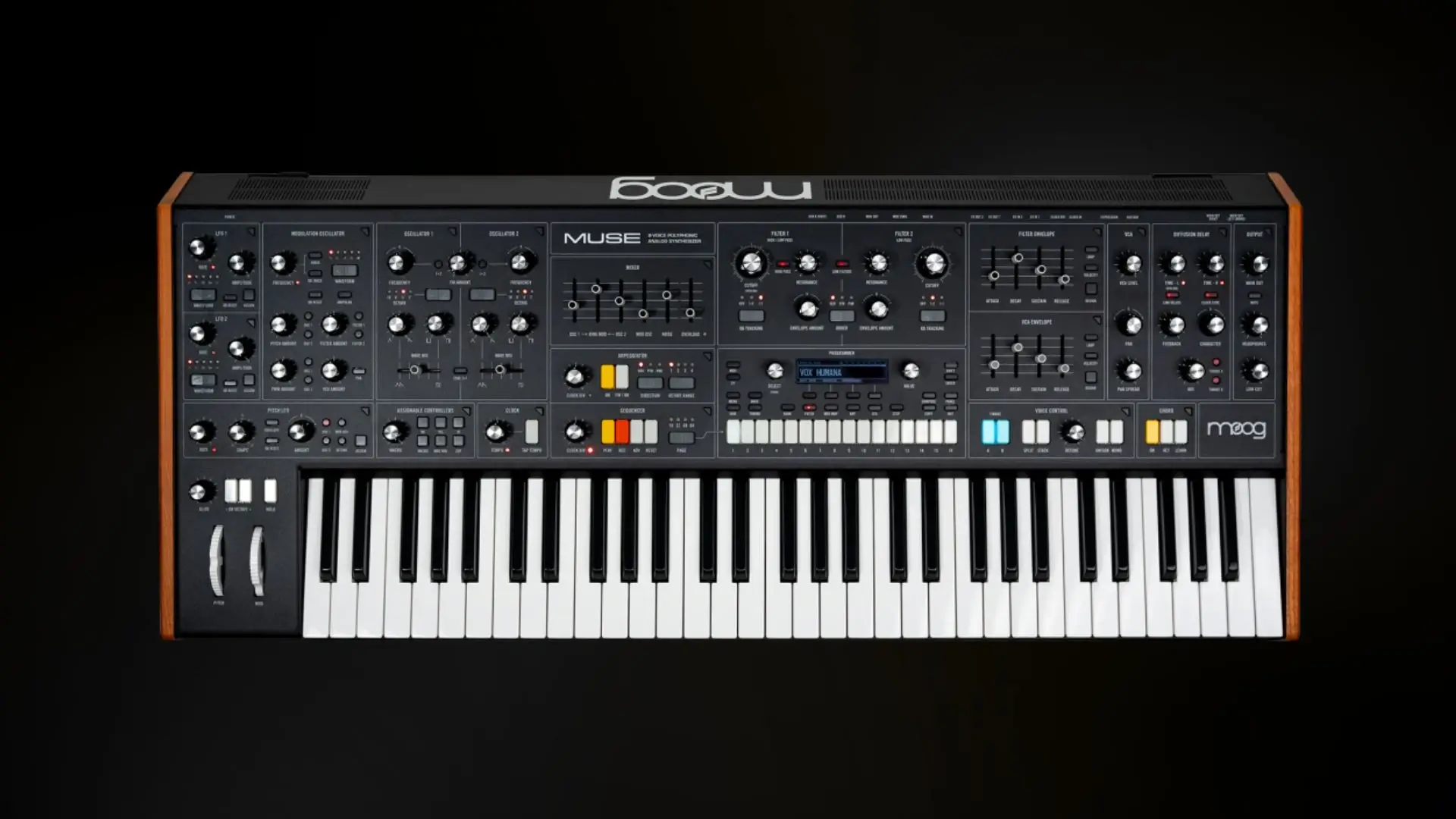
The Moog Muse is an eight-voice analog bi-timbral polyphonic synthesizer introduced in 2024 as a full-size 61-key instrument for studio and performance use. It combines two analog VCOs per voice, a per-voice modulation oscillator, dual ladder filters, a stereo VCA, a 64-step sequencer, an arpeggiator, patch memory, and a digital Diffusion Delay. Its importance is not only technical. Moog Muse arrived after Moog’s acquisition by inMusic and had to prove that a larger corporate structure could still produce a serious, characterful Moog instrument rather than merely trade on the brand’s mythology.
Table of Contents
Moog Muse sound and character
Moog Muse sounds like a modern Moog polysynth that refuses to become polite. Its basic tone is thick, forward, and harmonically active, with enough oscillator edge to keep even simple patches from feeling sterile. It is not a glassy, high-definition hybrid instrument built for endless digital variation. Its identity comes from analog voltage-controlled oscillators, saturated mixing, ladder filtering, and stereo voice architecture.
The instrument is especially convincing in basses, leads, brass-like chords, slow pads, cinematic strings, and split keyboard patches where the lower range carries a dense Moog bass while the upper range opens into stereo movement. The dual-filter system gives it a more spatial identity than older monolithic Moog designs: the filters can be used in serial, parallel, or stereo configurations, so the instrument can move from focused mono-like pressure to broader left-right animation.
Its character also depends on the modulation oscillator. Because it can operate at LFO or audio rate, it pushes Moog Muse beyond simple vintage emulation. It can behave like an extra modulation source, a source of analog instability, or a third oscillator-like element for more metallic, animated, and uneasy timbres. Ring modulation, oscillator FM, hard sync, noise, and the CP3-style overload circuit further extend the palette into sharper and more abrasive territory.
The Diffusion Delay is central to the personality of the instrument. It is not a broad multi-effects section, and that limitation matters, but the delay is unusually well matched to the synth. It can smear echoes into reverb-like density, add lo-fi grit, and give pads and leads a floating, cinematic afterimage. Moog Muse therefore sits between two identities: it is recognizably Moog in weight and tone, but it is also more stereo-conscious, more sequencer-oriented, and more performance-ready than a purely nostalgic Moog polysynth would be.
Features and architecture
- Manufacturer: Moog Music.
- Year introduced: 2024.
- Production years: 2024 to present.
- Synthesis type: Analog subtractive synthesis with digital control and a digital Diffusion Delay effect.
- Category: Full-size analog bi-timbral polyphonic keyboard synthesizer.
- Polyphony: 8 voices.
- Original price: $3,499 USD at launch.
- Current market price: Regular U.S. new price remains around $3,499, with current promotional listings around $3,299 in mid-2026.
- Oscillators: Two analog VCOs per voice, with wave mixing, variable pulse width, hard sync, and programmable analog FM.
- Additional tone sources: Per-voice analog modulation oscillator, analog noise generator, ring modulation, and CP3-style saturating mixer.
- Filter: Two discrete transistor ladder VCFs per voice; one filter can operate as low-pass or high-pass, while the second is low-pass, with serial, parallel, and stereo routing options.
- VCA: Stereo discrete transistor VCA per voice.
- LFOs: Two main LFOs, a dedicated pitch LFO, and modulation oscillator operation in LFO range.
- Envelopes: Two ADSR envelopes per voice with variable curves, looping, velocity response, and assignable routing.
- Modulation system: 16 modulation slots per timbre, per patch, with routing from LFOs, envelopes, modulation oscillator, aftertouch, velocity, pedals, CV inputs, mod wheel, macro knob, and random sources.
- Sequencer / arpeggiator: 64-step sequencer with sequence chaining, parameter recording, probabilistic editing, and an advanced arpeggiator with rhythmic and generative behavior.
- Effects: Digital Diffusion Delay.
- Memory: 256 patch locations; factory units ship with 224 presets. Sequence memory is organized as 16 banks of 16 sequences.
- Keyboard: 61 full-size semi-weighted Fatar keys with velocity and channel aftertouch.
- Inputs / outputs: Dual stereo 1/4-inch TRS main outputs, 1/4-inch stereo headphone output, sustain pedal input, expression pedal input, two 1/8-inch CV inputs, two 1/8-inch CV outputs, clock input, and clock output.
- MIDI / USB: 5-pin DIN MIDI in, out, and thru; USB-B for computer connection; USB-A for storage, updates, and host-related functions.
- Display: OLED display.
- Dimensions / weight: About 39 x 17 x 4.5 inches, or roughly 99 x 43 x 11 cm; about 32 lb, or 14.5 kg.
- Power: IEC AC input with universal 100–240 VAC, 50/60 Hz operation.
Strengths
- It gives Moog a convincing modern polyphonic voice. Moog Muse does not merely stretch a monosynth identity across eight voices; it uses stereo filtering, bi-timbrality, modulation, and sequencing to behave like a contemporary polysynth.
- The core tone has authority. The combination of analog VCOs, ladder filters, saturation, and stereo VCAs gives it weight without making it sound frozen in the 1970s.
- The modulation oscillator is more than a decorative feature. It allows audio-rate movement, filter animation, pulse-width modulation, stereo behavior, and unstable timbres that make the synth more exploratory than its traditional Moog vocabulary might suggest.
- The hands-on workflow matters. Muse has enough front-panel control to feel like an instrument rather than a software editor trapped in hardware.
- The sequencer is musically meaningful. Probability, parameter recording, polyphonic pitch data, and sequence chaining make it useful for evolving phrases, not just repeating arpeggio-like patterns.
- The stereo architecture gives it a strong contemporary role. Pan spread, stereo filter behavior, stacked or split timbres, and Diffusion Delay help Moog Muse sit in modern productions without relying on external processing immediately.
- It balances depth and approachability better than Moog One. Moog Muse is less extravagant than Moog One, but that restraint makes it more focused and easier to understand as a performance instrument.
Limitations
- Eight voices can feel tight in bi-timbral use. When stacked or split patches share the same voice pool, voice stealing can become a practical issue.
- There is no polyphonic aftertouch. The keybed supports channel aftertouch, which is expressive, but less advanced than the polyphonic aftertouch offered by some modern competitors.
- It has only one onboard effect. The Diffusion Delay is characterful, but users expecting a full effects suite with chorus, reverb, distortion, phaser, or multi-FX will need external processing.
- It is not the most versatile polysynth in its price range. Hybrid competitors with more voices, wavetables, digital oscillators, or broader modulation ecosystems can cover a wider spectrum of sounds.
- The filter section is powerful but not wildly varied. Dual ladder filters sound good and support useful routing, but they do not provide the broader contrast of synths that combine very different filter types.
- The price still places it in premium territory. Moog Muse is less expensive than Moog One was, but it remains a serious purchase rather than a broad-access instrument.
- Its size and weight matter. A 61-key, 32-pound analog polysynth is movable, but not casual in the way a compact desktop or 37-key keyboard synth is.
- Its long-term status is still forming. Because it is a recent instrument, its reliability reputation, resale behavior, and cultural footprint are not yet as settled as those of older Moog models.
Historical context
Moog Muse appeared at a sensitive moment in Moog history. In 2023, Moog Music was acquired by inMusic, a corporate group already associated with brands such as Akai, Alesis, Denon, M-Audio, Marantz, and Numark. For many musicians, that raised an obvious question: would Moog remain a serious instrument maker with a distinct engineering culture, or would the name become a label applied to safer mass-market products?
Moog Muse was the instrument that had to answer that question. It followed the Moog One, introduced in 2018 as Moog’s ambitious return to large analog polyphony. Moog One was powerful but expensive, complex, and physically imposing. Moog Muse retained the idea of a flagship analog Moog polysynth, but it narrowed the concept: eight voices instead of a sprawling multi-configuration ecosystem, two timbres instead of three, one distinctive effect rather than a wider effects architecture, and a panel that favors immediate control over maximal abstraction.