

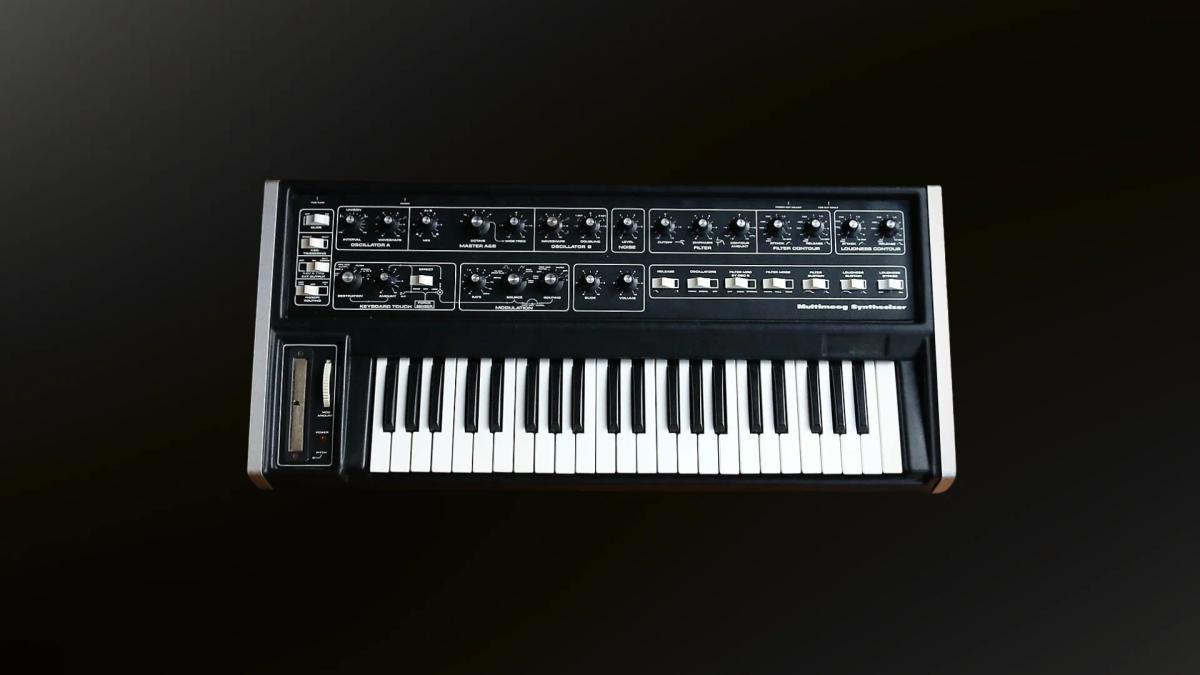
The Moog Multimoog is a monophonic analog synthesizer that Moog Music built from 1978 to 1981 as an expanded version of the Micromoog. It adds a second oscillator, oscillator sync, a dedicated LFO, a 44-key keyboard and, most notably, pressure sensitivity: the Moog Multimoog is one of the earliest synthesizers with aftertouch, routable to pitch, filter and waveshape. It keeps the Micromoog’s ribbon controller and 24dB/octave Moog ladder filter, and internally it even reuses the Micromoog’s main circuit board. At a glance it matters as Moog’s most expressive pre-wired monosynth of the late 1970s, sold for less than a Minimoog yet offering more performance control.
Table of Contents
Moog Multimoog sound and character
The Moog Multimoog has the Moog ladder filter at its core, but it does not sound like a Minimoog, and period writers said so. The Mix’s 1995 retrospective judged that it could not recreate Minimoog timbres convincingly and described its sound as harsher and brighter, “more ARP-like than Minimoog-like”. That brightness comes partly from the oscillators: both have continuously variable waveshapes from sawtooth through square to narrow pulse, and with sync engaged and the waveshape or pitch swept, the Moog Multimoog produces cutting, vocal leads that sit forward in a mix.
Its real character emerges under the fingers. Aftertouch, with adjustable sensitivity, can push the filter open, bend pitch, sweep the sync tone or shift the balance of oscillator A’s waveforms, so a held note can swell, growl or bend without the player touching a knob. Combined with the ribbon and switchable envelope behavior, this made it a strong solo instrument, and The Mix singled it out for lead playing as well as studio experimentation with sync, modulation and sample and hold.
The modulation section is broader than its predecessor’s. A dedicated LFO with triangle, square and random (sample-and-hold) shapes runs from about 0.5 to 30Hz, and oscillator B can modulate the filter at audio rate for quasi-ring-modulated, metallic tones. Weaknesses remain: the two envelopes are simplified attack-release designs with switches rather than full ADSRs (Vintage Synth Explorer lists an ADSR for the VCA, but most sources describe AR envelopes), and bass sounds are solid rather than as heavy as a Minimoog’s. It sits in the vintage, expressive, slightly aggressive corner of the Moog family.
Features and architecture
- Manufacturer: Moog Music, Inc. (a division of Norlin)
- Year introduced: 1978
- Production years: 1978 to 1981; total production is not documented, though owner and dealer accounts suggest roughly 1,000 or fewer units
- Synthesis type: analog subtractive
- Category: pre-wired keyboard monosynth
- Polyphony: monophonic
- Original price: £715 in the UK in October 1978 according to The Mix, later discounted from £799 to £645 in 1979; Soundprogramming.net lists a US MSRP of $1,595, a figure not confirmed elsewhere
- Current market price: Reverb shows used examples from about $2,500, with excellent and restored units listed from roughly $3,200 to over $5,400 in 2026
- Oscillators: 2 VCOs with continuously variable waveshape from sawtooth through square to narrow pulse; oscillator A tunable up to a fifth either side of oscillator B; shared octave switch; oscillator B has the Micromoog’s doubling feature, adding a square wave one or two octaves down; oscillator sync
- Noise: noise generator
- Filter: 24dB/octave Moog transistor ladder low-pass filter with cutoff, emphasis and contour amount; audio-rate modulation from oscillator B
- LFOs: 1 LFO with triangle, square and sample-and-hold waveforms, about 0.5 to 30Hz
- Envelopes: 2 attack-release envelope generators (filter and amplifier) with switchable sustaining or percussive behavior
- Modulation system: mod wheel and aftertouch routings to pitch, filter, sync and waveshape; ribbon with multiple routing options; sample and hold
- Controllers: 44-key keyboard (F to C) with aftertouch of adjustable sensitivity, ribbon controller, modulation wheel, portamento
- Sequencer / arpeggiator: none
- Effects: none
- Memory: none
- Keyboard: 44 keys, aftertouch, no velocity
- Inputs / outputs: high and low audio outputs, audio input, S-trigger in and out, keyboard and ribbon CV outputs, pressure CV output, filter and oscillator CV inputs, footswitch jacks for glide and modulation, alternative controller input
- MIDI / USB: none
- Display: none
- Dimensions / weight: about 31.75 x 15 x 5.5 inches and 26 lbs, according to Soundprogramming.net
- Power: internal supply, 120/240V switchable on export units; about 18W consumption
Strengths
- Aftertouch makes it unusually expressive for its era. Pressure can open the filter, bend pitch or change the waveform, giving held notes a life that wheels alone cannot match.
- Two oscillators with sync and continuously variable waveshapes give it a much wider palette than the Micromoog, especially for biting leads.
- The ribbon controller adds a second continuous performance control, useful for slides and wide bends that a wheel makes awkward.
- Its interfacing was generous for the time. Pressure, ribbon and keyboard CV outputs let it control other gear, including Moog modular systems, and footswitch inputs extend live control.
- The dedicated LFO with sample and hold and audio-rate filter modulation adds random patterns and metallic tones without sacrificing an oscillator.
- It offers a genuine 1970s Moog filter in an instrument that, in its day, cost less than the Minimoog.
Limitations
- The aftertouch, its defining feature, is fragile with age. Sources warn that the pressure sensor in many surviving units no longer works properly, and repair can be difficult.
- The envelopes are simplified attack-release designs, which limits the shaping of plucks and complex contours.
- It does not sound like a Minimoog. Buyers expecting that weight in the low end may find it brighter and thinner than they hoped.
- Both oscillators share one octave switch, and oscillator A’s tuning range is limited to about a fifth either side of B, which restricts wide intervals.
- It has no memory and no MIDI, and its S-trigger gates need suitable converters for modern setups.
- The molded case and late-1970s construction are less robust than the Minimoog’s wooden cabinet, and switches and pots need attention on older units.
Historical context
By the late 1970s Moog Music, owned by Norlin since the early part of the decade, was relying on performance instruments rather than modulars. The Micromoog of 1975 had established a cheaper pre-wired format, and Bob Moog left the company in 1977. The Moog Multimoog grew directly out of the Micromoog: it uses a stock Micromoog circuit board with a second board for the extra circuitry, and it reuses the case style and ribbon controller. Competition was intense, with ARP, Roland, Korg and Sequential all chasing the same players.
Introduced in 1978, it was positioned between the Micromoog and the Minimoog in price, yet Matrixsynth’s summary describes it as Moog’s most advanced non-modular instrument at the time. The aftertouch keyboard was its headline feature, arriving well before pressure sensitivity became common on synthesizers. UK prices, documented by The Mix, show the instrument being discounted within a year of launch, a sign of how quickly the monosynth market was becoming crowded.
Production ended in 1981, when the Moog Source took over as the company’s new monosynth, replacing the Moog Multimoog’s switches and knobs with a single data control and patch memory. The Moog Multimoog thus marks the end of Moog’s knob-per-function, 1970s-style monosynth line before the company turned to programmable designs.