

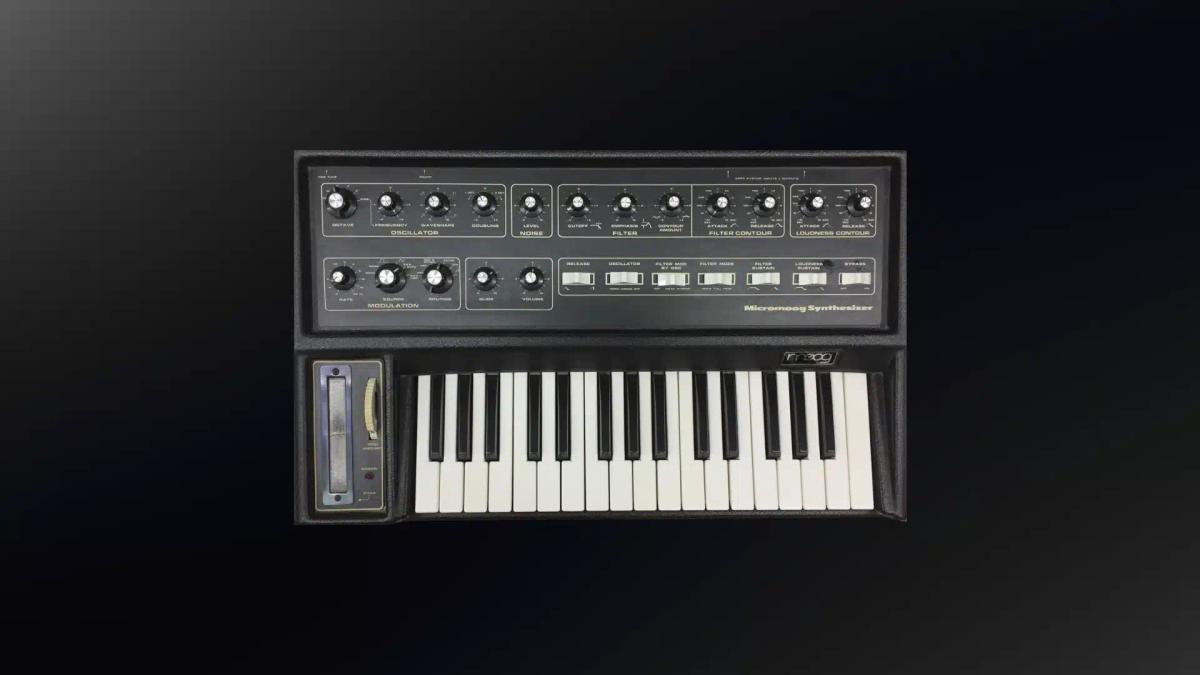
The Moog Micromoog (Model 2090) is a monophonic analog synthesizer that Moog Music produced from 1975 to 1979 as a smaller, much cheaper alternative to the Minimoog. Designed by Jim Scott with input from Tom Rhea, David Luce and Bob Moog, it pairs a single oscillator and sub-octave with a 24dB/octave low-pass filter, two simplified envelopes, a modulation section with sample and hold, and a 32-key keyboard. Its signature control is a ribbon for pitch bend beside the mod wheel. At a glance it matters as Moog’s first serious attempt at an entry-level instrument, and as the platform on which the more ambitious Multimoog was built.
Table of Contents
Moog Micromoog sound and character
The Moog Micromoog sounds unmistakably like a Moog, which surprises players who expect a one-oscillator budget synth to sound thin. The 24dB/octave low-pass filter is a transistor ladder design that Vintage Synth Explorer describes as nearly identical to the Minimoog’s, and it gives bass notes the familiar rounded weight. Bonedo’s reviewer found, in a direct comparison with a Moog Prodigy, that claims about the Moog Micromoog lacking real bass did not hold up, although he also noted a fairly noisy signal path.
The oscillator does more than its count suggests. Its waveshape sweeps continuously from sawtooth through square to narrow pulse, and the shape itself can be modulated, which produces moving, chorus-like timbres from a single source. A square-wave sub-oscillator one or two octaves below adds weight for basses. The filter has unusual tricks: in Tone mode it becomes a sine generator from roughly 50Hz to 5kHz, and it can be frequency-modulated by the oscillator for ring-modulated and metallic sounds. External audio can be routed through the filter and VCA, and Vintage Synth Explorer notes that some owners use it mainly as a filter processor.
Its weaknesses are part of the design. With only attack and release controls, plus switches for sustain and release, the envelopes cannot shape the precise decay-and-sustain plucks of a Minimoog. There is one voice and one oscillator, so the thick detuned stacks associated with Moog leads are out of reach. In character it sits firmly in the vintage, warm camp, best for basses, whistling leads, sample-and-hold effects and processed sounds rather than for big unison tones.
Performance details add to its character. Portamento is built in, and the ribbon gives bends a continuous, slightly vocal feel that suits lead lines, while routing the LFO triangle to the waveshape destination produces a slow pulse-width sweep that disguises the single oscillator. The sample-and-hold modes, one free-running and one stepped by the keyboard, create the burbling random patterns associated with 1970s science-fiction soundtracks. A Polish review in Muzyk praised its bass and solo sounds and noted that some listeners hear it as cooler and less warm than a Minimoog, a reminder that individual units and opinions vary.
Features and architecture
- Manufacturer: Moog Music, Inc. (then part of Norlin)
- Year introduced: 1975
- Production years: 1975 to 1979
- Synthesis type: analog subtractive
- Category: compact, pre-wired keyboard monosynth
- Polyphony: monophonic
- Original price: about $650 to $800 in the United States, according to Wikipedia; The Mix gives £565 in the UK, discounted to £449 by 1976
- Current market price: Reverb listings start at around $995, with clean, serviced examples asking considerably more
- Oscillators: 1 VCO with footages from 32′ to 2′ plus a Wide setting; waveshape continuously variable from sawtooth through square to pulse; square-wave sub-oscillator one or two octaves down
- Noise: pink noise source
- Filter: 24dB/octave low-pass ladder filter with resonance, Normal, Full and Tone modes, oscillator-to-filter modulation (Weak and Strong) for ring-mod effects; external audio input
- LFOs: 1 LFO with square and triangle waves
- Envelopes: 2 (filter and amplifier), each with attack and release, plus switches for sustain and release; the VCA label changed from Articulator to Loudness Contour from around serial 1500
- Modulation system: sources include ribbon bend, noise, LFO square and triangle, and two sample-and-hold modes (automatic and keyboard-triggered); destinations are oscillator, oscillator and filter, filter, and waveshape, with depth on the mod wheel
- Sequencer / arpeggiator: none; sample and hold can imitate stepped patterns
- Effects: none
- Memory: none
- Keyboard: 32 keys (F to C), no velocity or aftertouch; ribbon controller for pitch bend and a modulation wheel; portamento
- Inputs / outputs: high and low audio outputs, audio input to the filter, pitch CV in and out, filter CV input, S-trigger in and out, modulation jack, and an accessory power socket
- MIDI / USB: none; Moog Open System control voltages at 0.95V per octave rather than the usual 1V per octave
- Display: none
- Dimensions / weight: about 24 x 15 x 5.5 inches and around 20 lbs (9kg), according to Polynominal
- Power: internal power supply
Strengths
- It delivers genuine Moog filter tone for a fraction of a Minimoog’s price. The ladder filter is the main reason the Moog Micromoog still has a following.
- The continuously variable waveshape is more useful than a waveform switch. Sweeping or modulating it gives motion and color from one oscillator.
- The ribbon controller is expressive and quick. Bends, slides and vibrato feel different from a wheel, and the ribbon became a Moog trademark on later instruments.
- The modulation section is deep for its size. Two sample-and-hold modes, LFO shapes and four destinations allow effects many single-oscillator rivals could not match.
- The filter’s Tone mode and oscillator-to-filter modulation give it a second sound source and ring-mod style tones without extra hardware.
- The external input makes it a capable filter box for drum machines, other synths or recorded audio.
Limitations
- One oscillator limits its range. There is no way to stack detuned oscillators for the classic fat Moog lead without layering another instrument.
- The envelopes are simplified to attack and release with switches, so detailed decay and sustain shaping is not possible.
- The 32-key keyboard is short for two-handed lines, and players and reviewers describe the keybed as rattly, with uneven key heights and occasional double triggering.
- Build quality reflects the budget brief. The case is largely molded plastic with wooden ends, the pots are board-mounted, and the modulation switches have a known weakness.
- Its 0.95V per octave control standard and S-trigger gates complicate integration with modern CV gear and MIDI converters.
- Tuning stability is weaker than that of Japanese contemporaries such as Roland’s SH series, according to Bonedo.
Historical context
By the mid-1970s Moog Music, owned by Norlin, needed instruments that could sell in larger numbers than the $1,500 Minimoog. Competitors were moving into the same space: ARP’s Odyssey and Axxe and Japanese monosynths from Roland and Korg offered performance synthesis at lower prices. The Moog Micromoog was Moog’s answer, designed by Jim Scott with Tom Rhea consulting and with circuit refinements from David Luce and Bob Moog. The brief was explicit: keep the Moog sound and the essential controls, cut the cost.
Launched in 1975, it reached the price target through a single oscillator, a smaller keyboard and a cheaper case, while adding features the Minimoog lacked, including the ribbon, sample and hold, and a sub-oscillator. It was revised during production: early panels say Articulator where later ones say Loudness Contour, and later units added a rear trimmer for keyboard tracking along with internal keyboard changes. Its success led Moog to build the Multimoog on the same platform, with a second oscillator, a longer keyboard and early aftertouch.