

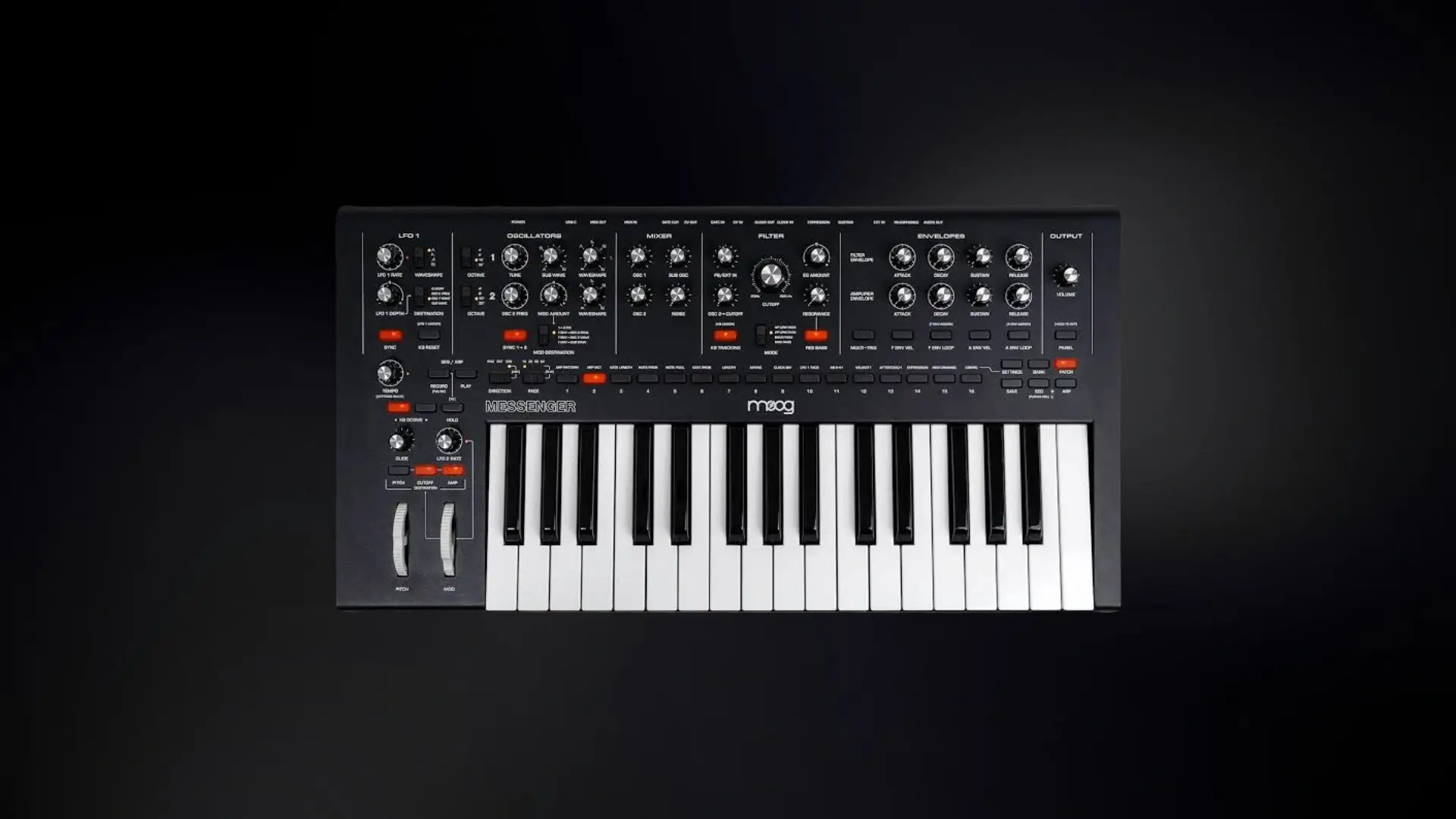
The Moog Messenger is a compact monophonic analog keyboard synthesizer introduced in 2025, positioned as a more accessible modern entry into Moog’s keyboard-based monosynth lineage. With 32 semi-weighted keys, velocity and aftertouch, two variable-shape VCOs with wavefolding, a variable sub-oscillator, a multimode Moog ladder filter with resonance bass compensation, 256 patch memories, and a 64-step sequencer, it is not a nostalgic reissue. It is a deliberate attempt to translate the Moog monosynth idea into a contemporary instrument that can move between classic bass authority, aggressive harmonic animation, and pattern-based electronic performance.
Table of Contents
Moog Messenger sound and character
The Moog Messenger sounds most convincing when it is treated neither as a miniature Minimoog nor as a generic modern mono synth. Its center of gravity is still recognizably Moog: basses are rounded, present, and physically grounded, with the familiar sense that the filter is not merely removing harmonics but reshaping the weight of the note. The sub-oscillator reinforces that identity, especially when used for deep basses, low-end layering, or compressed electronic sequences.
What makes the Moog Messenger more interesting is how quickly it can leave that conservative center. The variable waveshape oscillators and wavefolder give the Moog Messenger a brighter, more serrated edge than many older Moog monosynths. Instead of only moving between classic saw, pulse, and triangle colors, the oscillators can fold and distort their harmonic profile, giving leads and sequences a metallic, cutting, or almost West Coast-flavored bite. That does not erase the Moog identity, but it complicates it.
The filter is central to the Moog Messenger’s personality. The classic ladder low-pass response is present, but the Moog Messenger expands the vocabulary with 4-pole low-pass, 2-pole low-pass, band-pass, and high-pass behavior. The RES BASS function matters musically because it addresses a familiar ladder-filter tradeoff: as resonance rises, low-end weight can thin out. With resonance bass compensation engaged, acid-like resonance and strong bass foundation can coexist more easily.
The result is a synth that works well for thick basses, rubbery sequences, sharp leads, percussive analog hits, drones, and animated electronic textures. It is not lush in the way a vintage polyphonic synth is lush, and it is not unstable in the romantic sense of an old, drifting instrument. Its character is tighter, more controlled, and more modern. The Moog Messenger is strongest when its classic analog signal path is pushed by modulation, sequencer automation, wavefolding, and feedback rather than used only for static bass patches.
Features and architecture
- Manufacturer: Moog Music.
- Year introduced: 2025.
- Production years: 2025–present.
- Synthesis type: Analog subtractive synthesis with variable waveshaping, oscillator wavefolding, oscillator sync, FM options, feedback, and digital control/memory.
- Category: Compact monophonic analog keyboard synthesizer.
- Polyphony: Monophonic analog voice architecture; firmware 1.0.13 later added a duophonic/paraphonic playing mode.
- Original price: Announced at $899 USD.
- Current market price signal: New units have been observed around $599 USD at major retailers, with recent used sales commonly lower than the original launch price.
- Oscillators: Two variable-waveshape voltage-controlled oscillators with wavefolder, plus one variable-waveshape sub-oscillator tied to oscillator 1, analog white noise, and external input/mixer feedback.
- Filter: Voltage-controlled multimode Moog transistor ladder filter with selectable resonance compensation; modes include 4-pole low-pass, 2-pole low-pass, band-pass, and high-pass.
- LFOs: One selectable-waveshape LFO and one triangle-wave LFO tied to performance modulation.
- Envelopes: Two loopable ADSR envelopes for filter and amplitude duties.
- Modulation system: Front-panel routings plus Quick Assign modulation from sources such as LFO, envelope, keyboard tracking, keyboard sample-and-hold, velocity, aftertouch, and expression.
- Sequencer / arpeggiator: 64-step sequencer saveable per patch, arpeggiator functions, parameter recording, probability features, and pattern-oriented performance control.
- Effects: No onboard effects.
- Memory: 256 patch locations arranged as 16 banks of 16 patches; factory presets occupy the first 15 banks, with a user bank provided.
- Keyboard: 32 semi-weighted keys with velocity and aftertouch.
- Inputs / outputs: 6.5 mm audio input, 6.5 mm audio output, 6.5 mm TRS headphone output, sustain input, expression input, CV/gate input and output, and analog clock input/output.
- MIDI / USB: 5-pin DIN MIDI In and Out, plus USB-C for USB MIDI, firmware updates, and preset/editor communication.
- Display: No traditional display.
- Dimensions / weight: 58.50 cm wide, 32.16 cm deep, 9.65 cm high; 4.95 kg.
- Power: Included external 12V DC center-positive power supply, compatible with 100–240V AC, 50/60 Hz.
Strengths
- The Messenger keeps the immediate Moog monosynth signal flow while expanding the harmonic range with wavefolding, oscillator sync, FM-related routing, feedback, and variable waveshapes.
- The multimode ladder filter makes the Moog Messenger more flexible than a strictly classic low-pass Moog, while the RES BASS function gives high-resonance bass patches more practical low-end stability.
- Velocity, aftertouch, modulation wheel control, expression input, and a 32-key keyboard make it more performance-oriented than a desktop module or a tiny budget monosynth.
- The 64-step sequencer is not just a note recorder; parameter recording and probabilistic behavior make it useful for evolving basslines, electro patterns, acid-adjacent movement, and generative-style variation.
- The combination of patch memory and knob-heavy control gives it a useful balance between recall and hands-on synthesis.
- CV/gate and clock I/O let it sit between conventional MIDI studios and modular or semi-modular systems.
- The later editor/librarian support makes patch management and deeper programming less dependent on memorizing button combinations.
Limitations
- It is not a true polyphonic synthesizer; even with duophonic/paraphonic firmware behavior, it remains fundamentally a shared analog voice architecture.
- There are no onboard effects, so delay, chorus, reverb, or spatial widening must come from pedals, outboard gear, plugins, or a mixer.
- The lack of a display keeps the front panel clean, but it makes patch names, deeper settings, and some configuration tasks less immediately visible.
- The 32-key range is practical for basses, leads, and compact performance, but limited for players who want wider two-hand keyboard work.
- Some deeper functions depend on button combinations and secondary operations, so the Moog Messenger is not fully “one knob per function” once modulation assignment, configuration, and preset management are considered.
- Its launch price placed it above several strong competing monosynths, so the value argument depends heavily on whether the buyer specifically wants the Moog filter, keyboard feel, modulation system, and build format.
- Because new prices have already been discounted at major retailers, early resale values appear less stable than those of some older, more established Moog instruments.
Historical context
The Moog Messenger arrived at a sensitive moment in Moog’s history. Moog Music had been acquired by inMusic in 2023, a move that generated anxiety among musicians who associated the brand with Asheville-based craft, boutique manufacturing, and a long symbolic connection to Bob Moog’s engineering culture. The Muse polysynth had already shown that Moog could still build a serious flagship after the acquisition, but Moog Messenger addressed a different question: could the brand make a compact, lower-priced, modern keyboard monosynth without reducing the Moog idea to a logo?
Historically, Moog’s public identity is inseparable from the monosynth. The Minimoog Model D became a template for the portable performance synthesizer: oscillators into mixer, mixer into ladder filter, filter into amplifier, all made playable by an integrated keyboard and physical controls. Later Moog instruments such as the Voyager, Sub Phatty, Subsequent line, Grandmother, and Matriarch reworked that heritage in different directions. Moog Messenger belongs to that family, but it is not a reissue or a pure traditionalist statement.
Its timing matters because the modern monosynth market is crowded. By 2025, musicians could choose from affordable analog monosynths, hybrid instruments, semi-modular boxes, boutique desktop synths, and software instruments that cover classic subtractive territory very well. A new Moog monosynth therefore had to justify itself not by simply being analog, but by offering a specific performance identity. Moog Messenger’s answer was to combine the familiar Moog bass-and-filter center with features that older Moog monosynths were not historically built around: wavefolding, resonance bass compensation, deeper sequencing, patch memory, modern connectivity, and an editor-supported workflow.
It also represented a strategic shift. Rather than making a purely premium heritage instrument, Moog placed a recognizably serious analog keyboard at a more reachable price point than its larger keyboard synths. That does not make it a budget synth in the broader market, but it does make it a different kind of Moog product: less ceremonial, more utilitarian, and more directly aimed at producers and performers who want the brand’s analog vocabulary without entering flagship territory.