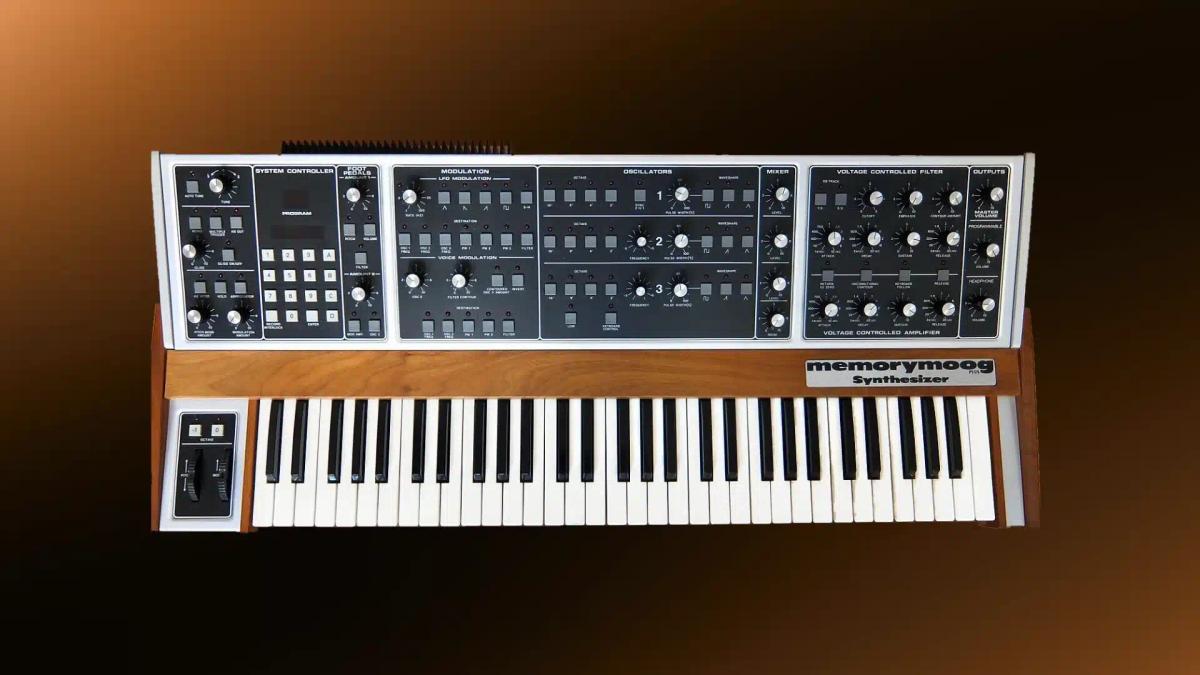
The Memorymoog Plus, reported by Electronics & Music Maker in January 1984, was Moog’s correction: MIDI, a six-memory polyphonic sequencer with monophonic CV output, clock sync for drum machines, improved pitch-stabilising circuitry and 100 new factory programs, with a retrofit kit for existing units. Sound On Sound records that a later polysynth, the SL8, was shown but never sold, which leaves the Moog Memorymoog as the final Moog instrument of the original company.
Legacy and significance
The Moog Memorymoog matters because it represents the last full statement of the original Moog Music’s design philosophy. It did not try to be cheaper, lighter or more modern than its rivals. It tried to be more Moog: more oscillators, a ladder filter in every voice, and a programmer built to make that power editable. In that sense it reads as the culmination of a decade of performance-synth development, a phrase used by synthesist Marc Doty when the Bob Moog Foundation raffled one in 2016.
Its flaws are part of its significance too. The Moog Memorymoog shows what happened when a company built an ambitious analog instrument at the edge of its engineering and financial resources, just as the market shifted under its feet. The Moog Memorymoog’s long afterlife in repair benches and modification workshops is unusual.
The Lintronics Advanced Memorymoog Modification, or LAMM, developed in Germany under Rudi Linhard and introduced in the early 1990s, replaced the CPU and operating system, rebuilt the voice cards and power supply, and added extensive MIDI, velocity, stereo output and a filter audio input. That a vintage synth would be re-engineered this deeply, at a cost Graham Massey compared to a new synthesizer, shows how much players valued the sound beneath the instability.
The design idea also echoed forward. Perfect Circuit’s history draws a line from the Moog Memorymoog to the Moog One of 2018, which returned to a 61-key, three-oscillator-per-voice analog polysynth on a much larger scale. In 2026, Arturia released Memory V, a software recreation, a clear sign that the Moog Memorymoog had become a reference point rather than a footnote.
Artists, users, and curiosities
The most documented user is Jan Hammer. In a 1986 Electronics & Music Maker interview he described building Miami Vice cues partly with the Moog Memorymoog’s built-in polyphonic sequencer driven over MIDI, and defended the instrument with a pointed question: “Who wants to struggle with unstable MiniMoogs when you can have a stable, polyphonic version with MIDI and a sequencer?” It was a striking position given the Moog Memorymoog’s reputation, and in 2004 Sound On Sound reported that Hammer used his old Moog Memorymoog again to re-record original parts for the Miami Vice Complete Collection.
Asia’s Geoff Downes owned one and was candid about it in Sound On Sound in 1986, describing its tuning as “very poor” while insisting he did not want to stop using it “because it’s got a really nice sound.” Matt “Dr. Fink” Fink of The Revolution used a Memorymoog Plus in the touring rig for the Purple Rain, Around the World in a Day and Parade tours; that same unit was raffled by the Bob Moog Foundation in 2019.
The most unusual modern use is Matthew Bourne’s album moogmemory, released by The Leaf Label in November 2016. It was recorded on a single LAMM-modified Memorymoog, and Graham Massey of 808 State noted in the liner notes that no other instruments are used on the album. Another curiosity: according to Perfect Circuit, the original factory programs included contributions from Wendy Carlos, Herbert Deutsch and Jan Hammer, linking the Moog Memorymoog directly to some of the earliest Moog pioneers.
Moog Memorymoog market value
- Current market position: a rare, high-value vintage polysynth valued as the last instrument of the original Moog Music
- New price signal: no new hardware exists; Arturia’s Memory V software, launched in 2026 at €149, is the nearest modern route to the sound
- Used market signal: prices have climbed sharply over time, from around £400 for a standard unit and £700 for a Plus in 1989, to over $6,500 for a serviced unit in 2016, to roughly 10,000 to 15,000 euros or dollars cited by Great Synthesizers in 2023, with current Reverb asking prices for serviced units around $12,000
- Availability: hard to find; units appear only occasionally and condition varies widely
- Buyer notes: verify how many voices pass the autotune, check for stuck or missing voices, test the touch buttons and display, listen to the fan, and ask for service history; Plus models, LAMM conversions, Kenton MIDI retrofits and modern memory upgrades all change both usability and value
- Support ecosystem: owner’s and service manuals circulate online, Kenton Electronics offers MIDI retrofits, Lintronics continues to offer the LAMM, and specialist vintage technicians service the platform
- Market character: collectible and rising, driven more by rarity and sound than by practicality
- Long-term position: likely to remain a blue-chip vintage Moog, with value increasingly tied to documented servicing and upgrades
Conclusion
The Moog Memorymoog is the sound of a great company making its final argument. It took the three-oscillator Moog voice, multiplied it by six and placed it under microprocessor control, producing chords and basses that still sound massive. It also arrived too late, cost too much and drifted too easily to change Moog’s fortunes. Yet that tension is exactly why it matters. The Moog Memorymoog marks the end of the original Moog era, and it remains one of the clearest examples of an instrument whose sound outlived both its flaws and the company that built it.
Sources
- History of the Moog Memorymoog, Perfect Circuit
- Moog Memorymoog (June 1996), Sound On Sound
- Moog Memorymoog, Vintage Synth Explorer
- Moog Memorymoog: TOP vintage poly-synth with 18 VCOs, Great Synthesizers
- Mister Memory (Music Technology, January 1989), Muzines
- Stop Press: MemoryMoog Plus (Electronics & Music Maker, January 1984), Muzines
- Hammer Strikes Out! (Electronics & Music Maker, February 1986), Muzines
- Geoff Downes (Sound On Sound, April 1986), Muzines
- Jan Hammer, Sound On Sound
- Memorymoog, Wikipedia
- Bob Moog Foundation Memorymoog raffle press release, Mountain Xpress
- Matthew Bourne: moogmemory, The Leaf Label
- Moog Memorymoog 1982 – 1985, Reverb
- Arturia releases polysynth inspired by Moog’s iconic 1982 Memorymoog, DJ Mag