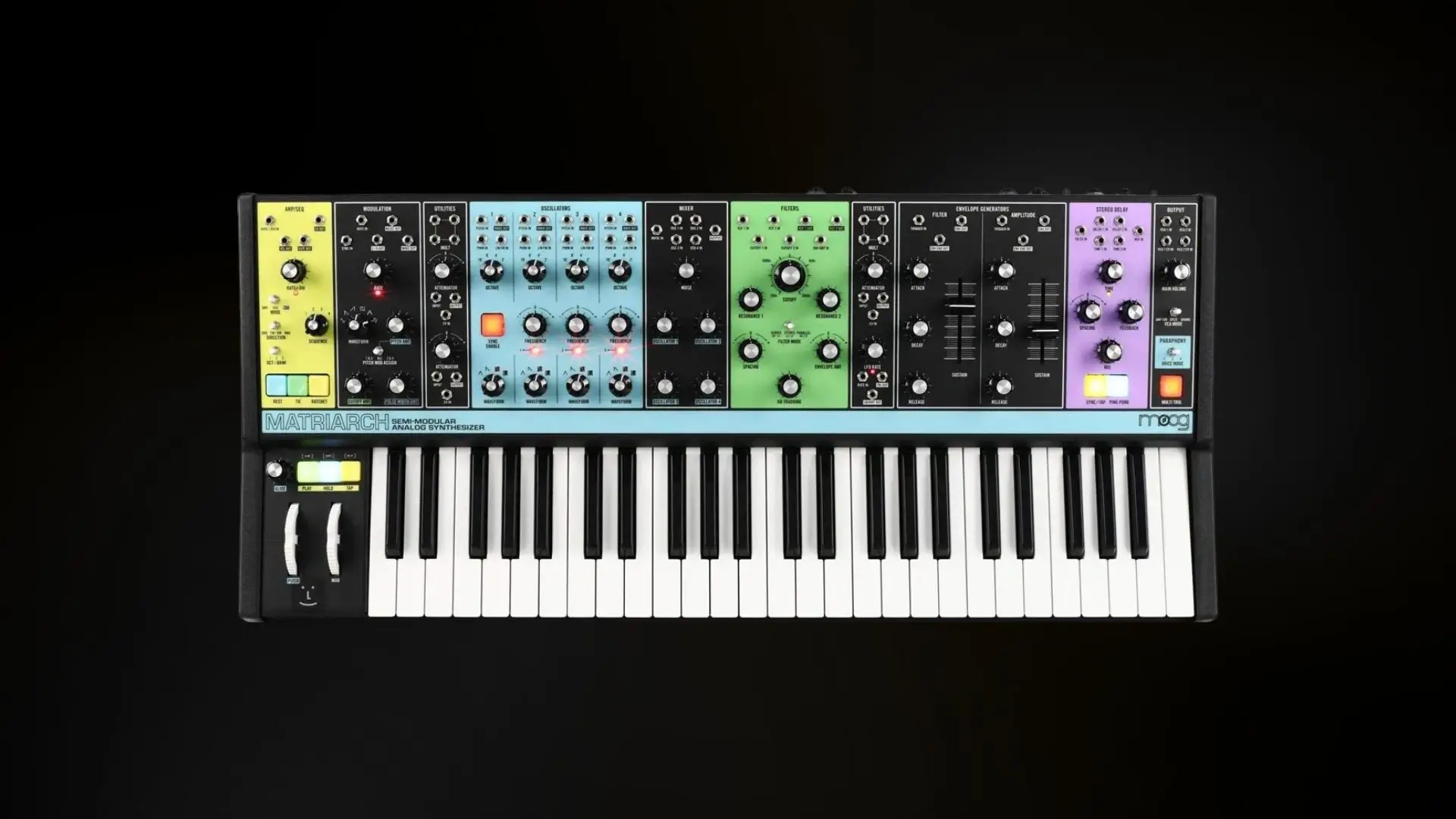
The Moog Matriarch deserves attention because it challenges a narrow definition of what a modern flagship analog keyboard should be. It does not compete primarily by offering the highest voice count, the deepest preset library, or the most streamlined production workflow. Instead, it insists that limitation, voltage behavior, and manual control can still be central values in a contemporary instrument.
Its significance lies in the way it joins three histories: the classic Moog modular tradition, the Minimoog-centered performance lineage, and the 21st-century modular revival. The Moog Matriarch is not purely any one of those things. It is a keyboard that behaves partly like a modular system, a paraphonic instrument that refuses to imitate true polyphony, and a performance synth that asks the player to think in terms of signal flow rather than menu structure.
For that reason, its legacy is likely to be more durable than its spec sheet alone suggests. A 4-note paraphonic synth with no preset memory is, on paper, easy to criticize. In practice, those same constraints are what give the instrument its identity. The Moog Matriarch is valuable because it does not smooth away the frictions of analog synthesis. It makes those frictions musical.
The Moog Matriarch’s launch was closely tied to Moogfest 2019. Moog introduced a limited Moogfest Edition, with the first 250 instruments connected to the event and presented through a special launch arrangement. That launch strategy reinforced the instrument’s identity as something more culturally situated than a standard product release: it was tied to a festival built around music, technology, art, and synthesis culture.
Early public demonstrations associated the Moog Matriarch with musicians and producers such as Lisa Bella Donna, Max Ravitz, Sarah Schachner, Paris Strother, and Philip Cornish. This matters because the instrument was presented not only as a keyboard for traditional lead and bass duties, but as a tool for composition, electronic performance, sound design, and hybrid studio use.
A particularly useful real-world example is Stephan Bodzin, who discussed using the Moog Matriarch heavily around the Boavista album and live setup. What is revealing is not just that he used it, but why: the absence of presets forced him toward sound creation from scratch, making errors and surprises part of the musical result. That is one of the clearest ways to understand the Moog Matriarch’s design philosophy. It is not optimized for instant repetition. It is optimized for encounter.
Another curiosity is that the instrument later received firmware improvements that refined performance behavior, including velocity-curve options and expanded CV-related response. That update is a reminder that even a synthesizer marketed around analog circuitry still depends on a modern control layer. The Moog Matriarch’s soul may be voltage, but its usability is also shaped by firmware.
- Current market position: Premium semi-modular analog keyboard, positioned above entry-level analog synths and outside the usual preset-polysynth category.
- New price signal: Around $1,899 in major U.S. retail listings in 2026, below the $1,999 launch-edition signal from 2019.
- Used market signal: Recent UK used-market aggregation based on Reverb sold listings points to an average around £1,391, with a stable short-term trend.
- Availability: Not rare in the vintage sense, but new availability can be uneven; some retailer signals show backorder conditions rather than constant immediate supply.
- Buyer notes: Check patch jacks, sliders, knobs, delay behavior, keybed response, aftertouch, MIDI, sequencer operation, and whether the correct power supply is included.
- Support ecosystem: Strong support environment through Moog documentation, firmware resources, patch books, tutorials, Eurorack compatibility, and a large community of semi-modular users.
- Ease of finding: Generally findable, but not always instantly available new; used examples depend on region and condition.
- Long-term status: Stable rather than explosively collectible at present. Its longer-term significance may strengthen because it belongs to Moog’s late employee-owned era, but current evidence supports steady demand more than speculative rarity.
The Moog Matriarch is not the most convenient analog keyboard, and it is not trying to be. It is too paraphonic to replace a polysynth, too manual to behave like a preset machine, and too large to be a casual accessory. That is also why it matters. It turns classic Moog circuit language into a performable, patchable, stereo, semi-modular instrument for the modern era. Its best argument is not efficiency, but consequence: every routing choice, oscillator interaction, filter movement, and delay smear feels like part of the composition.
From the same maker, see also our article on the Moog Little Phatty Stage II.