

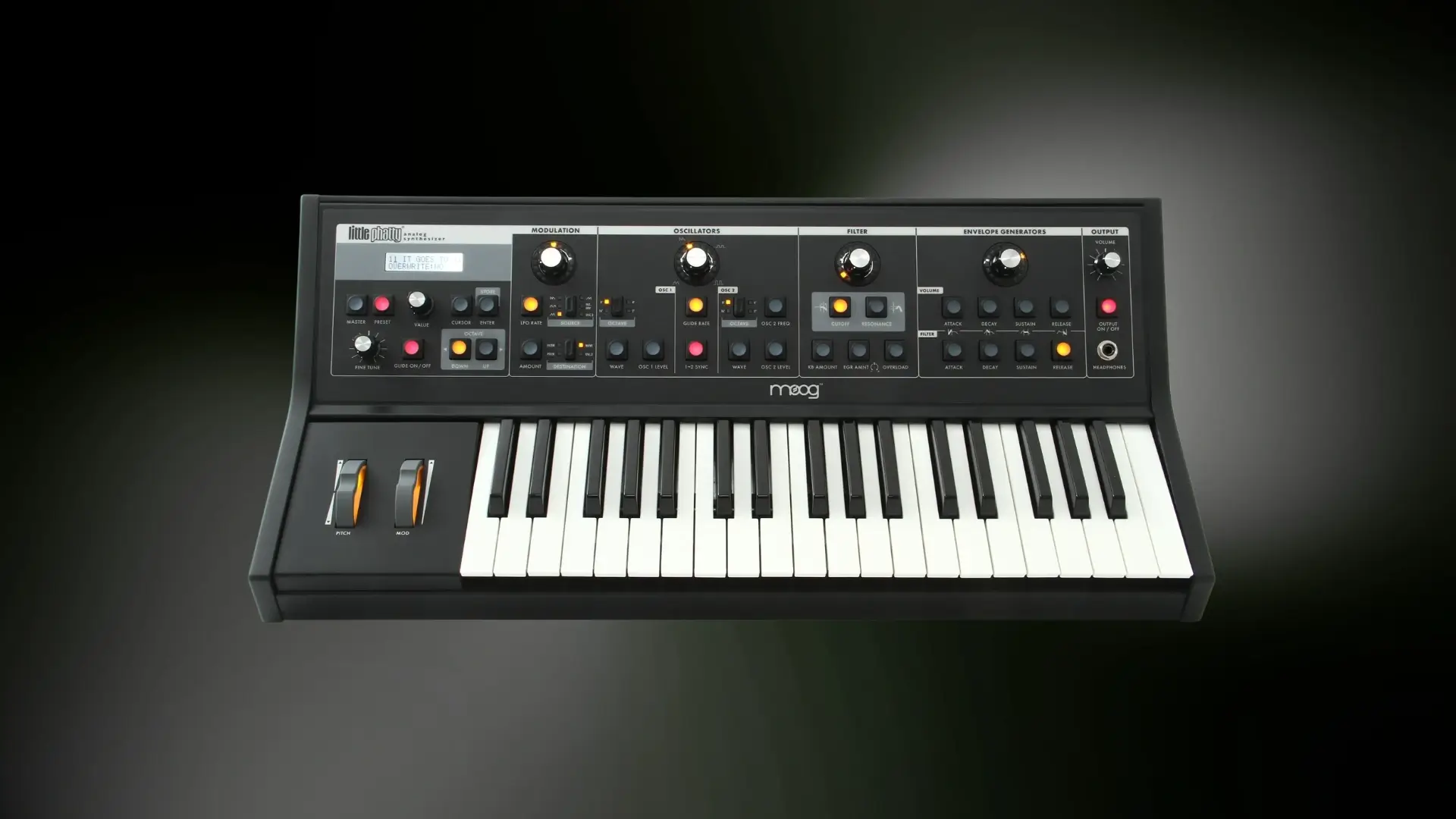
The Moog Little Phatty Stage II is a programmable monophonic analog synthesizer introduced in 2008 as an update to the earlier Little Phatty Stage Edition. It kept the core Little Phatty idea intact: a 37-key, two-oscillator Moog mono synth with memories, a compact performance interface, and a direct link to the Minimoog lineage. What made the Moog Little Phatty Stage II important was not that it reinvented Moog synthesis, but that it made a historically loaded analog voice more usable in a MIDI-centered, computer-aware, post-2000s performance environment.
Table of Contents
Moog Little Phatty Stage II sound and character
The Moog Little Phatty Stage II sounds unmistakably like a compact Moog: rounded, solid, bass-forward, and capable of a vocal upper-register lead when the filter resonance and glide are handled carefully. Its identity comes from the familiar combination of two voltage-controlled oscillators, a low-pass Moog filter, analog envelope shaping, oscillator sync, and filter overload. It is not a sprawling modular instrument, nor is it a multi-engine modern monosynth. Its personality is concentrated.
The bass character is the most immediate part of the instrument. With both oscillators set in the lower octave ranges and the filter working at a moderate slope, the Moog Little Phatty Stage II produces the thick, anchored low end people expect from a Moog mono. The tone is not as massive or flexible as a Voyager, and it does not have the later aggression of the Sub Phatty or Sub 37 architecture, but it has a focused weight that sits naturally in electronic, funk, progressive rock, synth-pop, and cinematic bass roles.
Its lead sounds are more dependent on performance technique. The pitch wheel, modulation wheel, octave switching, glide, and oscillator sync are central to its expressive value. Because the panel uses shared editing controls rather than one knob per function, the Moog Little Phatty Stage II encourages a slightly more deliberate way of programming. That can feel restrictive, but it also gives the instrument a clear performance identity: choose a sound, shape the essential parameters, and play it like an instrument rather than treat it as an endless laboratory.
The filter is the emotional center. At gentle settings, it gives the oscillators a rounded, slightly compressed smoothness. With resonance raised, it becomes more nasal and vocal. With overload pushed, it gains density and edge without turning into a modern distortion machine. The selectable pole structure also matters musically: lower pole settings can preserve more brightness and motion, while the classic 24 dB/octave setting gives the familiar Moog low-pass authority.
The Stage II is vintage-leaning in tone but not vintage in workflow. Its presets, USB MIDI, MIDI clock synchronization, arpeggiator, and tap tempo place it in a different cultural moment from the Minimoog. It belongs to the early analog revival period, when musicians wanted real analog circuitry but also expected instruments to live beside laptops, DAWs, and MIDI sequencers.
Features and architecture
- Manufacturer: Moog Music.
- Year introduced: 2008 as the Moog Little Phatty Stage II update to the Little Phatty Stage Edition.
- Production years: 2008 to 2013 for the Moog Little Phatty Stage II era; the broader Little Phatty line began in 2006 and was discontinued in 2013.
- Synthesis type: Analog subtractive synthesis with digitally managed control and preset memory.
- Category: 37-key monophonic analog keyboard synthesizer.
- Polyphony: Monophonic.
- Original price and current market price: Sweetwater’s archived reference page listed the Moog Little Phatty Stage II at $1,395. Current used-market signals generally place it in the lower-to-mid four figures depending on condition, edition, and region, with Reverb’s price guide showing a broad used-value range.
- Oscillators: Two analog VCOs. Oscillator 1 offers octave settings at 16’, 8’, 4’, and 2’, continuously variable waveforms from triangle through sawtooth and square/pulse, and level control. Oscillator 2 adds ±7 semitones of frequency adjustment, the same octave and waveform structure, level control, and oscillator sync.
- Filter: Moog low-pass filter with cutoff, resonance up to self-oscillation, keyboard tracking, bipolar filter envelope amount, overload, and selectable filter poles from 1 to 4, corresponding to slopes from 6 dB/octave to 24 dB/octave.
- LFOs: One LFO with a rate range from 0.2 Hz to 50 Hz.
- Envelopes: Two ADSR envelope generators, one for filter and one for volume, with attack, decay, and release times from 0.001 to 10 seconds and sustain from 0 to 100%.
- Modulation system: A modulation section with sources including LFO triangle, square, sawtooth, ramp, filter envelope, and oscillator 2; alternate options include sample-and-hold and noise through advanced preset settings. Destinations include pitch, oscillator 2, filter, and waveform, with a secondary modulation destination available through the advanced menu.
- Sequencer / arpeggiator: No full step sequencer. The Moog Little Phatty Stage II added an arpeggiator with internal, LFO, or MIDI clock sources, tap tempo, selectable patterns, octave range, modes, and latch behavior.
- Effects: No onboard effects section; tone shaping is centered on oscillator interaction, filter response, overload, envelopes, modulation, and external processing.
- Memory: 100 user-programmable presets.
- Keyboard: 37 keys, C to C, with velocity transmitted over MIDI.
- Inputs / outputs: Mono audio output, headphone output, external audio input, pitch CV input, filter CV input, volume CV input, and keyboard gate input.
- MIDI / USB: MIDI In and Out plus USB MIDI on the Moog Little Phatty Stage II.
- Display: 2 x 16 character LCD.
- Dimensions / weight: 26.75” x 14.75” x 6.75”; 22 lb / 9.9 kg.
- Power: Universal internal power supply, 100–250 VAC, 50–60 Hz, with 12 W power consumption listed in the Moog Little Phatty Stage II manual.
Strengths
- It gives the player a real Moog analog voice in a compact, programmable instrument. The Moog Little Phatty Stage II does not merely imitate a vintage Moog tone; it uses an analog signal path with two VCOs and a Moog low-pass filter, while adding preset storage for live and studio recall.
- The bass and lead sounds remain the main reasons to care. It excels at rounded basses, simple but authoritative leads, sync tones, resonant sweeps, and expressive glide lines. It is not broad, but the sounds it does well are musically useful.
- The Moog Little Phatty Stage II update made the Little Phatty more viable in modern rigs. USB MIDI, MIDI clock sync, tap tempo, and the arpeggiator gave it a practical place beside DAWs, drum machines, and sequenced setups.
- The interface is approachable without being shallow. Four shared edit controls limit immediate access, but the architecture is easy to understand. For players intimidated by large modular-style panels, the Stage II offers a relatively clear route into analog synthesis.
- The filter-pole options make it more flexible than its simple panel suggests. Being able to move between gentler slopes and the classic 24 dB/octave response gives the instrument a wider tonal range than a fixed-filter reading would imply.
- It carries historical weight without behaving like a museum piece. The Little Phatty line is tied to Bob Moog’s final design period, but the Moog Little Phatty Stage II version belongs to practical stage and studio use rather than pure nostalgia.
Limitations
- It is strictly monophonic. This is central to its design, but it limits harmonic writing, pads, and chordal performance unless it is layered with other instruments.
- The shared-control interface is efficient but not ideal for deep real-time editing. Compared with knob-per-function monosynths, the Moog Little Phatty Stage II can feel indirect when programming quickly or changing several parameters during performance.
- There is no onboard effects section. Reverb, delay, chorus, and saturation beyond the filter overload must come from external hardware, pedals, plugins, or a mixer/DAW chain.
- It lacks the broader sound-design vocabulary of later Moog monosynths. It does not offer the Sub Phatty/Sub 37 multidrive architecture, expanded sequencing, duophonic behavior, or the larger control surface of later models.
- Some useful functions live in menus. Filter poles, advanced modulation options, arpeggiator setup, keyboard priority, and related parameters are powerful, but not always immediately visible.
- Used-market condition matters. Since the instrument is discontinued, buyers should pay close attention to keyboard condition, encoder behavior, display health, firmware version, side-panel jacks, and whether any factory CV output modification is present.
Historical context
The Little Phatty appeared during a crucial period for Moog Music. The company had already reasserted itself in the 2000s with the Minimoog Voyager, but the Voyager was relatively expensive and physically more imposing. The Little Phatty answered a different question: could Moog offer a more accessible analog keyboard synth that still felt connected to the Minimoog tradition?
The original Little Phatty arrived in 2006, shortly after Bob Moog’s death, and the line was promoted as a tribute to his life and work. The Moog Little Phatty Stage II, announced in 2008, did not replace the concept; it modernized it. The additions of USB MIDI, MIDI clock sync, tap tempo, and an arpeggiator were not cosmetic. They made the instrument more compatible with how electronic musicians were actually working in the late 2000s.
This timing matters. By the late 2000s, software instruments were already dominant in many studios, but analog hardware was regaining symbolic and practical value. Musicians wanted immediacy, circuitry, instability, and tactile control, but they also wanted synchronization, patch memory, and computer integration. The Moog Little Phatty Stage II sat directly inside that tension.