

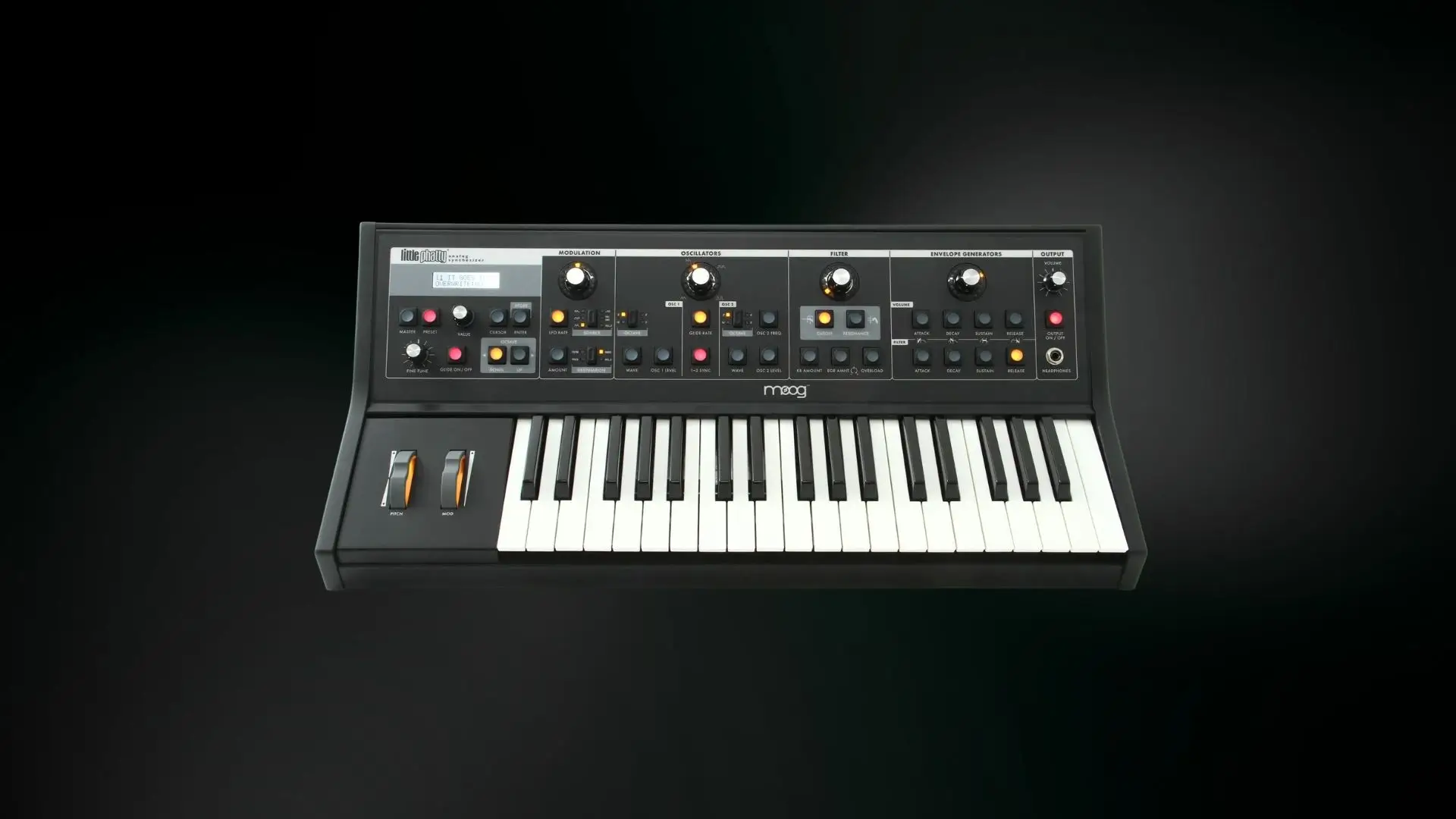
The Moog Little Phatty Stage Edition is a 37-key monophonic analog synthesizer introduced in 2007 as the more stage-oriented production version of the Moog Little Phatty Stage Edition concept that began with the limited Tribute Edition. It combined a two-oscillator analog Moog voice, a 24 dB/octave low-pass ladder filter, 100 programmable presets, MIDI, control-voltage inputs, and a compact performance layout. Its importance is not that it radically expanded synthesis architecture, but that it translated the Moog monosynth into a more practical late-2000s instrument: analog where it mattered sonically, digital where memory and performance control mattered musically.
Table of Contents
Moog Little Phatty Stage Edition sound and character
The Moog Little Phatty Stage Edition sounds unmistakably like a modern Moog monosynth: direct, rounded, bass-heavy, and centered. Its architecture is simple, but that simplicity is part of the sound. Two voltage-controlled oscillators feed a classic Moog low-pass filter, and the result is a voice that favors weight and focus over complexity. It is a synth for basses that occupy the middle of a track with authority, leads that carry glide and filter movement clearly, and sync or pulse-width-style tones that remain controlled rather than chaotic.
The instrument does not behave like a sprawling modular system or a polyphonic texture machine. Its personality comes from compression of intent: oscillator, filter, envelope, modulation, and performance controls are aimed at making one note matter. The Overload function adds drive before and after the filter stage, giving the sound a harder edge when needed, but the Moog Little Phatty Stage Edition is not naturally abrasive in the way some later monosynths can be. It is more compact, muscular, and polished than unstable or wild.
The digitally stored preset system also affects how the instrument feels. This is not a vintage monosynth where every sound must be rebuilt from memory. The Moog Little Phatty Stage Edition keeps the analog signal path while allowing patch recall, which changes the practical role of the instrument. It can behave like a classic Moog voice in a live set without forcing the player into vintage-era compromises. That tension between analog tone and modern recall is central to its identity.
Features and architecture
- Manufacturer: Moog Music.
- Year introduced: 2007.
- Production years: The Moog Little Phatty Stage Edition appeared after the 2006 Tribute Edition and was followed by the Stage II version in 2008; the broader Little Phatty line ran through the early 2010s.
- Synthesis type: Analog subtractive synthesis with digital patch memory and digitally managed control.
- Category: Monophonic analog keyboard synthesizer.
- Polyphony: Monophonic.
- Original price and current market price: Original list/value was reported around US$1,375, with early street pricing just under US$1,300; current used-market signals generally sit around the low-to-mid four figures depending on condition, version, and finish.
- Oscillators: Two analog voltage-controlled oscillators with continuously variable waveforms, octave ranges, oscillator sync, glide, and oscillator 2 tuning offset.
- Filter: Moog 24 dB/octave low-pass ladder filter with cutoff, resonance capable of self-oscillation, keyboard tracking, envelope amount, and Overload drive.
- LFOs: One modulation LFO with triangle, square, sawtooth, and ramp waveforms.
- Envelopes: Two ADSR envelope generators, one for filter and one for amplitude.
- Modulation system: Six modulation sources and four destinations, including pitch, oscillator 2, filter, and waveform modulation.
- Sequencer / arpeggiator: No onboard sequencer or arpeggiator on the original Stage Edition.
- Effects: No dedicated onboard effects section.
- Memory: 100 user-editable presets.
- Keyboard: 37-note keyboard, C to C, with octave controls extending the playable range.
- Inputs / outputs: Main audio output, headphone output, external audio input, pitch CV input, filter CV input, volume CV input, and keyboard gate input.
- MIDI / USB: MIDI In and MIDI Out; USB was not part of the original Stage Edition feature set.
- Display: 2 x 16 LCD.
- Dimensions / weight: Approximately 26.75 x 14.75 x 6.75 inches, with a weight of about 22 lb / 9.9 kg.
- Power: Universal internal power supply, 100–250 VAC, 50–60 Hz.
Strengths
- It delivers a genuine Moog analog monosynth voice in a format that is smaller, less ceremonial, and more stage-practical than larger Moog instruments of the period.
- The two-oscillator architecture is limited on paper, but musically efficient: basses, leads, sync tones, and filter-driven patches can be built quickly and sit clearly in a mix.
- The 100-preset memory system makes it more usable live than a purely manual vintage-style monosynth, especially for players who need repeatable sounds across a set.
- The Real Analog Control concept gives the instrument a useful compromise between patch recall and hands-on analog behavior.
- CV inputs and external audio input keep it connected to older analog and semi-modular workflows rather than locking it into MIDI-only use.
- The tuning-stability approach made the instrument more practical for live performance than a romanticized but temperamental vintage monosynth.
- Its design preserves the essential Moog performance vocabulary: glide, filter movement, wheel control, oscillator sync, and a bass-forward voice.
Limitations
- It is strictly monophonic, so chords, pads, and layered harmonic writing require another instrument or multitracking.
- The original Stage Edition lacks the USB, arpeggiator, and MIDI-clock additions that later helped define the Stage II.
- The architecture is intentionally narrow: two oscillators, one main filter, one LFO, and no onboard effects. That focus is useful, but it also limits experimental range.
- The interface is not fully one-knob-per-function. The four main edit pots are elegant, but deeper editing still involves selection, menus, and the small LCD.
- It is not a Voyager replacement. Players expecting a more expansive Moog flagship architecture may find the Moog Little Phatty Stage Edition too direct.
- Original Stage Edition units are less common than broader Little Phatty or Stage II listings, so buyers often have to judge market value through related models.
- Rubberized surfaces and performance controls on older units should be inspected carefully, because aging soft-touch materials can become unpleasant or sticky.
- It has CV inputs rather than a full modern CV output system, so integration with modular gear is useful but not as complete as later CV-oriented variants.
Historical context
The Moog Little Phatty Stage Edition arrived at a sensitive point in Moog history. Bob Moog had died in 2005, and the company had to prove that it could continue developing meaningful instruments without turning the brand into a museum of its own past. The Moog Little Phatty Stage Edition concept was closely linked to that transition: the limited Tribute Edition honored Bob Moog, while the Moog Little Phatty Stage Edition turned the idea into a more accessible and durable production instrument.
In that sense, the Moog Little Phatty Stage Edition was not a nostalgic reissue. It was a continuation strategy. It took the basic Moog monosynth language, two oscillators into a ladder filter, performance wheels, glide, and a strong bass/lead identity, and placed it in a more contemporary package with patch storage, MIDI, CV inputs, and a more road-friendly physical design. The rubberized side panels and orange-red illumination made it visually distinct from the Tribute Edition, but the more important change was conceptual: this was a Moog that could live on a modern stage without abandoning the older analog grammar.
Its timing also mattered because the late 2000s were a transitional period for hardware synthesis. Software instruments had become powerful and affordable, yet a renewed appetite for hands-on analog hardware was growing. The Moog Little Phatty Stage Edition did not compete by offering vast modulation, multitimbrality, or workstation depth. It competed by making a focused Moog voice easier to own, recall, transport, and perform.