

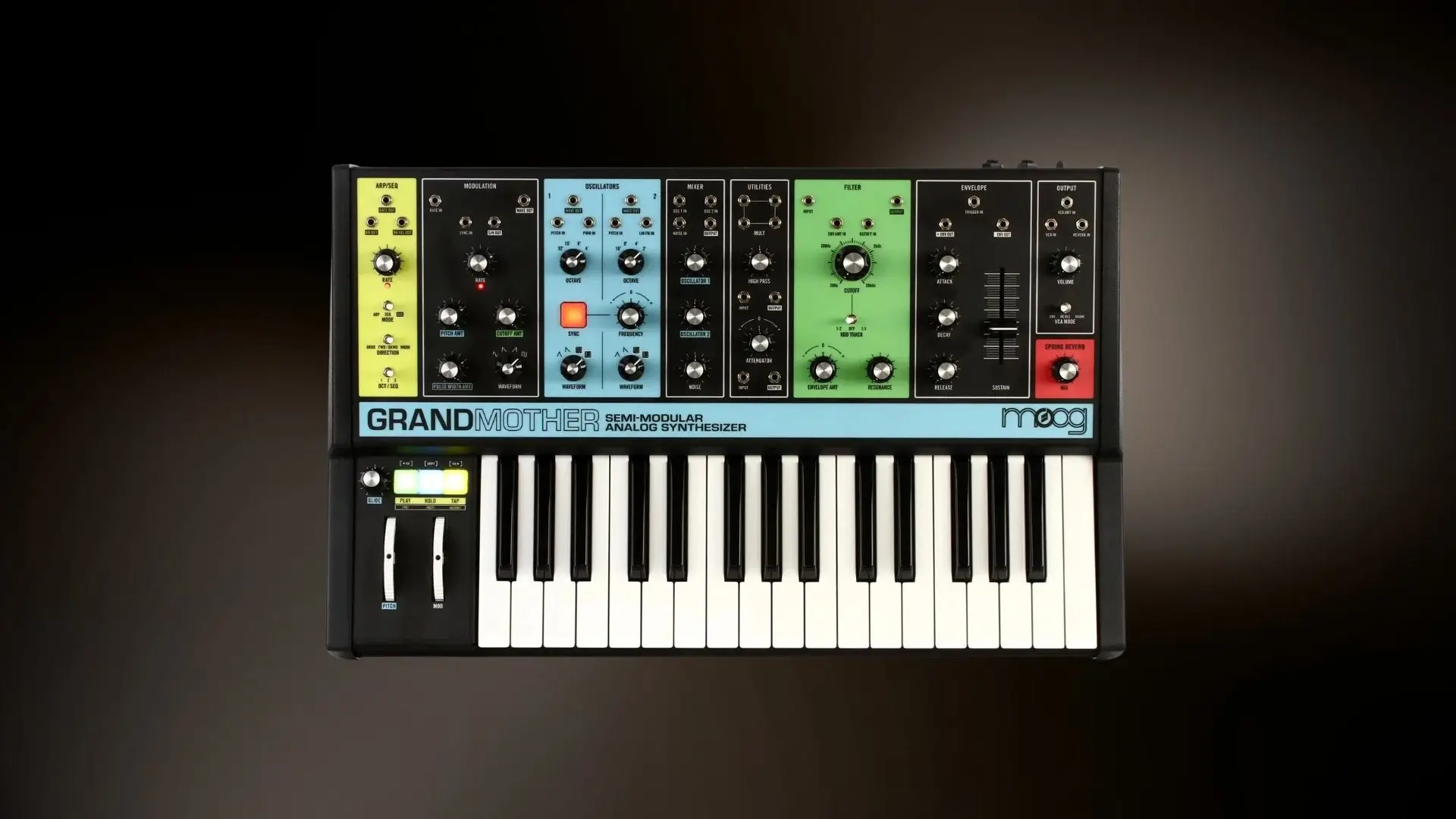
The Moog Grandmother is a monophonic semi-modular analog keyboard synthesizer introduced in 2018, combining a fixed signal path with modular patch points, two analog oscillators, a Moog ladder filter, a built-in arpeggiator/sequencer, and a real spring reverb tank. Its significance is not that it reinvented analog synthesis, but that it made a historically Moog-like modular vocabulary feel physically immediate, playable, and approachable without reducing it to a preset machine.
Table of Contents
Moog Grandmother sound and character
The Moog Grandmother sounds direct, physical, and unapologetically analog. Its core voice is built around two voltage-controlled oscillators, a noise source, a mixer, a 24 dB/octave Moog low-pass ladder filter, a patchable high-pass filter, an ADSR envelope, and a spring reverb. That architecture places it close to the subtractive vocabulary of older Moog systems, but the experience is less museum-like than that description suggests. The instrument has enough normalization to behave like a conventional monosynth, yet enough patch access to destabilize that path whenever the player wants to push it away from predictable bass-and-lead duties.
Its strongest sounds are thick basses, vocal filter sweeps, sync leads, overdriven oscillator blends, resonant sequences, drones, and spring-reverb-soaked textures. The ladder filter gives the Moog Grandmother its central gravitational pull: closing the cutoff darkens the tone in a musically familiar way, while resonance can push the voice toward sharper, more animated shapes. The two oscillators are simple on paper, but their octave ranges, detuning, hard sync, pulse-width modulation, and oscillator-2 linear FM give the instrument a wider personality than a basic vintage-style monosynth.
The spring reverb is crucial to the identity of the Moog Grandmother. It does not behave like a neutral studio reverb. It adds a physical afterimage, sometimes beautiful, sometimes unruly, and it makes the Moog Grandmother feel closer to an electromechanical object than a sealed digital device. That reverb can be used subtly to give a bass or lead a halo, or pushed into surfy, unstable, and haunted territory. The result is a synth that can sound old without becoming politely nostalgic: it can be warm, rubbery, raw, percussive, metallic, and occasionally messy.
Features and architecture
- Manufacturer: Moog Music.
- Year introduced: 2018.
- Production years: 2018 to current market availability; current resale databases list the model across 2018–2026, and major retailers still show new units.
- Synthesis type: Analog subtractive synthesis with semi-modular architecture.
- Category: Monophonic semi-modular keyboard synthesizer.
- Polyphony: Monophonic.
- Original price and current market price: Announced with a $899 street price and $999 MSRP; current new listings commonly show $999, while used-market estimates generally sit below the new price.
- Oscillators: Two analog oscillators with selectable waveforms; oscillator 2 supports sync to oscillator 1 and linear FM. The instrument also includes a white noise generator and external audio input.
- Filter: 24 dB/octave Moog ladder low-pass filter with resonance and self-oscillation; patchable 6 dB/octave high-pass filter.
- LFOs: One wide-range analog modulation oscillator with sine, sawtooth, ramp, and square waveforms, sync input, and sample-and-hold output; it can be used at audio rate.
- Envelopes: One four-stage ADSR envelope.
- Modulation system: Semi-modular normalized routing with 41 patch points across the front and rear panels; modulation sources include the modulation oscillator, sample-and-hold, envelope, and keyboard tracking.
- Sequencer / arpeggiator: Built-in arpeggiator and step sequencer; the sequencer supports up to 256 steps and three sequence files.
- Effects: Built-in analog spring reverb.
- Memory: No onboard patch memory for sound programs; sequence memory is limited to three sequence files.
- Keyboard: 32 full-size velocity-sensing keys. Velocity is not hard-wired into the voice path, but is available through MIDI and the keyboard velocity output jack.
- Inputs / outputs: 1/4-inch external audio input, 1/4-inch headphone/line output, Eurorack-level output, spring reverb output, and multiple 3.5 mm patch inputs and outputs.
- MIDI / USB: 5-pin DIN MIDI In, Out, and Thru, plus MIDI over USB.
- Display: No conventional screen-based display; the interface is panel-driven.
- Dimensions / weight: 23 x 14 1/4 x 5 1/2 inches; 16 lb / 7.25 kg.
- Power: Included 12V DC power adapter, positive tip, 2A, 100–240V AC, 50/60Hz.
Strengths
- The Moog Grandmother delivers a strong Moog voice without forcing the player into a fully modular workflow. It can be played immediately as a normal monosynth, but its patch points reward curiosity and deeper programming.
- Its sound has unusual physicality for a modern production instrument. The combination of analog oscillators, ladder filter, and real spring reverb gives it a tactile instability that software and many digitally controlled synths often imitate but do not exactly reproduce.
- The panel layout teaches synthesis by design. The separated functional sections make the signal path visible, so the instrument works as both a playable synth and a practical introduction to modular thinking.
- The spring reverb is more than an effect. Because it can process internal and external sound sources, it turns the Moog Grandmother into a character processor as well as a synth voice.
- The oscillator section is simple but not shallow. Hard sync, pulse-width modulation, linear FM into oscillator 2, noise, and external input make the Moog Grandmother more flexible than its one-voice specification might imply.
- The arpeggiator and sequencer make the instrument especially useful for rhythmic basslines, looping motifs, Berlin-school patterns, and live improvisation.
- Its Eurorack and Mother-series compatibility helps it sit naturally between a keyboard studio instrument and a modular control surface.
Limitations
- It is strictly monophonic. Players looking for chords, paraphony, or layered polyphonic pads will need another instrument.
- There is no patch memory. This is philosophically consistent with the Moog Grandmother, but it is a practical limitation for stage work, repeatable studio sessions, and users who need instant recall.
- The keyboard has velocity, but velocity is not internally routed to the voice by default. Expressive velocity behavior requires patching or MIDI use rather than being immediately part of the main sound path.
- The instrument has only one ADSR envelope, which limits complex independent contouring of filter and amplitude unless the player uses patching and external modulation.
- The main output is not a stereo output, and the onboard effect is spring reverb rather than a broader multi-effects system.
- The spring reverb is part of the charm, but it is also physically sensitive. It can react to vibration and electromagnetic interference, which may be musically interesting in the studio but inconvenient in some live or cramped setups.
- Its size and weight are reasonable for a real keyboard synth, but it is not a tiny desktop module. Buyers wanting a compact Eurorack-adjacent Moog may find the Mother-32-style format easier to place.
Historical context
The Moog Grandmother arrived in 2018, after Moog had already re-entered the semi-modular conversation with instruments such as Mother-32 and DFAM. That timing matters. The 2010s saw a broad return to patchable analog hardware, helped by Eurorack’s growth and by musicians looking for instruments that felt less screen-driven than laptops and workstations. The Moog Grandmother responded to that climate by taking the modular impulse and putting it under the hands of keyboard players.
It was not a reissue of a single vintage Moog model. Instead, it was a reinterpretation of Moog’s modular past in a normalized, performance-oriented form. The panel colors of the original edition visually separated functional modules, while the later Dark Series leaned more obviously into the black-panel visual language associated with classic Moog modular systems. In both forms, the instrument’s point was the same: to make modular behavior legible without making the user build every patch from silence.
The launch itself reinforced the historical theater around the Moog Grandmother. It debuted around Moogfest 2018, with a Moog Pop-Up Factory where visitors could see units being built, and the first 500 Moogfest Edition units carried a special badge and came with a denim jacket. That was a clever but also telling gesture: the Grandmother was presented not merely as a product, but as a cultural object tied to Moog’s mythology, physical manufacturing, and festival community.
Legacy and significance
The Moog Grandmother matters because it showed that a modern Moog did not need to chase preset depth, polyphony, or digital convenience to feel contemporary. Its modernity lies in its workflow. It takes historically grounded circuitry ideas and frames them as a living performance system rather than as a collector’s reissue.