

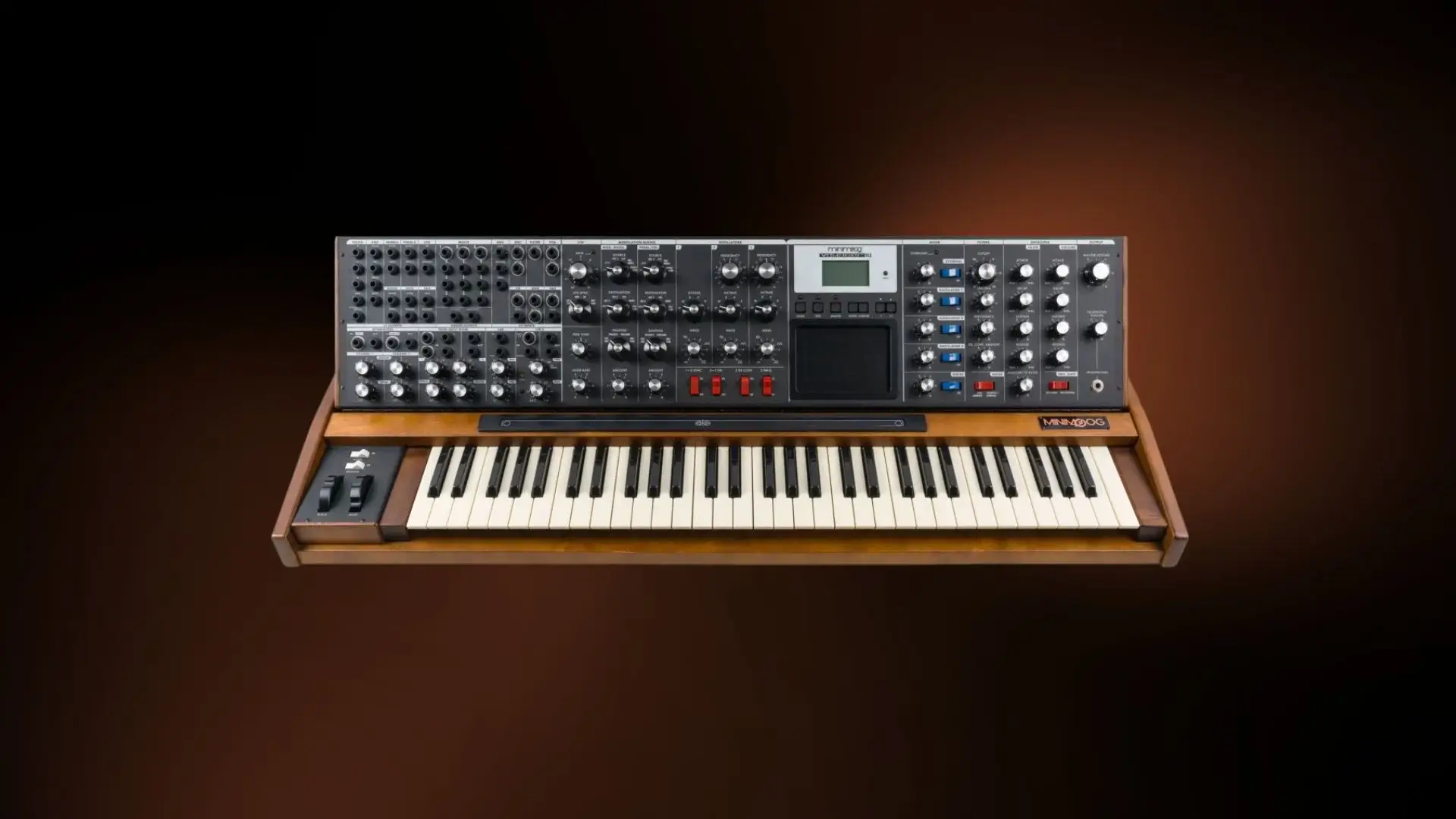
The Minimoog Voyager XL is a programmable monophonic analog synthesizer introduced by Moog Music in 2010 to celebrate the 40th anniversary of the Minimoog Model D. It takes the core Voyager architecture (three analog oscillators, noise, mixer, dual filters, two envelopes, preset memory, MIDI, and a fully analog signal path) and expands it into a 61-key instrument with a ribbon controller, a front-panel CV/Gate patch bay, additional modulation utilities, and a physical scale closer to a studio centerpiece than a compact monosynth. Its importance lies in that contradiction: it is a one-voice synthesizer built with the ambition, size, and control surface of a flagship.
Table of Contents
Minimoog Voyager XL sound and character
The Minimoog Voyager XL sounds like a Voyager before it sounds like a modular system. That distinction matters. Its core voice is not radically separate from the standard Minimoog Voyager; the Minimoog Voyager XL’s significance comes from the way it gives that voice more reach, more control, and more physical performance vocabulary. The tone is dense, rounded, and authoritative, with the familiar Moog emphasis on bass weight, vocal filter movement, and harmonically rich lead sounds.
The three analog oscillators provide the foundation: wide-range VCOs with continuously variable waveforms rather than simple fixed waveform switching. That gives the Voyager XL a smoother way of moving between triangle, saw, square, and rectangular timbres, so its sound can shift gradually rather than jump between static oscillator colors. Slight detuning between oscillators gives the classic beating and width expected from a large analog monosynth, while oscillator sync and oscillator 3 frequency modulation push it toward sharper, more metallic, or unstable territories.
The filter section is a major part of its identity. In dual-lowpass mode, the Minimoog Voyager XL stays closest to the classic Moog vocabulary: basses with strong low-end authority, rounded leads, resonant sweeps, and vocal emphasis around the cutoff point. In highpass/lowpass mode, the two filters work more like a band-defining pair, letting the Minimoog Voyager XL thin, narrow, or animate the sound in ways that a traditional Minimoog Model D cannot. The Spacing control is especially important because it makes the filter section feel less like a single cutoff point and more like a moving tonal architecture.
Where the Minimoog Voyager XL becomes more than a luxury Voyager is in motion. The touch surface, ribbon controller, two modulation busses, patch bay, attenuators, CV mixer, lag processor, mults, and extra LFO resources turn a thick analog voice into something that can be played, bent, and animated in real time. It excels at basses, leads, drones, filter percussion, evolving voltage-controlled textures, external-audio processing, and expressive solo lines. It is not a modern polyphonic workstation, and it is not trying to be one. Its personality is large, tactile, and unapologetically monophonic.
Features and architecture
- Manufacturer: Moog Music.
- Year introduced: 2010.
- Production years: 2010–2017, with official discontinuation announced in 2017 and final units built while parts and materials lasted.
- Synthesis type: Programmable monophonic analog subtractive synthesis with a fully analog signal path and digital control for memory, MIDI, and operating-system functions.
- Category: Flagship 61-key analog monosynth with extensive CV/Gate patching and semi-modular control integration.
- Polyphony: Monophonic, monotimbral.
- Original price and current market price: Original list price was $4,995. Current market signals vary widely because the instrument is discontinued; recent asking and valuation signals include used listings around the mid-to-upper four-figure range and new-old-stock listings well above the original price.
- Oscillators: Three analog voltage-controlled oscillators with continuously variable waveform control; oscillator 3 can operate in a low-frequency range for auxiliary modulation; one noise source; five-input mixer for oscillators, noise, and external audio.
- Filter: Two voltage-controlled filters, configurable as dual lowpass or highpass/lowpass; resonance, cutoff, spacing, and keyboard tracking are central tone-shaping controls.
- LFOs: Primary LFO with triangle and square waves plus sample-and-hold; additional six-waveform LFO processor in the patch-panel section with MIDI sync and external clock capability.
- Envelopes: Two ADSR envelope generators, one dedicated to the filter and one to the amplifier, also available for modulation duties and CV output.
- Modulation system: Two programmable modulation busses, pot mapping, touch surface with X/Y/A/Gate control, ribbon controller with CV/Gate output, patch bay, two active attenuators with offset, four-input CV mixer, lag processor, and three four-way multiples.
- Sequencer / arpeggiator: No onboard sequencer or arpeggiator.
- Effects: No onboard effects; includes external audio input and a Mixer Out/Filter In insert point for processing the signal between mixer and filter.
- Memory: 1,024 presets in eight banks, with 896 user-rewritable locations.
- Keyboard: 61 keys, C-to-C, velocity sensitive, with aftertouch; ±2 octave transpose extends the playable range.
- Inputs / outputs: Stereo audio outputs, headphone output, external audio input, Mixer Out/Filter In insert, 14 pedal/control inputs for CV and gate functions, and 23 CV/Gate outputs.
- MIDI / USB: MIDI In, Out, and Thru on DIN connections; no direct USB port.
- Display: LCD status display with Preset, Edit, and Master interface modes.
- Dimensions / weight: 41.25” wide by 18” deep; height is 3” with the panel flat and 12” with the panel upright; weight is 49 lb / 22.2 kg.
- Power: Universal AC power supply, 100–250 VAC, 50–60 Hz.
Strengths
- It turns the Voyager into a serious performance instrument. The 61-key range, aftertouch, pitch and modulation wheels, touch surface, and ribbon controller make the Minimoog Voyager XL unusually expressive for a monophonic analog synth.
- The patch bay gives the Minimoog Voyager XL a deeper relationship with voltage control. It can function as a self-contained Moog monosynth, a controller for external analog gear, or the central voice in a hybrid modular setup.
- The sound remains rooted in the Voyager’s strong analog voice. Thick basses, singing leads, filter-driven motion, oscillator sync, FM gestures, and external-audio filtering all feel connected to the Moog tradition without being limited to Model D nostalgia.
- Preset memory makes it more practical than many vintage-style analog monosynths. The Minimoog Voyager XL can store complex programmed sounds while still allowing hands-on analog control.
- Its interface makes synthesis visible. The large panel, dedicated controls, patch points, and performance controllers encourage the player to understand signal flow rather than simply browse presets.
- It has genuine stage and studio presence. The size is impractical for casual use, but it gives the instrument a seriousness and visibility that smaller desktop modules cannot replicate.
Limitations
- It is still monophonic. The 61-key format can look like a polysynth, but the Minimoog Voyager XL produces one note at a time.
- It is large and heavy. At 49 lb and more than 41 inches wide, it needs a serious stand, careful transport, and enough studio space.
- The price was high when new and remains high on the used market. The Minimoog Voyager XL is not a rational budget choice if the goal is simply to get a Moog bass or lead sound.
- There is no onboard USB, no onboard effects, and no built-in sequencer or arpeggiator. It is powerful, but not modern in the workstation or groovebox sense.
- The patch bay does not make every parameter equally direct. Some destinations, such as filter spacing or resonance, require modulation-bus or pot-mapping workarounds rather than dedicated CV inputs.
- It does not have a fundamentally new core tone compared with the standard Voyager. Its value lies in expanded control, range, and integration, not in a completely different sound engine.
- It can be overkill for players who want the immediacy of a smaller monosynth. The Minimoog Voyager XL rewards deliberate exploration more than quick setup.
Historical context
The Minimoog Voyager XL appeared at a revealing moment in Moog history. The original Voyager, introduced in 2002, had already established itself as Bob Moog’s modern successor to the Minimoog idea: a monophonic analog instrument with MIDI, patch storage, stable oscillators, performance controls, and a fully analog signal path. The Minimoog Voyager XL took that concept to its maximal form.
Its 2010 introduction linked it directly to the 40th anniversary of the Minimoog Model D. That framing was not cosmetic. The original Minimoog made the synthesizer portable, playable, and stage-oriented by reducing the complexity of modular synthesis into a fixed architecture. The Minimoog Voyager XL, by contrast, moved in the opposite direction: it took a fixed-architecture performance synth and reopened it toward modular-style voltage control.
That reversal is what makes the Minimoog Voyager XL historically interesting. It is not a reissue of the Model D, nor a purist attempt to recreate the 1970s circuit path. It is a late Voyager-era statement about what a flagship analog monosynth could be after MIDI, memory, and modern studio expectations had become normal. It responded to a different set of desires: larger keyboard range, ribbon control, richer modulation, hands-on patching, and easier integration with other voltage-controlled equipment.