

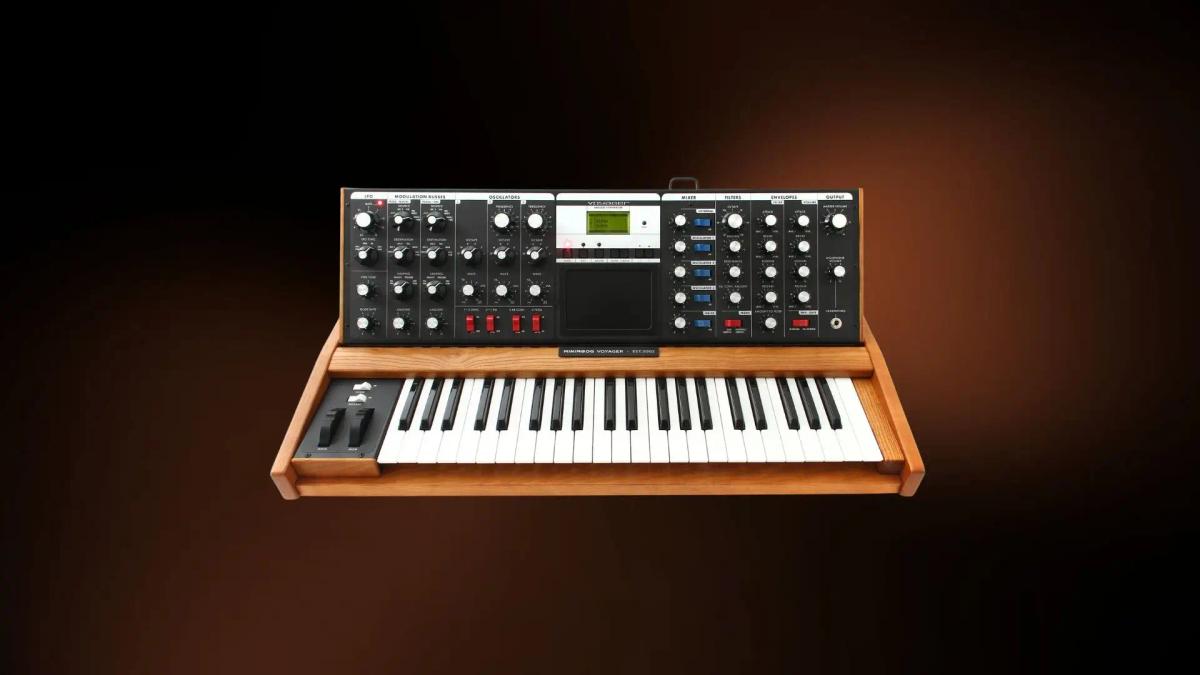
The Minimoog Voyager Old School is a monophonic analog performance synthesizer introduced by Moog Music at Winter NAMM 2008 and produced during the brief 2008-2009 window. It belongs to the Minimoog Voyager family, but it removes the elements that made the standard Voyager more modern: no patch memory, no MIDI, no display, and no touch surface. What remains is a 44-key, three-oscillator analog instrument that deliberately turns the Voyager concept back toward the tactile discipline of the Minimoog Model D era.
Table of Contents
Minimoog Voyager Old School sound and character
The Minimoog Voyager Old School sounds like a Voyager stripped of administrative layers. Its identity comes from three analog voltage-controlled oscillators, a five-input mixer, dual voltage-controlled filters, two envelope generators, an LFO, and two modulation busses. That gives it the familiar Moog vocabulary of thick basses, singing leads, rounded filter sweeps, and harmonically dense oscillator stacks, but the absence of presets changes how those sounds are approached. It is not a machine built for instant recall. It is a machine built for listening while turning.
The oscillator section is central to its force. Each oscillator has continuously variable waveform control, which means the sound can move between familiar waveform positions rather than jumping between fixed wave choices. That matters musically because basses and leads can be shaped in small tonal increments: less brittle than a hard square wave, brighter than a triangle, narrower or wider in pulse-like behavior. Oscillator sync and linear FM add harder edges when needed, so the Minimoog Voyager Old School is not limited to polite vintage bass. It can become vocal, metallic, or aggressive when Oscillator 2 sync and Oscillator 3-to-1 FM are pushed into more unstable territory.
The filter section gives the Minimoog Voyager Old School more range than a strict Model D recreation. In Dual Lowpass mode, the two lowpass filters can be offset with the Spacing control and routed to left and right outputs, producing a wider, animated tone that can feel almost phaser-like. In Highpass/Lowpass mode, the filters work as a bandpass configuration, narrowing the Minimoog Voyager Old School into more nasal, focused, or formant-like territory. That is one of the reasons the Minimoog Voyager Old School is not simply a nostalgia object. It borrows the Minimoog’s directness, but it retains a broader Voyager-era filter architecture.
Its character is best understood as authoritative rather than flexible in the modern workstation sense. It excels at basses that occupy space immediately, leads that respond well to glide and wheel movement, oscillator drones, analog effects, external-audio processing, and modular-adjacent CV work. It is not polished in the sense of being convenient, but it is stable and deliberate. The Minimoog Voyager Old School asks the player to treat sound design as performance, not file management.
Features and architecture
- Manufacturer: Moog Music.
- Year introduced: 2008.
- Production years: 2008–2009.
- Synthesis type: Analog subtractive synthesis.
- Category: Monophonic analog keyboard synthesizer.
- Polyphony: 1 voice.
- Original price: Contemporary reports placed it around US$2,600, with sources variously reporting approximately US$2,595 to US$2,695.
- Current market price: Scarce used examples and old-stock listings generally sit well above the original price; recent public listings have appeared around US$4,000 to US$5,000 depending on condition, region, and seller.
- Oscillators: 3 analog voltage-controlled oscillators with continuously variable waveform control.
- Additional sound sources: Noise source and external audio input.
- Mixer: 5-input mixer.
- Filter: 2 voltage-controlled filters, switchable between Dual Lowpass and Highpass/Lowpass configurations.
- LFOs: 1 dedicated LFO with triangle, square, stepped sample-and-hold, and smoothed sample-and-hold behavior.
- Envelopes: 2 envelope generators, one for the filter and one for volume.
- Modulation system: 2 programmable modulation busses, each with selectable source, controller, destination, and amount.
- Sequencer / arpeggiator: No onboard sequencer or arpeggiator.
- Effects: No onboard effects.
- Memory: No patch memory or presets; sounds must be recreated manually or documented with patch sheets.
- Keyboard: 44 full-size keys, F to C.
- Performance controls: Pitch wheel, modulation wheel, glide switch, release switch, master volume, and headphone volume.
- Keyboard control outputs: Monophonic velocity and aftertouch control voltages.
- Inputs / outputs: Stereo audio outputs, headphone output, external audio input, mixer out/filter in insert point, 14 CV/gate inputs, 2 CV outputs, and DB-25 accessory output port for the optional VX-351 CV Expander.
- MIDI / USB: No MIDI and no USB computer connection specified for performance or patch control.
- Display: No display.
- Dimensions: 30.5 inches wide, 18 inches deep, 3 inches high with the panel flat, or 12 inches high with the panel fully upright.
- Weight: 40 lb / 18.2 kg.
- Power: Universal internal power supply, 100–250 VAC, 50–60 Hz.
Strengths
- It delivers the core Voyager analog voice without the distraction of preset management, making it unusually direct for a modern Moog of its era.
- The three-oscillator architecture gives it real authority for bass, lead, drone, and stacked monophonic sounds.
- The dual-filter design expands the Minimoog Voyager Old School beyond strict Minimoog traditionalism, especially through stereo Dual Lowpass behavior and Highpass/Lowpass bandpass shaping.
- The modulation busses make it more flexible than a basic vintage monosynth while still preserving a front-panel, hands-on workflow.
- The CV/gate connectivity makes it more useful with analog sequencers, modular systems, Moogerfoogers, and external control processors than its “old school” label might suggest.
- The lack of patch memory can be a creative advantage for players who want each sound to emerge through physical interaction rather than preset browsing.
- The hinged panel, wood cabinet, and large-format controls give it a strong performance identity and a physical presence closer to a classic instrument than to a menu-driven studio device.
Limitations
- It is monophonic, so it is not suitable for chords, pads, or polyphonic performance without external layering.
- The absence of patch memory makes it impractical for live sets that require fast, repeatable sound changes.
- The absence of MIDI makes DAW sequencing and modern studio integration less immediate unless a MIDI-to-CV converter is used.
- There is no onboard arpeggiator or sequencer, which makes it less self-contained than later analog monosynths.
- There are no onboard effects, so ambience, delay, distortion, and modulation effects must come from external gear or software.
- It lacks the Voyager touch surface, display, and digitally controlled conveniences found on other Voyager models.
- Its size and weight are significant for a monophonic instrument.
- Current prices can make it difficult to justify purely as a practical monosynth, especially when modern Moog and non-Moog alternatives offer memory, MIDI, sequencing, and smaller footprints.
- Because it was produced briefly, finding a clean example may require patience and careful condition checking.
Historical context
The Minimoog Voyager Old School appeared at a strange and revealing moment. By 2008, software instruments, DAW sequencing, USB controllers, and preset-heavy hardware were already normal parts of electronic music production. Moog had already re-established itself in the modern market with the Voyager, a synth that connected the Minimoog lineage to a newer world of patch storage, MIDI, digital control, and expanded performance features. The Minimoog Voyager Old School deliberately moved in the opposite direction.
That reversal is the point. The standard Voyager had shown that a Minimoog descendant could survive in the twenty-first century by adding modern control. The Minimoog Voyager Old School asked whether a modern player might still want the opposite: an expensive, full-size analog keyboard that refused memory and MIDI in favor of voltage, knobs, and patch documentation. It was not a budget synth in the ordinary sense. It was a statement about how analog instruments could remain culturally meaningful even when they ignored the dominant workflow of the computer-based studio.
Within Moog history, the Minimoog Voyager Old School sits between the original Voyager’s revival logic and the later Voyager XL’s modular expansion logic. The Voyager family as a whole was important because it marked the return of the Minimoog idea under Bob Moog’s revived company, while the Old School was a short-lived correction inside that family: less programmable, less digital, more physically committed. Its brief production run makes sense historically. It was too specialized to become the mainstream Voyager, but too conceptually sharp to be dismissed as a mere variant.