

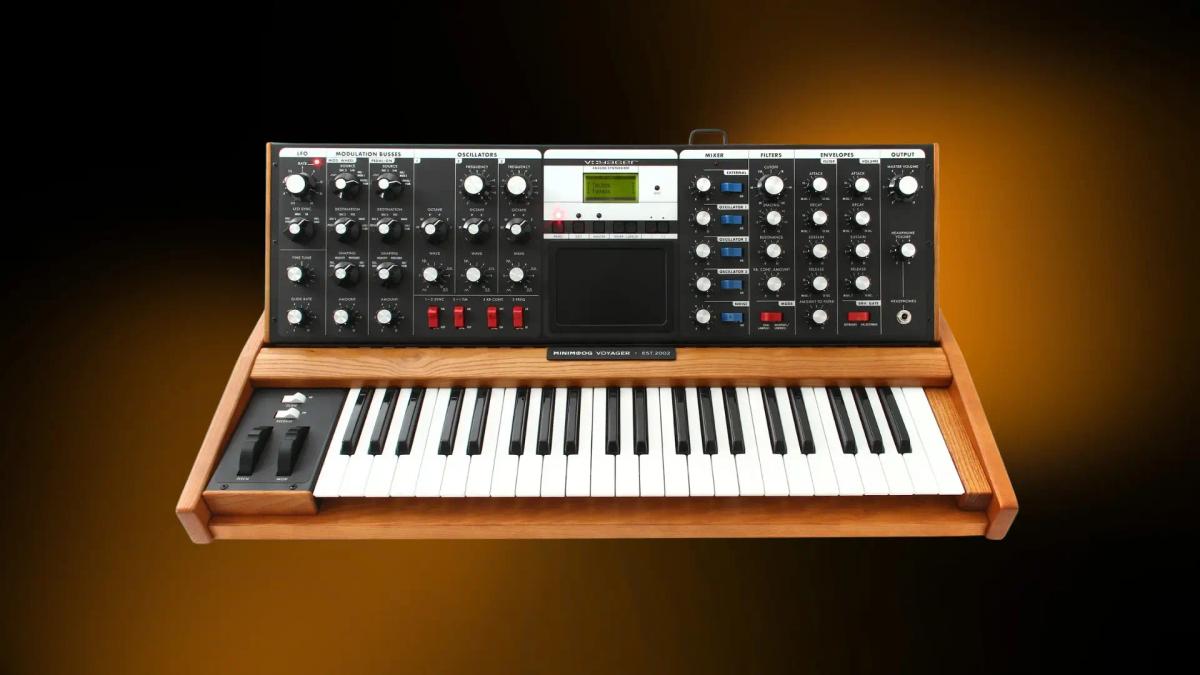
The Minimoog Voyager is a programmable monophonic analog synthesizer introduced by Moog Music in 2002 as a modern descendant of the classic Minimoog. It preserved the essential language of three analog oscillators, subtractive synthesis, hands-on performance controls, and a Moog filter-centered signal path, while adding patch memory, MIDI, extensive control-voltage integration, dual filter modes, and a three-dimensional touch surface. Its importance is not only technical. The Minimoog Voyager marked the return of Moog as a contemporary keyboard-synth manufacturer and became the last synthesizer Bob Moog designed from start to finish.
Table of Contents
Minimoog Voyager sound and character
The Minimoog Voyager sounds recognizably Moog, but it is not simply a Model D replica. Its character is thick, controlled, rounded, and physically present, with enough weight in the low end to handle bass duties and enough harmonic density to carry leads without needing much external processing. Compared with the wilder reputation of some vintage Minimoogs, the Voyager often feels more refined and more stable. That is not a weakness. It makes the instrument easier to place in a modern production while still retaining the pressure, bloom, and harmonic authority expected from a serious analog monosynth.
Much of its identity comes from the combination of three continuously variable-waveform oscillators, a five-input mixer, and a filter section that goes beyond a single traditional low-pass path. In dual low-pass mode, the Minimoog Voyager can produce broad, animated, stereo-aware filter movement. In high-pass/low-pass mode, it moves toward a variable band-pass behavior, giving it a more sculpted and sometimes more nasal or vocal edge. The spacing control is especially important because it changes the relationship between the two filters rather than merely brightening or darkening the whole instrument.
It excels at basses, sync leads, expressive solo tones, drones, and animated analog effects. The external audio input and mixer insert point also make it useful as a processing instrument, not only as a keyboard synth. The Minimoog Voyager’s sound is therefore less about vintage imitation than about extending the Minimoog idea into a programmable, performance-oriented analog system.
Features and architecture
- Manufacturer: Moog Music.
- Year introduced: 2002.
- Production years: 2002–2015 for the standard Minimoog Voyager line.
- Synthesis type: programmable analog subtractive synthesis with digital control for memory and system functions.
- Category: flagship monophonic analog performance synthesizer.
- Polyphony: monophonic.
- Original price: the Performer Edition was listed at US$2,995, while the first Signature Edition units were listed at US$3,495.
- Current market price: used prices vary strongly by edition and condition; the standard Performer Edition generally sits in the high used-market range rather than the affordable monosynth category.
- Oscillators: three analog oscillators with continuously variable waveform control, plus noise and external audio input as additional sound sources.
- Filter: two voltage-controlled filters configurable as dual low-pass filters or as high-pass/low-pass in series, with cutoff, resonance, spacing, and software-selectable pole slopes.
- LFOs: one LFO with triangle and square waves, used through the modulation busses and sample-and-hold system.
- Envelopes: two envelope generators, one for the filter and one for the amplifier.
- Modulation system: two programmable modulation busses, touch-surface control, pot mapping, keyboard performance modulation, and extensive CV/gate integration.
- Sequencer / arpeggiator: no onboard sequencer or arpeggiator in the standard Voyager architecture.
- Effects: no onboard effects; the Mixer Out/Filter In insert point allows external processing before the filter stage.
- Memory: 896 presets in seven banks in the later documented operating system, with user-rewritable locations.
- Keyboard: 44-key keyboard from F to C, with MIDI transmission of velocity and aftertouch, pitch and modulation wheels, glide and release switches, and a three-dimensional touch surface on keyboard models.
- Inputs / outputs: stereo quarter-inch audio outputs, front-panel headphone output, external audio input, Mixer Out/Filter In insert, 14 CV/expression/gate inputs on keyboard models, accessory ports for CV expansion, and BNC lamp socket on keyboard models.
- MIDI / USB: MIDI In, Out, and Thru; operating system updates via MIDI SysEx; no native USB port in the official Voyager keyboard specification.
- Display: backlit LCD with contrast control.
- Dimensions / weight: keyboard version approximately 30.5 inches wide, 18 inches deep, 3 inches high with the panel flat or 12 inches high with the panel upright; approximately 40 lb / 18.2 kg.
- Power: universal AC power supply, 100–250 VAC, 50–60 Hz.
Strengths
- It preserves the immediacy of a classic performance monosynth while adding preset memory, which makes it far more practical for stage and studio recall than a purely vintage-style instrument.
- The three-oscillator architecture gives it enough density for authoritative basses, leads, drones, and effects without needing polyphony to feel substantial.
- The dual-filter design gives the Minimoog Voyager a wider tonal vocabulary than a strict Model D recreation, especially when using filter spacing and stereo outputs.
- The touch surface adds a genuinely performative dimension, letting the player shape multiple parameters with hand movement rather than relying only on wheels and knobs.
- The CV and accessory-port ecosystem makes the Minimoog Voyager more expandable than its clean front panel might suggest, especially when paired with Voyager CV expanders or other voltage-controlled equipment.
- Its build, size, panel angle, and physical layout make it feel like an instrument designed for deliberate playing rather than casual preset browsing.
- It occupies a rare historical position: modern enough for MIDI-era workflows, old-school enough to remain rooted in analog voltage-controlled sound design.
Limitations
- It is monophonic, so it cannot provide chords, pads, or polyphonic textures without external layering or multiple units.
- It is large and heavy for a monosynth, which makes it less convenient than later compact Moog instruments.
- It has no onboard effects, sequencer, or arpeggiator, so rhythmic patterning and spatial polish require external gear or a DAW.
- It lacks native USB in the official keyboard specification, which makes computer integration less direct than on many later synthesizers.
- Some deeper functions require menu access, so it is not as purely one-knob-per-function as the vintage instruments that inspired it.
- It is not the best choice for someone who wants an exact Model D reissue; the Voyager is a reinterpretation with its own filter behavior, control system, and sonic polish.
- Current used prices can be difficult to justify if the buyer only needs a basic Moog bass or lead sound, because newer and smaller monosynths can cover simpler duties at lower cost.
Historical context
The Minimoog Voyager appeared at a moment when analog synthesis was no longer the mainstream default, but it was becoming culturally desirable again. Software instruments, digital workstations, and virtual analog machines had reshaped production, yet musicians were returning to tactile analog hardware for sound, identity, and performance control. In that climate, the Minimoog Voyager was not merely a nostalgic object. It was a statement that a high-end analog monosynth could still be a serious modern instrument.
Its timing was also crucial for Moog Music. Bob Moog had regained the right to use the Moog name, Big Briar became Moog Music, and the Minimoog Voyager became the company’s flagship keyboard instrument. Historically, it sits between eras: after the original Minimoog had left production, before the later Model D reissues, and before Moog’s 2010s expansion into instruments such as the Sub line, Grandmother, and Matriarch. It was not a budget expansion or a simple reissue. It was a modernized successor, designed to translate the Minimoog concept into a world of MIDI, memory, external control, and contemporary stage expectations.
Legacy and significance
The Minimoog Voyager matters because it reframed the Minimoog not as a museum piece, but as a living design language. It showed that the core idea of a powerful monophonic analog keyboard could survive the transition into the digital studio without becoming merely symbolic. Its memory system, MIDI implementation, touch surface, and CV architecture turned a historically important format into a practical working instrument for musicians who needed repeatability as well as immediacy.