Home›Articles›What is the most famous Moog synthesizer? Why the Minim…
Articles

What is the most famous Moog synthesizer? Why the Minimoog Model D still wins

The Minimoog Model D is the most famous Moog synthesizer. Here is why it beats the modular systems, Taurus and Moog One, plus where Moog Music stands in 2026.

Bernardo de Azevedo
Bernardo de Azevedo
· Updated
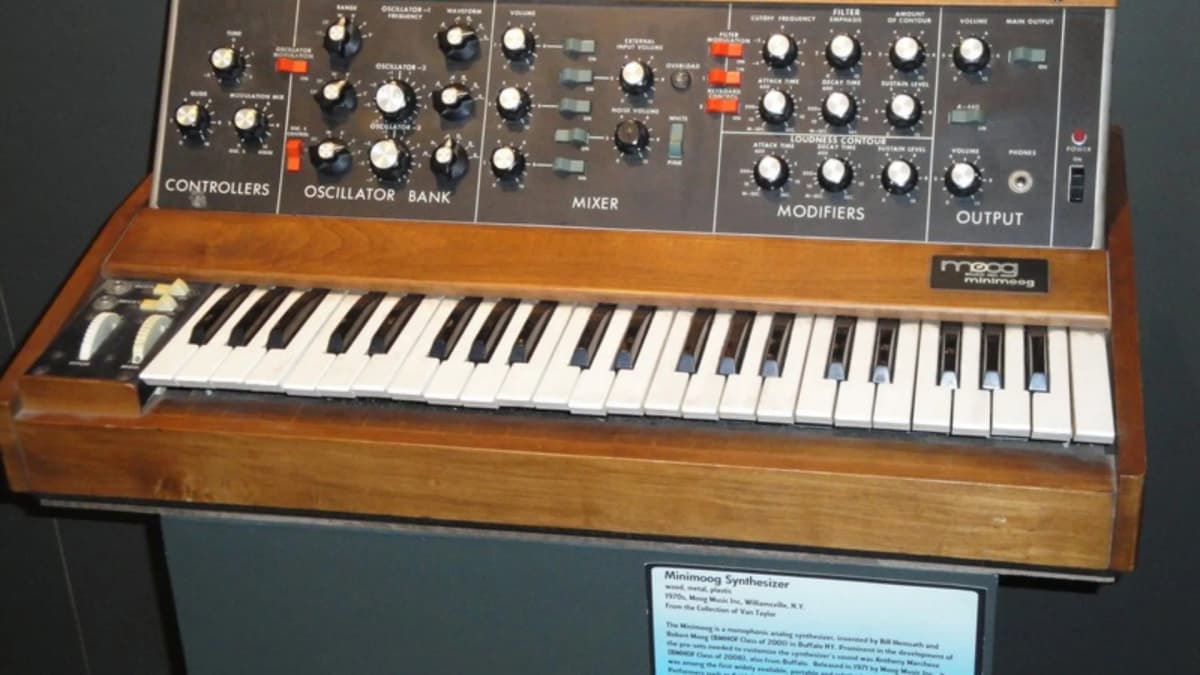
Minimoog synthesizer on display at the Buffalo Museum of Science

The most famous Moog synthesizer is the Minimoog Model D. Released in 1970, it was the first synthesizer sold in ordinary music stores, it put the Moog ladder filter and three-oscillator sound on stages around the world, and it has been reissued several times since. Wired has called it the most famous synthesizer in music history, and its basses and leads became the template for what most people still imagine when they hear the word “synth”.

The big Moog modular systems have a strong claim on historical importance, and a few other models have their own followings. Below is why the Model D comes out on top, followed by the honourable mentions and a note on where Moog Music stands as of late 2026.

Why the Minimoog Model D is the most famous Moog synthesizer

Before 1970, a Moog meant a cabinet full of modules connected by patch cables. Those systems were expensive, needed patching for every sound, and lived mostly in studios and universities. The Minimoog folded the essential parts of a modular, three oscillators, a mixer with noise, the 24 dB per octave ladder filter and two contour generators, into a portable keyboard with no patching needed. Moog itself describes the original as the first portable, performance-ready analog keyboard synthesizer.

Several things made it stick:

  • It reached ordinary musicians. As the first synth sold through music retail, it moved synthesizers from studios into bands.
  • It was built for playing. It introduced the pitch wheel, which let keyboard players bend notes like guitarists and made it a natural lead instrument.
  • The sound. The ladder filter could go from round, heavy bass to bright, cutting leads, and that range made it useful in prog rock, funk, jazz, disco and electronic music.
  • The records. Kraftwerk used it on Autobahn and The Man-Machine; Stevie Wonder, Herbie Hancock, Chick Corea, Keith Emerson, Rick Wakeman, Sun Ra and Giorgio Moroder are among its well-known users, and Pink Floyd’s Rick Wright used one on Wish You Were Here.
  • Longevity. More than 12,000 originals were made before production stopped in 1981, and Moog has returned to it repeatedly since.

For the full history, see our Minimoog story and our Minimoog Model D profile. Kraftwerk’s use of it gets its own article in how Kraftwerk turned the Minimoog into a machine.

The Model D after 1981

The Minimoog’s story did not end with the original. The Minimoog Voyager (2002) was the relaunched company’s first big synth and, by Wikipedia’s count, sold more than 14,000 units, outselling the original. Moog then reissued the Model D itself in 2016, ending that run around 2017, and again in 2022 with refinements such as a spring-loaded pitch wheel. In April 2026 Moog announced the Bob Moog Tribute Edition, a 500-unit Model D in a quartersawn oak case, hand-built in North Carolina; we cover it in our Tribute Edition article.

Its fame also shows in the number of clones. Behringer’s Model D and Poly D, plus software and firmware recreations, all trade on the original’s design. If you are weighing one against the real thing, read Model D vs Minimoog Model D.

Honourable mentions

Model Years Claim to fame
Moog modular (Synthesizer III, System 55 and others) From 1964 The original Moog; used on Switched-On Bach and Abbey Road
Taurus bass pedals 1976–1983; Taurus 3 in 2011 Huge bass under foot for rock bands
Polymoog 1975–1980 Moog’s first big polyphonic keyboard
Memorymoog 1982–1985 Programmable polysynth, a cult favourite
Sub 37 / Subsequent 37 2014; Subsequent 37 from 2017 Modern, preset-based Moog mono
Grandmother and Matriarch 2018 and 2019 Colourful semi-modular revival
Moog One 2018 Moog’s flagship polyphonic analog
Muse 2024 Eight-voice bitimbral analog poly
Messenger 2025 Entry-level mono, first new synth of the inMusic era

The Moog modular and System 55

If the question were “most historically important”, the modular might win. It was the instrument Bob Moog showed in 1964, the one Wendy Carlos used for Switched-On Bach and the one the Beatles used on Abbey Road. The System 55 is the best-known large configuration and Moog has periodically reissued it. Read our System 55 story and the comparison System 55 vs Minimoog.

Taurus

The Taurus pedals brought Moog bass to bands whose keyboard player was already busy, and they became a fixture of prog and arena rock stages. See our Moog Taurus story.

Polymoog and Memorymoog

These were Moog’s attempts at polyphony in the late 1970s and early 1980s. The Polymoog is remembered for its distinctive preset sounds, the Memorymoog for its fat programmable voices and its reputation for unreliability. Both are covered in our Polymoog and Memorymoog articles.

Subsequent 37, Grandmother, Matriarch, Moog One, Muse and Messenger

Among modern Moogs, the Subsequent 37 is the closest thing to a modern Minimoog with memory. The Grandmother and Matriarch revived semi-modular patching in bright colours. The Moog One is the most ambitious instrument the company has made, though retailers reported in June 2024 that it had been discontinued and Moog did not confirm that publicly at the time. The Muse and the Messenger are the newest; Synth Anatomy reports that the Messenger, launched in June 2025, effectively replaced the Subsequent 25, which was discontinued in March 2025.

None of these comes close to the Model D’s recognition outside synth circles, which is the real test of “famous”.

Where Moog Music stands in 2026

Moog Music has changed hands several times since Bob Moog founded R. A. Moog Co. in 1953. He regained the Moog name in 2002, the company became partly employee-owned in 2015, and in June 2023 it was acquired by inMusic, the group behind brands such as Akai Professional. In September 2023 Moog confirmed layoffs at its Asheville, North Carolina factory; reports put the cuts at more than half of the staff there, and the company said some assembly would move to long-standing overseas partners while key products such as the Moog One and Minimoog Model D would still be built in Asheville. Our Moog Music story covers the full company history.

The latest news concerns the Matriarch. In September and October 2026, retailers including Thomann and Sweetwater stopped listing it, with Thomann describing it as end-of-life and Sweetwater’s page saying it is no longer available. Synth Anatomy, reporting on October 15, 2026, noted that Moog had not made an official announcement and still showed the Matriarch on its website, and speculation about a successor remains unconfirmed. So the fairest summary as of late October 2026 is that the Matriarch appears to be discontinued according to major retailers, without an official statement from Moog. The Model D, meanwhile, remains the company’s centrepiece, as the Tribute Edition shows.

FAQ

Did the Beatles use a Moog?

Yes. The Beatles used a Moog modular synthesizer on several tracks of Abbey Road in 1969. That was a large modular system, not a Minimoog, which did not exist until 1970. Read the full story in the Beatles and the Moog.

Who invented the Moog synthesizer?

Robert Moog, working with input from composer Herb Deutsch, developed the first Moog modules in 1963 and 1964 and showed them at the Audio Engineering Society convention in New York in October 1964. He did not invent the first synthesizer, but he built the first commercially successful voltage-controlled one.

Is the Minimoog still made?

The original ran from 1970 to 1981. Moog has reissued the Model D in 2016 and 2022, and in 2026 released a limited 500-unit Bob Moog Tribute Edition.

Is the Minimoog the same as the Model D?

Yes. “Model D” was the production version of the Minimoog, after earlier prototypes, and the name is now used to tell it apart from later models such as the Voyager.

Related articles

Sources

Image credits: Minimoog photo by Alex Harden, Wikimedia Commons, CC BY 2.0. The photo was cropped to fit the featured image.


Bernardo de Azevedo
Written by
Bernardo de AzevedoFounder & Editor

His connection with music began at age 6, in the 1980s, when his father introduced him to Jean-Michel Jarre's Rendez-Vous on vinyl. He works professionally in the legal field, while synthesizers became his space for abstraction and creative exploration. Founder of The Synth Source.