

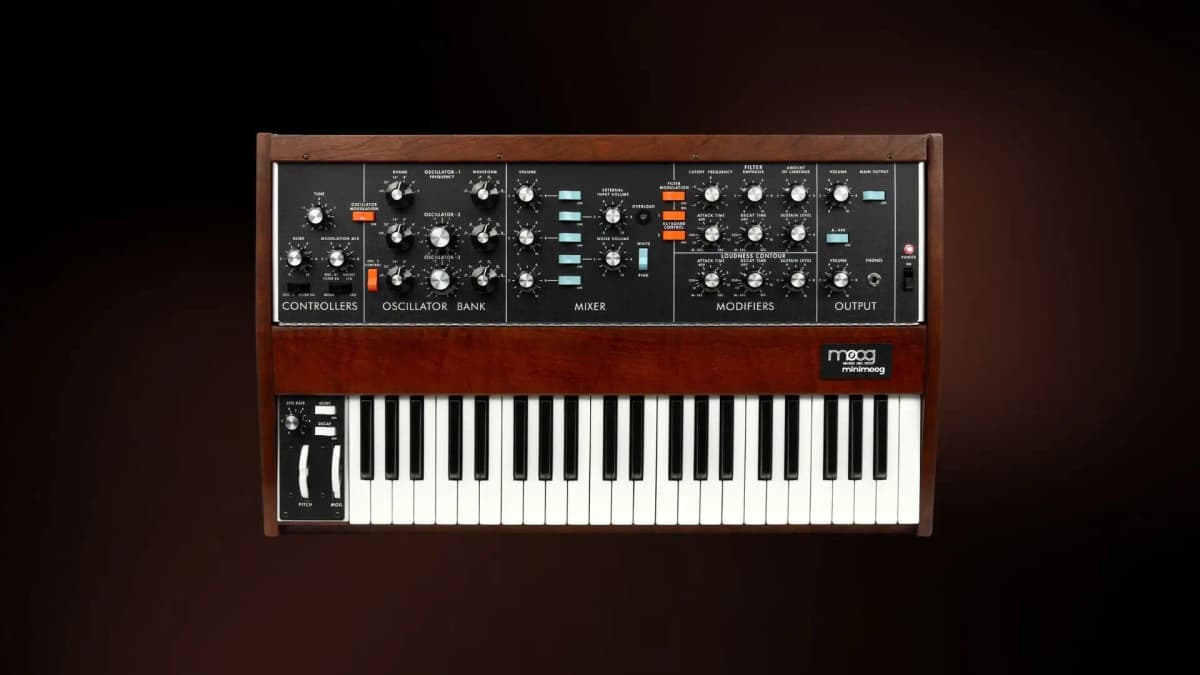
The Minimoog Model D Reissue is Moog Music’s modern return to the monophonic analog keyboard synthesizer that helped define the portable performance synth. First reissued in 2016 after decades away from production, then brought back again in 2022, it preserves the essential three-oscillator, ladder-filter architecture of the original Model D while adding practical modern concessions such as MIDI, a dedicated LFO, improved keyboard control, and expanded CV connectivity. Its meaning is larger than its feature list: this is not a new design competing on novelty, but a deliberate attempt to keep one of synthesis history’s central instruments physically playable in the present.
Table of Contents
Minimoog Model D Reissue sound and character
The Minimoog Model D Reissue sounds direct, saturated, and physically assertive. Its basic architecture is simple, but that simplicity is deceptive: three analog oscillators into a mixer, then into a resonant low-pass ladder filter, gives the Minimoog Model D Reissue a density that can feel larger than its monophonic voice count suggests. It excels at basses, leads, drones, filter sweeps, synthetic brass, electronic percussion, and those unstable, vocal-like lines that made the Minimoog a recurring presence in funk, progressive rock, electronic pop, hip-hop, and film scoring.
Its character comes partly from the oscillator section and partly from gain staging. The three oscillators can be tuned tightly for focused bass, spread slightly for thickness, or pushed into beating movement that gives a single note internal motion. The ladder filter then shapes that mass into something rounded, nasal, liquid, or biting depending on cutoff, resonance, contour amount, and mixer level. The reissue does not try to turn the Minimoog into a workstation or modulation laboratory. Its force is narrower and more physical: a single line can carry harmonic weight, rhythmic authority, and expressive bend in a way that many more complex synths struggle to match.
The reissue also keeps the older instrument’s performance psychology intact. There is no preset-first workflow. The player approaches the panel as a live circuit, not as a browser. That makes it slower than a modern memory synth, but it also makes the relationship between hand movement and sound unusually immediate. The added dedicated LFO matters here because it reduces the need to sacrifice Oscillator 3 for vibrato or filter modulation, while still keeping the panel’s classic logic recognizable.
Features and architecture
- Manufacturer: Moog Music.
- Year: Reissued in 2016; returned again in 2022; a Bob Moog Tribute Edition appeared in 2026 as a limited edition.
- Production years: Original Model D production ran from 1970 to 1981. The first modern reissue run lasted from 2016 to 2017. The later reissue returned in 2022, with the 2026 Tribute Edition limited to 500 units.
- Synthesis type: Analog subtractive synthesis.
- Category: Monophonic analog keyboard synthesizer.
- Polyphony: One voice.
- Original price and current market price: The 2016 reissue was listed around the mid-$3,000 range in the US market; the 2022 standard reissue appeared at $4,999 in major retail listings; the 2026 Bob Moog Tribute Edition was priced at $3,999. Used reissue values vary by condition, year, and finish, with recent Reverb guide ranges sitting roughly in the high-$2,000 to low-$4,000 zone.
- Oscillators: Three analog oscillators, noise generator, and external audio input. Oscillator waveforms include triangle, triangle-sawtooth, reverse sawtooth, sawtooth, rectangle, wide pulse, and narrow pulse, depending on oscillator.
- Filter: Voltage-controlled Moog ladder low-pass filter with resonance/emphasis and filter contour control.
- LFOs: Oscillator 3 can still operate as a modulation source, and the reissue adds a dedicated analog LFO with triangle and square waves.
- Envelopes: Dual contour generators for filter and loudness shaping.
- Modulation system: Mod wheel-centered architecture using oscillator, noise, filter contour, external modulation source, and dedicated LFO options; the reissue adds modern CV outputs for pitch, gate, velocity, and aftertouch.
- Sequencer / arpeggiator: None on the hardware instrument.
- Effects: No onboard effects. The mixer and feedback/overload behavior are part of the analog signal path rather than a digital effect section.
- Memory: No patch memory and no preset recall on the hardware synth.
- Keyboard: 44-key keyboard, F0 to C4 range; modern reissues use a velocity- and aftertouch-capable keybed.
- Inputs / outputs: External audio input, high and low audio outputs, headphone output, modulation input, and CV-related connections depending on version.
- MIDI / USB: Five-pin DIN MIDI In, Out, and Thru for basic MIDI integration; no USB MIDI on the hardware reissue.
- Display: No modern patch display.
- Dimensions / weight: Approximately 28.625 in wide, 17.125 in deep, 5.75 in high with the panel lowered; about 32 lb / 14.5 kg.
- Power: External universal power supply on the reissue.
Strengths
- It delivers the core Minimoog experience with modern reliability advantages, letting players access the architecture without depending entirely on a fragile vintage unit.
- The three-oscillator sound remains unusually authoritative for bass and lead work, especially when slight detuning and mixer drive create harmonic movement before the filter.
- The ladder filter gives the Minimoog Model D Reissue a recognizable vocal and rounded quality, but it can also become forceful when the mixer and resonance are pushed.
- The interface remains one of the clearest teaching tools in subtractive synthesis: oscillator, mixer, filter, contour, and loudness sections behave like a physical signal-flow diagram.
- The dedicated LFO is a musically useful modernization because it allows vibrato and other modulation without always taking Oscillator 3 out of audio duty.
- MIDI and CV additions make it easier to integrate with a contemporary studio while preserving the largely analog, hands-on identity of the Minimoog Model D Reissue.
- The lack of presets can be a strength for players who want to program by ear rather than manage stored patches.
Limitations
- It is strictly monophonic, so it is not a substitute for a polysynth, string machine, or chordal analog instrument.
- It has no patch memory, which makes exact recall slow in live or session contexts.
- It has no onboard sequencer, arpeggiator, or effects, so rhythmic automation and spatial treatment require external tools.
- MIDI implementation is intentionally basic compared with modern synths that support deep parameter automation, USB MIDI, and DAW-oriented control.
- The price is high for a single-voice instrument, especially when cheaper clones, software emulations, and Moog-inspired alternatives exist.
- Its size and weight are part of the appeal but also make it less convenient than desktop monosynths or compact modern keyboards.
- The reissue is historically faithful enough that some limitations are philosophical rather than accidental; buyers expecting a Voyager-style feature expansion may find it deliberately conservative.
Historical context
The original Minimoog Model D appeared in 1970, when large modular synthesizers were still associated with laboratories, studios, institutions, and technically demanding patch-cable workflows. Its importance was not only that it sounded powerful, but that it condensed the Moog modular idea into a playable keyboard instrument. That changed the social position of the Minimoog Model D Reissue. It was no longer only a studio apparatus; it could be taken to the stage, played with pitch and modulation wheels, and treated as an expressive lead or bass instrument.
The 2016 reissue arrived in a very different world. By then, analog synthesis had already returned as a major market force, and musicians could buy affordable analog monosynths, software emulations, Eurorack modules, and digital recreations of classic circuits. Moog was not filling a functional absence. It was answering a cultural and material one: the desire for the Model D itself, not merely a Minimoog-like sound.
The short 2016–2017 production run reinforced that point. It showed that the market for historically faithful analog instruments was not only about nostalgia, but about trust in layout, circuit behavior, build, and symbolic continuity. The 2022 return extended that logic after several years away, while the 2026 Bob Moog Tribute Edition turned the Model D into an even more explicit heritage object: functionally linked to the 2022 version, but framed around Bob Moog’s legacy and limited production.
Legacy and significance
The Minimoog Model D Reissue matters because it exposes a contradiction at the center of modern synth culture. On paper, it is limited. It has one voice, no patch memory, no onboard effects, no screen, no sequencer, and only basic digital integration. Yet those limits are precisely what make the Minimoog Model D Reissue historically legible. It is a reminder that the Minimoog did not become important by offering everything. It became important by arranging a small number of sound-shaping decisions into a playable, intuitive, musically forceful system.