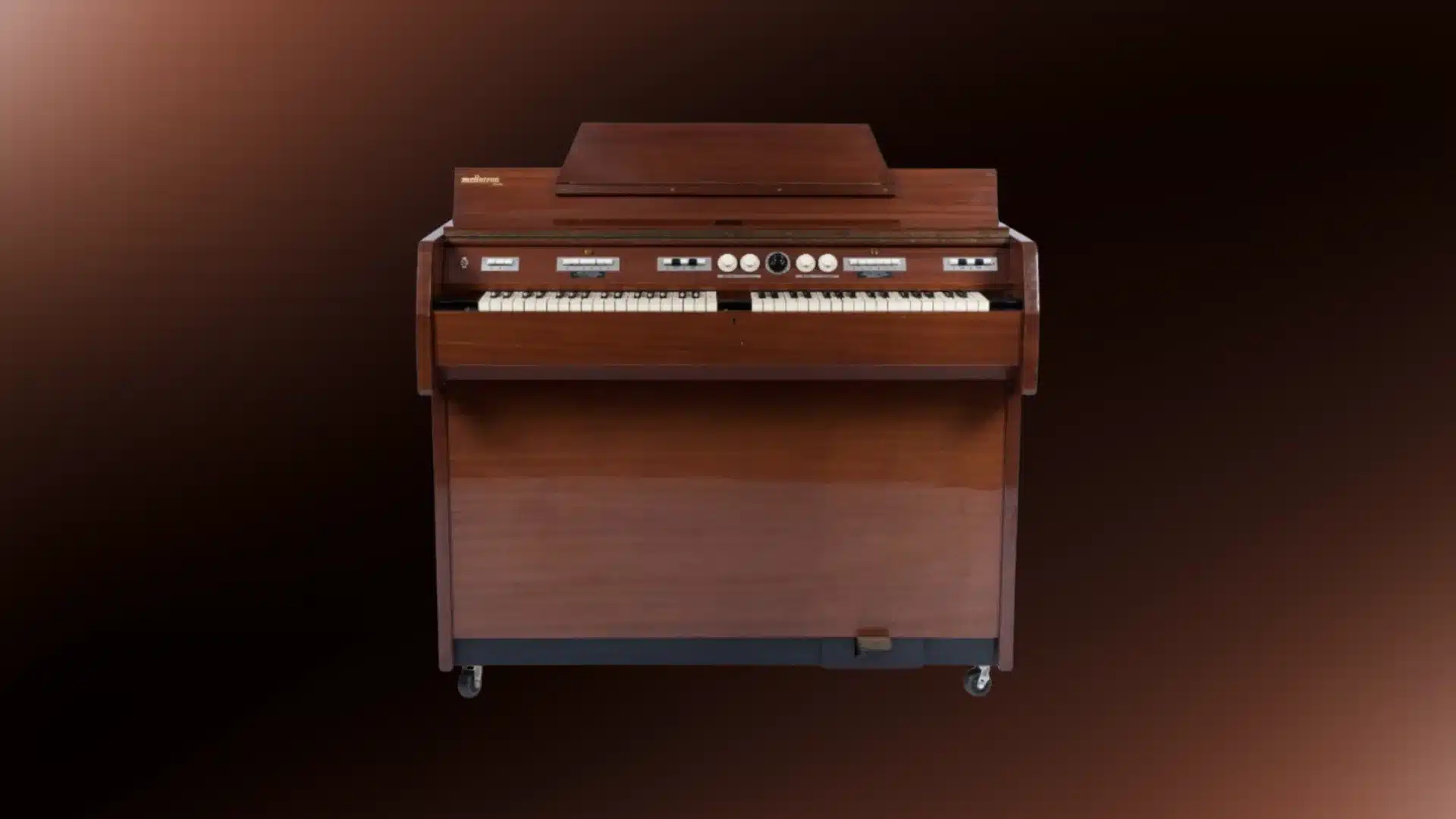
The Mellotron Mk II’s size and fragility pushed the company toward the single-manual Model 300 in 1968 and the portable M400 in 1970, which became the best-selling Mellotron. The Mellotron Mk II was, in effect, the prototype of a rock instrument not yet designed for rock.
Legacy and significance
The Mellotron Mk II matters because it changed what a keyboard player could be in a band. Before it, a pop group wanting strings or flutes had to hire session players. After it, one person at one console could suggest an orchestra with a texture that was not a copy of one but its own thing: recorded, compressed in time, slightly out of tune and immediately evocative. That substitution reshaped psychedelic pop and laid much of the groundwork for progressive rock.
It is also often described as an ancestor of the sampler, and the comparison holds in concept even though the mechanism is entirely different. Its fixed library, eight-second notes and slow bank changes are exactly the limits digital sampling would later remove, yet many musicians came to value the Mellotron Mk II for the character those limits created.
Its afterlife confirms that significance. Streetly’s modern M4000 emulates the Mellotron Mk II’s station system with a digital bank selector, compact models such as the M4000D Mini and Mellotron Micro carry the tape-derived sounds into portable formats, and GForce’s M-Tron MkII plug-in was developed with Streetly from the original library. Rebuilding a 1964 mechanism again and again is not preserving a curiosity. It is preserving a vocabulary.
Artists, users, and curiosities
The Beatles provide the most famous Mellotron Mk II moment. The flute-like introduction to “Strawberry Fields Forever”, recorded in late 1966, was played by Paul McCartney on Mellotron, and the song’s coda uses the “Swinging Flutes” setting recorded in reverse, a fill name that appears in the Mellotron Mk II’s rhythm and accompaniment library.
Several sources describe the instrument on the session as a hired Mellotron Mk II rather than John Lennon’s own. Lennon did own one: a black Mellotron Mk II, reportedly one of only six finished in black. According to Far Out Magazine, that instrument later passed to Interscope’s founders and was lent to Trent Reznor in the early 1990s before Streetly restored it in 2009.
The Rolling Stones’ Mk II, now in Mick Jagger’s collection and on loan to the Metropolitan Museum of Art, was played by Brian Jones on “2000 Light Years from Home” and “She’s a Rainbow” from Their Satanic Majesties Request, and on songs from Beggars Banquet. Mike Pinder’s Mellotron work defined the Moody Blues’ sound on “Nights in White Satin” and Days of Future Passed, and a Mellotron Mk II once owned by Pinder is now held by the SMEM museum in Switzerland.
King Crimson used two Mk IIs early on: serial number 113 on In the Court of the Crimson King, with Ian McDonald playing the Mellotron parts, and serial 211 as the band’s first touring Mellotron, played by Robert Fripp on In the Wake of Poseidon. Genesis used a Mellotron Mk II on early albums including Foxtrot, whose “Watcher of the Skies” opening is one of the most cited Mellotron Mk II performances.
The strangest story belongs to serial number 109, the ninth Mellotron built: made as a Mk I in December 1963 and upgraded to Mellotron Mk II in 1965, it was later cut in half by Robert Webb of the band England so it could be moved without four people. After years in a garden shed, Streetly restored it as the “Half’A’Tron”, echoing a single-manual prototype the company had built and scrapped in 1965.
Mellotron Mk II market value
- Current market position: a rare, historically important vintage instrument valued more as a collectible and studio artifact than as a practical gigging keyboard
- New price signal: no new Mellotron Mk II production; Streetly Electronics’ current hardware is the M4000, which recreates the Mk II’s station-switching concept digitally
- Used market signal: verified public sale prices are scarce; Sound On Sound’s Gordon Reid wrote in 2022 that an original Mellotron Mk II would cost something approaching 100 times the £299.99 price of the GForce emulation, which signals a high-value collector market
- Availability: very hard to find, given a production run in the low hundreds and the attrition of six decades
- Buyer notes: the condition of tapes, heads, pinch rollers, motor control and station-change mechanism is critical; serial history and documented restoration matter, and moving a 159 kg machine needs planning
- Support ecosystem: Streetly Electronics, run by descendants of the original makers, offers restoration, replacement tapes and full rebuilds of original Mellotrons and Chamberlins
- Market character: collectible and provenance-driven, with instruments linked to famous owners attracting attention far beyond ordinary examples
- Long-term position: likely to remain a blue-chip historical keyboard, since its cultural significance is settled and the surviving pool can only shrink
Conclusion
The Mellotron Mk II was built to play bossa novas in comfortable living rooms and ended up supplying the orchestral imagination of late-1960s rock. It is not a synthesizer, and it never pretended to be one. Its importance lies elsewhere: it proved that recorded sound could be played as an instrument, and it gave a generation of bands a voice that was neither a real orchestra nor an electronic imitation, but something stranger and more personal. Heavy, temperamental and limited, it nonetheless changed the role of the keyboard player in a band, and its wavering flutes and violins remain one of the most recognizable sounds of an entire musical era.
Sources
- The Rime Of The Ancient Sampler: The Mellotron, A Historical Perspective, Sound On Sound (June 1993, via Muzines)
- Total Recall: The A-Z of Analogue, The Mix (February 1995, via Muzines)
- A Mellotron History, Mellotron.com
- Mellotron Mk II Rhythms, Fills and Leads, Mellotron.com
- Mellotron Mark I and Mark II, Out of Phase
- The Models, Norm Leete
- Mellotron MkII, The Metropolitan Museum of Art
- Mellotron Mark II Electro-Mechanical Instrument, SMEM
- GForce M-Tron MkII review, Sound On Sound
- Back In Black: The restoration of the Mellotron Half’A’Tron, Sound On Sound (March 2015, via Out of Phase)
- Nigel Hopkins remakes Mellotron MkII classics, GForce Software
- King Crimson’s Mellotrons, UC Berkeley faculty page
- From The Beatles to Broken: the curious story of John Lennon’s Mellotron, Far Out Magazine
- The Moody Blues’ ‘Nights in White Satin’: An Oral History, Rolling Stone
- Mellotron, Wikipedia